Sunday, January 23, 2022

No Need To Treat Your Child's Flat Feet

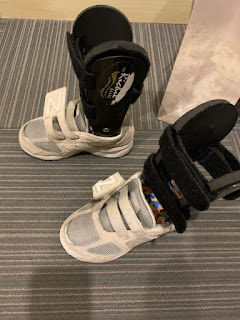
My young patient (only 6 years young then) was told he had flat feet, pronated 'too much' and needed orthotics. He was prescribed the pair of ankle foot orthoses pictured below. His parents ended up a few thousand dollars poorer and they were told to bring him back for more appointments. 

I could not begin to imagine the trauma this child had to go through mentally and physically, having had to wear those orthotics (picture below) whenever he went out. In my opinion, these 'orthotics' look like they will do a better job limiting ankle movement with the stiff upright medial (inner) and lateral (outer) sections.

Parents with children who have flat feet please take note. This latest Cochrane Review (just published on 14/1/22) states that "in the absence of pain, the use of high cost customised foot orthoses (CFO) for healthy children (from 11 months to 19 years old) with flexible flat feet has NO supporting evidence, and draws very limited conclusions about foot orthoses for treating paediatric flat feet". 

Review articles from the Cochrane Database of Systematic Reviews are highly respected and trusted. Google it if you like.

Not just costly CFO's, less expensive prefabricated (off the shelf) foot orthoses are not needed as well.

This Cochrane review also suggests that there is no further need to research asymptomatic flat feet in healthy children. It is better to focus on other paediatric conditions instead. 

Parents, now you know, do not waste your time and hard earned money on orthotics for your children. Don't worry too much about their shoes too. Email me if you want a copy of the article.


Reference

Evans AM, Rome K, Carroll M et al (2022). Foot Orthoses For Treating Paediatric Flat Feet. Cochrane Database of Systematic Reviews. Issue 1. Art No: CD006311. DOI: 10.1002/14651858.CD006311.pub3. Accessed 18 January 2022.

Wednesday, January 19, 2022

The Escape Room

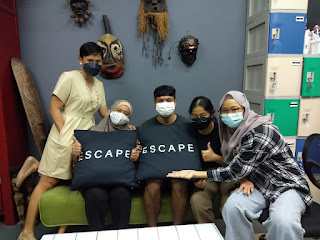
Our clinics took time off work this morning and had a Team Building session together. It was nice to spend some time together albeit in our groups of 5 outside the clinic.
Byron looking at the wrong camera
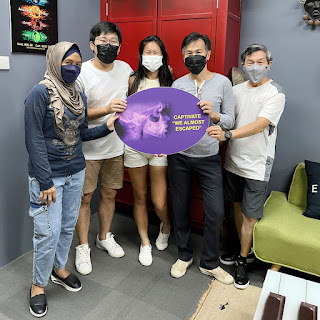
Both teams did 'escape' from their respective rooms even though the team above posed with the 'almost escaped' banner. It wasn't that easy, we needed to ask for clues and everyone had to work together.

So when's the next session, some of our staff are already asking. We're definitely already planning the next session.

Sunday, January 16, 2022

How To Improve Your Shoulder Range (If You Have Frozen Shoulder)

Last week, we wrote about how Covid-19 may cause frozen shoulder (also known as adhesive capsulitis), so I thought I'd follow up with a post on how we can increase or at least maintain shoulder flexion range during the first and second stage of frozen shoulder. 

Table slide
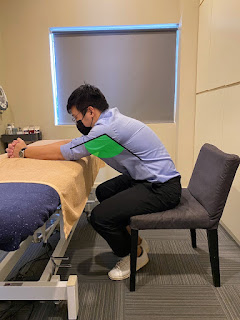
Research (Rabin et al, 2021) suggest that doing the 'table slide' and 'forward bow' rather than self assisted flexion will give better results for shoulder flexion and less pain. Byron demonstrates the table slide above. Seat slightly forward comfortably on a standard chair (ususally 45 cm high) with your forearms resting on a higher table (80cm). Interlock your hands together and lean forward by sliding your forearms until you reach your tolerable stretch.

Forward bow
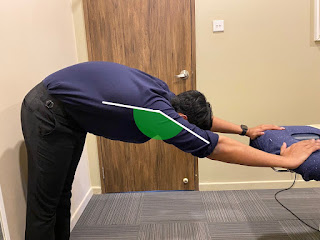
For the forward bow, in a standing position, you need to place both palms with elbows straight on a table. Next you need to step back slightly, lower your chest towards the floor until you reach maximum tolerable range.

Assissted flexion
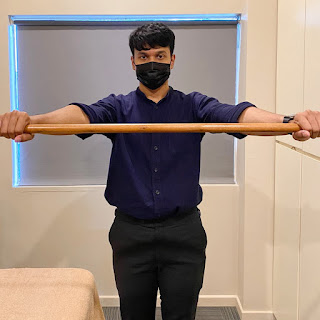
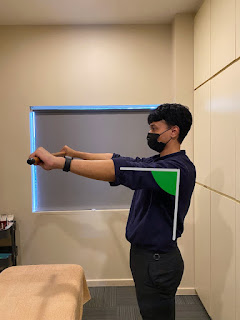
Of course you can still do the self assissted flexion. But it may elicit more pain and the range you attain is usually less. This can be done in standing or even lying down. Thiviyan (above) is holding a stick with both elbows straight while using the unaffected arm to lift the stick into maximum tolerable shoulder flexion. 

Some physiotherapists may suggest using a rope and pulley anchored over the top of a door using the unaffected arm to pull the affected side up. Research also suggests the rope and pulley method is less effective and more painful.

How do we, at Physio Solutions and Sports Solutions, treat frozen shoulder? 

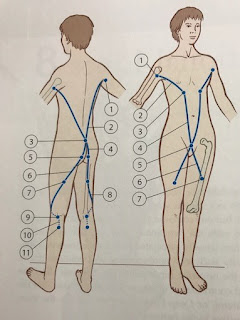
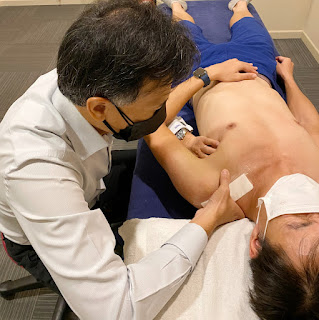
I already revealed this in a previous post. We get best results treating the hip and the arm lines. Remember I wrote previously that our arms and shoulders are connected to our hips?

Have a look at the connections again above and below.

Don't put up with pain and limited range. we are here to help you.


Reference

Rabin A, Maman E, Dolkart O et al (2021). Regaining Shoulder Motion Among Patients With Shoulder Pathology - Are All Exercises Equal? Shoulder and Elbow. 0(0): 1-8. DOI: 10.1177/17585732211067161

Tuesday, January 11, 2022

Cycling Champion Rides Again 2 Weeks After Breaking Collarbone

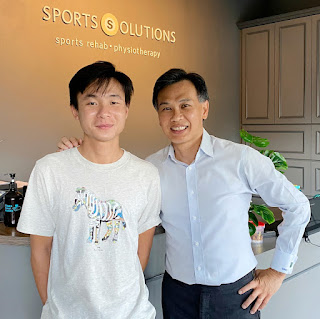
The champ Donaben Goh Choon Huat
While we're on shoulders, guess what? My patient fell while cycling on Boxing day (26/12/21) and fractured his left collarbone. He was operated on 27/12/21. Today he's back cycling again, not on an indoor trainer but outside.
Giving him some grief
We worked really hard getting his range and strength back so he could get back on the bike quickly.

Donaben won 2 bronze medals at the last Sea Games in 2019 in the time trial and road race event (Singapore last won a medal in the road race more than 30 years ago).

Please do not try this if you have a broken collarbone, not 14 days after your operation anyway. As a professional cyclist he needs to ride again as soon as possible.

Please ride safely Donaben! All the best as you train for the SEA Games and Asian Games later this year.

Sunday, January 9, 2022

Can Frozen Shoulder Be Caused By Covid-19?

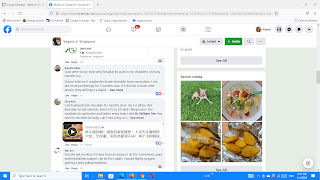
Aized was looking at her FB feed (pictured above) earlier this week when someone asked what else could be done for her frozen shoulder (or adhesive capsulitis). This lady was told by her doctor at Tan Tock Seng hospital that her frozen shoulder was possibly caused by her vaccination injections.

Then I recall reading a paper published last July 2021 that it may be Covid-19 that can cause frozen shoulder (rather than the vaccination injections). 

In that published paper (Ascani et al, 2021), 1120 patients were evaluated at the shoulder surgery unit. Of these, 146 were found to have frozen shoulder or adhesive capsulitis (AC). Of these 146 subjects, 12 had AC after contracting Covid-19, 8 female and 4 male. The patients were between 42-73 years. Frozen shoulder in the patients started 1.5 to 3 months after the Covid-19 diagnosis (mean onset was 2 months after Covid-19). 

Covid-19 symptoms were mild in 5 of the patients, were the other 7 were asymptomatic. None of the patients were severely or critically ill. 2 of the patients had diabetes that were well controlled. You can read more about that study and how the authors suggested AC can be caused by Covid-19 here.  

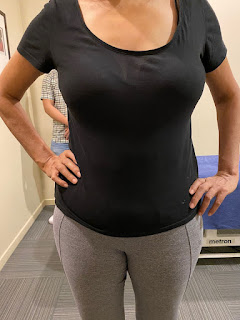
Can't do L hand on hip
With AC, there is pain and later lots of stiffness in the affected shoulder. First clue if you have AC, you cannot put your hands on your hips (the affected side of course, pictured above). That hand behind your back is definitely out of the question. You have difficulty bringing your arms overhead from the front and side (when your elbows are straight). The pain seems to worsen at night, disrupting sleep. Quality of life is definitely affected.

We really do not know what causes AC. Even doctors and research scientists are not sure either. However, we do know that AC afflicts women more commonly than men. Especially women above 50, more so if they are diabetic, had a prior stroke or thyroid disorders. Sometimes, it occurs after a recent shoulder surgery as well.

There seems to be some recent evidence that AC is a metabolic condition. Meaning if you're hypertensive, overweight, you drink, smoke, you have a poor diet and do little or no exercise, then you have a higher chance of getting AC.

There are usually 3 stages with AC. The first stage is the 'freezing' stage where pain is increasing with most shoulder movements. End range of motion in the shoulder starts to be limited. This stage can last from 3 to 6 months. 

The next stage is the 'frozen' stage. There usually isn't as much pain as the first stage but shoulder range is definitely more limited. Patients often complain of increasing 'stiffness' in this stage.

The last stage is known as the 'thawing' state where shoulder range starts to improve. There is usually much less pain during this stage.

AC can last between 9 to 18 months. I've seen some patients get a whole better after 6 months although it can drag for up to 24 months in other patients. 

I will write how we can help with AC in my next post. Stay tuned.


Reference 

Ascani C, Passaretti D, Scacchi M et al (2021). Can Adhesive Capsulitis Of The Shoulder Be A Consequence Of Covid-19? Case Series Of 12 Patients. 30(7): E409-413. DOI: 10.1016/j.jse.2021.04.024

Sunday, January 2, 2022

Pain Does Not Mean You're Injured

I had niggles most of the time when I was training seriously. Especially after a good block of training. If I tried running hard for consecutive days, my left knee usually would start to hurt a little.

Most elite athletes I treat are similar, always dealing with pain and niggles. Some pain would disappear while other pain tend to persist and linger.

A recent article (Hoegh et al, 2021) suggests that in the context of sports medicine, pain and injuries are 2 different distinct entities and should not be lumped together.

That article (Hoegh et al, 2021) suggests that when pain is inappropriately labeled as an injury, it creates fear and anxiety. It may even change how we move the affected body part, creating further problems.
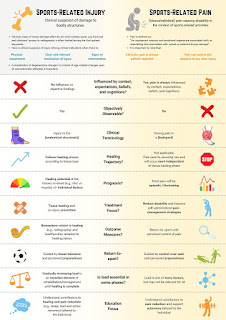
From Hoegh et al, 2021
An example given in the article is patellofemoral joint pain, an extremely common diagnosis assigned to runners by sports doctors, physiotherapists etc. This just means that there is pain around/ inside the knee joint but they cannot figure out exactly why it's hurting. Compare this to patella tendinopathy where there is a clinically identifiable cause for pain (wear and tear in the tendon).

Reading words like stabbing pain or burning sensations can affect how you feel. When we complain of pain, it may feel like something is damaged. However, as I often tell my patients, pain is subjective. To my patient it may feel like a 3 out of 10 kind of pain, but to me it may be an 8 out of 10 pain. Or vice versa. Pain can occur and exist even without an injury.

Pain can be influenced by beliefs, the process of cognition (knowing and perceiving), expectations and circumstances. Injuries are not. The onset of pain can be unpredictable, and how severe the pain is does not usually depend on the stage of healing.

Injuries can be identified by sight, orthopaedic tests and scans. The prognosis for an injury will depend on where the injury is. A muscle tear will usually heal faster than a bone fracture. 

After a sports injury, in order for the athlete to return to sport, we gradually increase their training load on their damaged tissue during rehabilitation until healing is complete and able to handle the demands of more strenuous training and competition.

With sports related pain, one cannot gradually increase training load and hope that the pain will go away. However, we can improve the patient's ability to manage the pain especially since pain is subjective.

If you have a bone stress fracture, you will have to take time off running until it heals and gradually increase load. Once healed, pain usually is no longer an issue. The injury and the associated pain are tightly connected. 

Other cases may not be as straight forward. An example would be patients who have chronic pain in their Achilles tendon with no damage on their MRI scans. There is no clear link between the physical state of their tendon and how it feels (or hurts). In such cases, surely we can manage and reduce their pain to allow them to run rather than waiting for their tendon to 'heal'. 

Another recent publication by Friedman et al (2021) warn of the dangers of diagnostic labels. Calling a patient's knee injury a meniscal tear rather than a meniscal strain may nudge the patient to opt for arthroscopic surgery even though that may not be considered the best approach.

According to the authors (Friedman et al, 2021), words chosen by medical professionals to describe injuries may present a situation as considerably worse than it actually is. This will increase anxiety and cause fear of movement.

Judging what pain to ignore and which ones to take seriously can be a delicate art rather than science and how we choose to label it can affect the outcome.

Sometimes pain is just pain.


References

Friedman DJ, Tulloch D, and Khan KM (2021). peeling Off Musculoskeletal Labels: Sticka and Stones May Break My Bones, But Diagnostic Labels Can Hamstring Me Forever. BJSM. 55: 1184-1185. DOI: 10.1136/bjsports-2021-103998.

Hoegh M, Stanton T, George S et al (2021). Pain Or Injury? Why Differentiation Matters In Exercise And Sports Medicine. BJSM. DOI: 10.1136/bjsports-2021-104633.

Sunday, December 26, 2021

Training Through This Holiday Season

Picture by Jeffrey Keng on 010119
This is usually my favourite time of the year. The weather is a little cooler from the rain. The international school just down the road from where we live is closed for the year which means little or much less cars along our street. Many of our patients are traveling or visiting families so we see less people in our clinics.  

Handling the extra social meetings, holiday shopping, festivities and of course, the extra eating while keeping your training intact is going to be challenging for many.

Here are some suggestions to keep your training intact if you keep your long term objectives in mind while keeping your expectations realistic.

I would usually have slightly more time to ride in the wee morning hours during the weekdays the last 2 weeks of the year. Not this year after my recent accident. My only time on a bike currently is on the stationary bike. Not that I have a choice, doctor's orders.

If you're a cyclist, early starts are great these 2 weeks since all school kids are on holidays. No need to drive your kids and definitely less morning traffic as well. Get your ride in early and have the rest of the day free for your family or other social engagements. Personally I find riding or running with your group of friends helpful as they help to make sure you turn up.

Whether it is cycling, triathlon or ultra running, consistency is key. You may not be able to fit in that extra long run or bike ride during this period. What matters more is you try to  fit in a session on most days, i.e. cutting overall training time rather than reduce frequency of your sessions. So if you're running an hour most weekdays and 2-3 hours on the weekends, running 30 mins on most weekdays and an hour on the weekend may suffice to keep your running routines, habits and adaptations intact.

Caught this view on my morning run
If some training sessions must be wiped off from your calender, lose the slow, easy aerobic sessions as retaining the intensity is key to maintaining fitness.

Do leave room for days when you really cannot fit any exercise in. Your child or other loved ones may fall sick, your boss may give you no notice for a last minute project or other stuff can happen. Take a deep breath and tell yourself that you definitely will not win or lose a race later in the upcoming season by missing a workout in December. There will be many other opportunities to train specifically in the new year. You're only getting ready to train in January. Don't sweat the the fact that you are too busy and distracted to follow the strictest training plan.

When I was still competing, this would be the time when I took 2 weeks off training. No swimming, cycling, running or weights training. Just resting, chilling, time with family, eating etc. I'll be raring to go by the time the new year came round. You may want to take time off to recharge too.

The holiday period definitely brings another layer of complexity if you're still training. However, it also provides a chance to celebrate and connect with traditions and people that matter most to us. Personally, it has given me a chance to be thankful since Covid-19 has delivered more struggles than most of us admit.

We already squeeze our training into our typically demanding schedules and this time of the year provides us a chance to slow down and reflect. Merry Christmas to all our readers.