Showing posts with label Patellofemoral joint pain. Show all posts

Sunday, August 28, 2022

It's The Hip Not The Knee

My patient came with anterior (or front) knee pain yesterday. She had been to see another physiotherapist who said she needed to strengthen her quadriceps muscle. Who says physios can't prescribe exercises compared to strength and conditioning coaches

Pardon the link - it seems that almost every single patient that comes to our clinic (after seeing another physiotherapist) had been given exercises to do during the treatment session itself. Maybe that's why the general public thinks all a physiotherapist does is teach exercises.

In our clinics, we may give an exercise or two to our patients near the end of the session, for them to do at home. However, we do not make our patients do any exercises DURING the treatment session. We treat them, mostly using our hands. We do treatment that the patients cannot do themselves, while they are in the clinic. 

Anyway back to my patient with knee pain who was asked to strengthen her quads. I've written a few times since 2009 that treating (or strengthening the hip) is much more important than strengthening the knee (quadriceps). Well, here is further proof.

In this systematic review referenced below, researchers studied data from 14 suitable studies (out of 119) that were found between 1994 and September 2019. Results from all 14 studies demonstrated that strengthening the hip 2-4 times a week (for 3-8 weeks) effectively relieved pain and improved knee function compared to quadriceps stengthening and no exercise. This lasted for up to 12 months post intervention.

The researchers recommended that hip muscle strengthening be a standard clinical practice while treating patients with anterior knee pain. So if the physiotherapist that you're seeing gets you to do quadriceps strengthening for your anterior knee pain, you need to tell them that hip strengthening is superior to quadriceps exercise. Please note that hip strengthening does not mean clam shell exercises.

Please also note that this present review included  randomized clinical trials that also got their subjects to do both hip plus quadriceps strengthening exercises over just the quadriceps alone. All except one study showed that hip and quadriceps strengthening exercises over just quadriceps alone. There were no no hip plus quadriceps strengthening versus hip exercises alone study done.

Perhaps a combination of hip-quadriceps strengthening may be a more effective strategy in the treatment of anterior knee pain? We can certainly try that in our clinic before more studies are done. It would depend on what we find to be weak at your objective examination ;)


Reference

Alammari A, Spence N, Narayan A et al (2022). Effect Of Hip Abductors And Lateral Rotators' Muscle Strengthening On Pain And Functional Outcome In Adult Patients With Patellofemoral Pain : A Systematic Review And Meta-analysis. J baxk Muscl Rehab. Pre-press. pp 1-26. DOI: 10.3233/BMR-220.

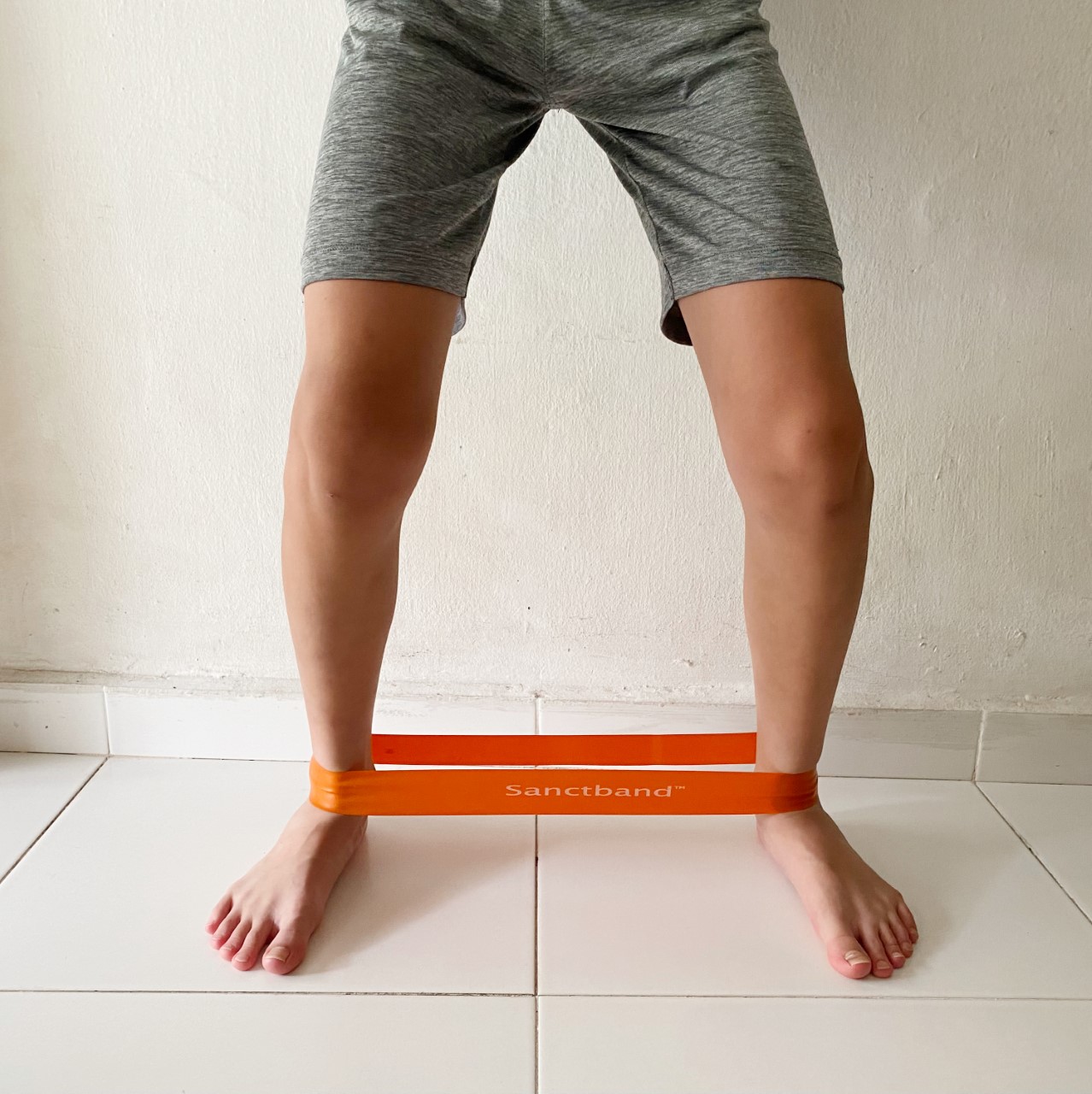
** For those of you wondering, there were no standardized protocol for hip and knee exercises in the various studies. The common hip exercise protocol included hip abduction against an elastic band while standing and with weights in a side-lying position coupled with hip lateral rotation against an elastic band while seated and hip extension (3 sets of 10 repetitions). 

Conversely, quadriceps strenthening in all studies generally involved weight bearing and non weight bearing exercises such as closed kinetic chain exercises, seated knee extension, leg press, squatting and stretching of hamstrings and quadriceps (3 sets of 10 repetitions). 

Sunday, January 2, 2022

Pain Does Not Mean You're Injured

I had niggles most of the time when I was training seriously. Especially after a good block of training. If I tried running hard for consecutive days, my left knee usually would start to hurt a little.

Most elite athletes I treat are similar, always dealing with pain and niggles. Some pain would disappear while other pain tend to persist and linger.

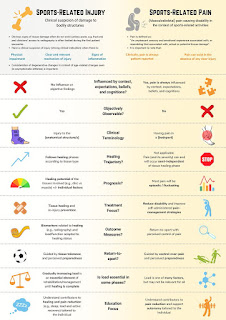
A recent article (Hoegh et al, 2021) suggests that in the context of sports medicine, pain and injuries are 2 different distinct entities and should not be lumped together.

That article (Hoegh et al, 2021) suggests that when pain is inappropriately labeled as an injury, it creates fear and anxiety. It may even change how we move the affected body part, creating further problems.

From Hoegh et al, 2021
An example given in the article is patellofemoral joint pain, an extremely common diagnosis assigned to runners by sports doctors, physiotherapists etc. This just means that there is pain around/ inside the knee joint but they cannot figure out exactly why it's hurting. Compare this to patella tendinopathy where there is a clinically identifiable cause for pain (wear and tear in the tendon).

Reading words like stabbing pain or burning sensations can affect how you feel. When we complain of pain, it may feel like something is damaged. However, as I often tell my patients, pain is subjective. To my patient it may feel like a 3 out of 10 kind of pain, but to me it may be an 8 out of 10 pain. Or vice versa. Pain can occur and exist even without an injury.

Pain can be influenced by beliefs, the process of cognition (knowing and perceiving), expectations and circumstances. Injuries are not. The onset of pain can be unpredictable, and how severe the pain is does not usually depend on the stage of healing.

Injuries can be identified by sight, orthopaedic tests and scans. The prognosis for an injury will depend on where the injury is. A muscle tear will usually heal faster than a bone fracture. 

After a sports injury, in order for the athlete to return to sport, we gradually increase their training load on their damaged tissue during rehabilitation until healing is complete and able to handle the demands of more strenuous training and competition.

With sports related pain, one cannot gradually increase training load and hope that the pain will go away. However, we can improve the patient's ability to manage the pain especially since pain is subjective.

If you have a bone stress fracture, you will have to take time off running until it heals and gradually increase load. Once healed, pain usually is no longer an issue. The injury and the associated pain are tightly connected. 

Other cases may not be as straight forward. An example would be patients who have chronic pain in their Achilles tendon with no damage on their MRI scans. There is no clear link between the physical state of their tendon and how it feels (or hurts). In such cases, surely we can manage and reduce their pain to allow them to run rather than waiting for their tendon to 'heal'. 

Another recent publication by Friedman et al (2021) warn of the dangers of diagnostic labels. Calling a patient's knee injury a meniscal tear rather than a meniscal strain may nudge the patient to opt for arthroscopic surgery even though that may not be considered the best approach.

According to the authors (Friedman et al, 2021), words chosen by medical professionals to describe injuries may present a situation as considerably worse than it actually is. This will increase anxiety and cause fear of movement.

Judging what pain to ignore and which ones to take seriously can be a delicate art rather than science and how we choose to label it can affect the outcome.

Sometimes pain is just pain.


References

Friedman DJ, Tulloch D, and Khan KM (2021). peeling Off Musculoskeletal Labels: Sticka and Stones May Break My Bones, But Diagnostic Labels Can Hamstring Me Forever. BJSM. 55: 1184-1185. DOI: 10.1136/bjsports-2021-103998.

Hoegh M, Stanton T, George S et al (2021). Pain Or Injury? Why Differentiation Matters In Exercise And Sports Medicine. BJSM. DOI: 10.1136/bjsports-2021-104633.