Showing posts with label fracture healing. Show all posts

Sunday, January 2, 2022

Pain Does Not Mean You're Injured

I had niggles most of the time when I was training seriously. Especially after a good block of training. If I tried running hard for consecutive days, my left knee usually would start to hurt a little.

Most elite athletes I treat are similar, always dealing with pain and niggles. Some pain would disappear while other pain tend to persist and linger.

A recent article (Hoegh et al, 2021) suggests that in the context of sports medicine, pain and injuries are 2 different distinct entities and should not be lumped together.

That article (Hoegh et al, 2021) suggests that when pain is inappropriately labeled as an injury, it creates fear and anxiety. It may even change how we move the affected body part, creating further problems.
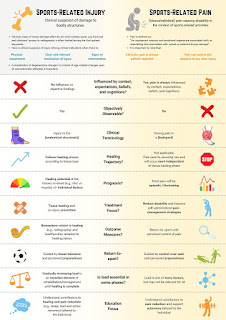
From Hoegh et al, 2021
An example given in the article is patellofemoral joint pain, an extremely common diagnosis assigned to runners by sports doctors, physiotherapists etc. This just means that there is pain around/ inside the knee joint but they cannot figure out exactly why it's hurting. Compare this to patella tendinopathy where there is a clinically identifiable cause for pain (wear and tear in the tendon).

Reading words like stabbing pain or burning sensations can affect how you feel. When we complain of pain, it may feel like something is damaged. However, as I often tell my patients, pain is subjective. To my patient it may feel like a 3 out of 10 kind of pain, but to me it may be an 8 out of 10 pain. Or vice versa. Pain can occur and exist even without an injury.

Pain can be influenced by beliefs, the process of cognition (knowing and perceiving), expectations and circumstances. Injuries are not. The onset of pain can be unpredictable, and how severe the pain is does not usually depend on the stage of healing.

Injuries can be identified by sight, orthopaedic tests and scans. The prognosis for an injury will depend on where the injury is. A muscle tear will usually heal faster than a bone fracture. 

After a sports injury, in order for the athlete to return to sport, we gradually increase their training load on their damaged tissue during rehabilitation until healing is complete and able to handle the demands of more strenuous training and competition.

With sports related pain, one cannot gradually increase training load and hope that the pain will go away. However, we can improve the patient's ability to manage the pain especially since pain is subjective.

If you have a bone stress fracture, you will have to take time off running until it heals and gradually increase load. Once healed, pain usually is no longer an issue. The injury and the associated pain are tightly connected. 

Other cases may not be as straight forward. An example would be patients who have chronic pain in their Achilles tendon with no damage on their MRI scans. There is no clear link between the physical state of their tendon and how it feels (or hurts). In such cases, surely we can manage and reduce their pain to allow them to run rather than waiting for their tendon to 'heal'. 

Another recent publication by Friedman et al (2021) warn of the dangers of diagnostic labels. Calling a patient's knee injury a meniscal tear rather than a meniscal strain may nudge the patient to opt for arthroscopic surgery even though that may not be considered the best approach.

According to the authors (Friedman et al, 2021), words chosen by medical professionals to describe injuries may present a situation as considerably worse than it actually is. This will increase anxiety and cause fear of movement.

Judging what pain to ignore and which ones to take seriously can be a delicate art rather than science and how we choose to label it can affect the outcome.

Sometimes pain is just pain.


References

Friedman DJ, Tulloch D, and Khan KM (2021). peeling Off Musculoskeletal Labels: Sticka and Stones May Break My Bones, But Diagnostic Labels Can Hamstring Me Forever. BJSM. 55: 1184-1185. DOI: 10.1136/bjsports-2021-103998.

Hoegh M, Stanton T, George S et al (2021). Pain Or Injury? Why Differentiation Matters In Exercise And Sports Medicine. BJSM. DOI: 10.1136/bjsports-2021-104633.

Saturday, November 13, 2021

Are You A 'Difficult Patient'?

*Have to walk with crutches - 2003
I had a patient call me yesterday asking if he could see me in our clinic as he had been called a 'difficult patient' by the last health professional he saw. I explained that I was still on medical leave after my cycling accident, and he could perhaps see my colleagues in our clinic. However, I would be happy to answer his queries if needed.

Picture from coreimpodcast.com
Of course I then asked why he was called a 'difficult patient' and his reply was "because I ask too many questions". My immediate thoughts were how can any healthcare professional tell patients that they are 'difficult patients'  when they are just asking questions about their own health?

Actually, I'm probably a very 'difficult patient' too. Make that the worst 'difficult patient'. I've been a patient before while still racing/ competing triathlons with three knee operations. Following that a skull and spine compression fracture and now another another spine compression fracture just ten weeks ago. 

Aized will tell you that during ALL of my doctor's appointments, I'm always in the doctor's clinic asking the poor guy lots of questions. "Ok Dr A, B or C, the the million dollar questions are; when can I cycle, run, carry my child, lift weights or go back to work?" These were questions that were very important to me. Still are now. Even though as a physiotherapist I should know most if not all the answers myself.

Borrowing the words of Aized's wise friend, "Healing isn't a bed of roses, it isn't a fluffy fairytale. It is tiring, gruesome and painful". I can definitely vouch for that.

Most times, it's just that patients want confirmation of what they have researched on the internet. Most of us have all done this at some point or other. Of course we need to bear in mind that answers off the internet may not necessary be medically sound advice or correct diagnoses. 

For me, personally, patients who ask a lot of questions are actually good, but wanting me (or another healthcare professional) to tell them what they want to hear may not always happen.

Back to my patient. I asked that patient what his questions were.  His reply was "I'm so glad you asked, I have quite a few on my list!"

That is also why I usually end my time with each patient by asking, "Any questions so far?", "Which questions have we not answered today?" or, "Is there anything we should have talked about that we have not?"

In our clinics, I actually give out my personal mobile phone number, in case patients have questions any time after their appointment. Why? Because I do expect questions from patients. Or they can message or email me if they think of some after their treatment session.

*The picture above was taken on 16th July 2003 after my 3rd knee operation in Adelaide, South Australia, where I was studying for my Masters in Musculoskeletal and Sports Physiotherapy. The surgeon said I had to be non weight-bearing on my R leg for 6 weeks after the operation. However, he said cycling was fine since the articular cartilage he repaired would benefit from exercise that stimulated the repaired area without weight bearing forces. 

So I taped the crutch to my bike, cycled to university and walked around with crutches. Aized thinks I'm a DIFFICULT patient ;)
