Showing posts with label diabetes. Show all posts

Sunday, September 25, 2022

More Sugar More Pain?

Many patients tell me they have a high threshold for pain. Until I start to work on them. Then they change their mind (not everyone of course).

Being in the pain business (i.e. finding the cause of patients' pain and treating it), I've always been intrigued about how we tolerate pain. Some patients can definitely tolerate pain better than others.

The article referenced below (Ye et al, 2022) definitely caught my eye. The researchers investigated the effects of high blood sugar on pain sensitivity and pain inhibition (the act of stopping or slowing down pain) in healthy adults with normal and excess body fat.

The researchers found that ingesting just 75 grams of glucose (2 standard cans of soft drink) in the overweight group of subjects caused the subjects more pain when both their feet were submerged in cold water for 1 minute.

In addition, having acute hyperglycaemia (high blood sugar levels) also suppressed resting heart rate variablity (HRV) in the group with excess fat mass. *HRV is where the amount of time between your heart beats fluctates slightly.These fluctuations can indicated current or future health problems like heart conditions or anxiety and depression.

Regardless of blood sugar levels, the group with excess fat mass could not tolerate the pain from a pin prick after cold water immersion. This group also reported higher pain levels during a 5-minute period of blood flow occlusion.

In addition to the effects of high blood sugar on pain sensitivity and pain inhibition, effects on HRV and reactive hyperaemia (increase of blood flow) after arterial occlusion were also investigated. Both high blood sugar and excess body fat affected HRV and reactive hyperaemia only in people with extra fat mass.

Interpreted together, the researchers concluded that high blood sugar levels affected pain processing levels and autonomic function, especially in people with excess body fat mass. 

So, if you are overweight and consume more than 75 grams of sugar (2 standard cans of soft drinks) you will more likely feel more pain compared to someone who is not overweight.

The authors added that since both hyperglycaemia (high blood sugar levels) and being overweight are risk factors for diabetes, further research should be done on whether and how these sources of pain affects people with diabetes.


Reference

Ye D, Fairchild TJ, Vo L et al (2022). High Blood Glucose And Excess Body Fat Enhance Pain Sensitivity And Weaken Pain Inhibition In Healthy Adults: A Single-blind And Cross-over Randomised Controlled Trial. J of Pain. In Press, published 16 Sep 2022. DOI: 10.1016/j.pain.2022.09.006

*HRV responds uniquely for everyone. As a rule of thumb, values under 50 ms are unhealthy, 50-100 ms signal compromised health and readings above 100 ms are healthy.

Sunday, January 16, 2022

How To Improve Your Shoulder Range (If You Have Frozen Shoulder)

Last week, we wrote about how Covid-19 may cause frozen shoulder (also known as adhesive capsulitis), so I thought I'd follow up with a post on how we can increase or at least maintain shoulder flexion range during the first and second stage of frozen shoulder

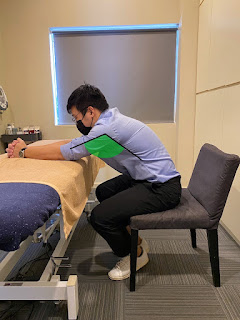
Table slide
Research (Rabin et al, 2021) suggest that doing the 'table slide' and 'forward bow' rather than self assisted flexion will give better results for shoulder flexion and less pain. Byron demonstrates the table slide above. Seat slightly forward comfortably on a standard chair (ususally 45 cm high) with your forearms resting on a higher table (80cm). Interlock your hands together and lean forward by sliding your forearms until you reach your tolerable stretch.

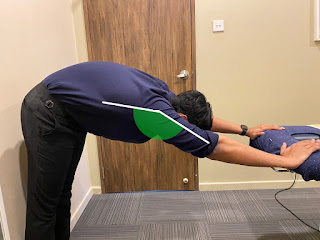
Forward bow
For the forward bow, in a standing position, you need to place both palms with elbows straight on a table. Next you need to step back slightly, lower your chest towards the floor until you reach maximum tolerable range.

Assissted flexion
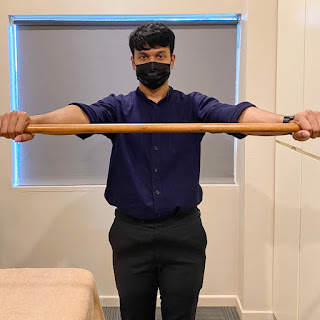
Of course you can still do the self assissted flexion. But it may elicit more pain and the range you attain is usually less. This can be done in standing or even lying down. Thiviyan (above) is holding a stick with both elbows straight while using the unaffected arm to lift the stick into maximum tolerable shoulder flexion. 

Some physiotherapists may suggest using a rope and pulley anchored over the top of a door using the unaffected arm to pull the affected side up. Research also suggests the rope and pulley method is less effective and more painful.

How do we, at Physio Solutions and Sports Solutions, treat frozen shoulder

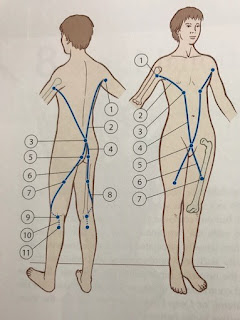
I already revealed this in a previous post. We get best results treating the hip and the arm lines. Remember I wrote previously that our arms and shoulders are connected to our hips?

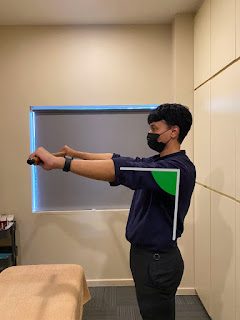
Have a look at the connections again above and below.

Don't put up with pain and limited range. we are here to help you.


Reference

Rabin A, Maman E, Dolkart O et al (2021). Regaining Shoulder Motion Among Patients With Shoulder Pathology - Are All Exercises Equal? Shoulder and Elbow. 0(0): 1-8. DOI: 10.1177/17585732211067161

Sunday, January 9, 2022

Can Frozen Shoulder Be Caused By Covid-19?

Aized was looking at her FB feed (pictured above) earlier this week when someone asked what else could be done for her frozen shoulder (or adhesive capsulitis). This lady was told by her doctor at Tan Tock Seng hospital that her frozen shoulder was possibly caused by her vaccination injections.

Then I recall reading a paper published last July 2021 that it may be Covid-19 that can cause frozen shoulder (rather than the vaccination injections). 

In that published paper (Ascani et al, 2021), 1120 patients were evaluated at the shoulder surgery unit. Of these, 146 were found to have frozen shoulder or adhesive capsulitis (AC). Of these 146 subjects, 12 had AC after contracting Covid-19, 8 female and 4 male. The patients were between 42-73 years. Frozen shoulder in the patients started 1.5 to 3 months after the Covid-19 diagnosis (mean onset was 2 months after Covid-19). 

Covid-19 symptoms were mild in 5 of the patients, were the other 7 were asymptomatic. None of the patients were severely or critically ill. 2 of the patients had diabetes that were well controlled. You can read more about that study and how the authors suggested AC can be caused by Covid-19 here.  

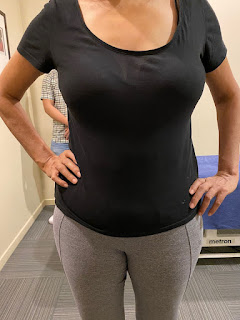
Can't do L hand on hip
With AC, there is pain and later lots of stiffness in the affected shoulder. First clue if you have AC, you cannot put your hands on your hips (the affected side of course, pictured above). That hand behind your back is definitely out of the question. You have difficulty bringing your arms overhead from the front and side (when your elbows are straight). The pain seems to worsen at night, disrupting sleep. Quality of life is definitely affected.

We really do not know what causes AC. Even doctors and research scientists are not sure either. However, we do know that AC afflicts women more commonly than men. Especially women above 50, more so if they are diabetic, had a prior stroke or thyroid disorders. Sometimes, it occurs after a recent shoulder surgery as well.

There seems to be some recent evidence that AC is a metabolic condition. Meaning if you're hypertensive, overweight, you drink, smoke, you have a poor diet and do little or no exercise, then you have a higher chance of getting AC.

There are usually 3 stages with AC. The first stage is the 'freezing' stage where pain is increasing with most shoulder movements. End range of motion in the shoulder starts to be limited. This stage can last from 3 to 6 months. 

The next stage is the 'frozen' stage. There usually isn't as much pain as the first stage but shoulder range is definitely more limited. Patients often complain of increasing 'stiffness' in this stage.

The last stage is known as the 'thawing' state where shoulder range starts to improve. There is usually much less pain during this stage.

AC can last between 9 to 18 months. I've seen some patients get a whole better after 6 months although it can drag for up to 24 months in other patients. 

I will write how we can help with AC in my next post. Stay tuned.


Reference 

Ascani C, Passaretti D, Scacchi M et al (2021). Can Adhesive Capsulitis Of The Shoulder Be A Consequence Of Covid-19? Case Series Of 12 Patients. 30(7): E409-413. DOI: 10.1016/j.jse.2021.04.024

Friday, August 28, 2020

Another Call For Bike Lanes In Singapore

ST 280820
After my previous article written earlier this month, it is heartening to see transport minister Ong Ye Kung suggest that certain under-used road lanes be converted to cycling and bus lanes in today's Straits Times (page A4 under Top of the news).

Well, definitely preferably cycling lanes please.

Remember Prime Minister Lee Hsien Loong's 2017 National Day Rally speech on the number of Singapore citizens with diabetes?  I suggested weight training as evidence suggests it helps with improved insulin sensitivity among people with diabetes and pre diabetes. If more Singaporeans start to cycle to run errands or work instead of taking the car, that definitely adds up too.

By riding to work, you get a workforce that gets fitter as they lose weight, save money and help the environment. Our mental health improves and we feel less stress and feel happier. In addition to having a cleaner and greener Singapore, we reduce our carbon footprint as well.

I have a particular favorite, when you ride bikes, you get the sheer joy of feeling the wind in your face - a better and greener version than driving a convertible.

Over to you Minister Ong Ye Kung and the Ministry of Transport.

Sunday, January 13, 2019

Increase Of Strokes In Young Adults


Last December, one of my colleagues needed to take urgent leave to go to Taiwan. He found out that his 36 year old brother had a suspected stroke and their whole family went to Taiwan to be with him.

I was shocked as his brother seemed relatively young to suffer a stroke (although I remember while still working in the hospital my youngest stroke patient was just 29 years young). The same colleague mentioned that at least four other friends younger than his brother also had a stroke!

Though it may seem shocking to you for such a young person to experience a stroke, evidence shows that this is becoming more common in young adults.

An article published in JAMA Neurology found that the number of men aged between 35 to 44 hospitalized for stroke increased by a staggering 42 percent when they compared 2003-2004 to 2011-2012.

It seems to be more common among males (41 percent versus 30 percent for females). The authors found significant increased risk of getting a stroke if you are diabetic, have hypertension, heart disease, smoking cigarettes currently and long term alcohol consumption.

The majority of the above listed factors are definitely easily modified, correctable or can be stopped. So prevention strategies definitely have the potential to reduce the impact of stroke in this young age group.

I'd add that exercising will definitely reduce your risk too.


Reference

George MG, Tong X and Bowman BA (2017). Prevalence Of Cardiovascular Risk Factors And Risk Factors And Strokes in Younger Adults. Jama Neurol. 74(6): 695-703. DOI: 10.1001/jamaneurol.2017.0020.

Sunday, May 27, 2018

Can You Keep Running With Bad Knees?

Picture by richseow from Flickr
I often get this question from my patients. Will running wear out my knees? And my answer to them is a definite no. Not if they don't have a preexisting knee condition.

It's been proven beyond reasonable doubt that running does not wear out your knees. Numerous studies found no evidence that runners were more likely to develop knee osteoarthritis while comparing groups of runners versus non runners.

In fact, runners seem less likely to develop knee problems due to the reduced weight and the ability of articular cartilage to get stronger due to the running (Williams, 2013).

No this is without doubt good news for runners without any knee problems.

What if the runner already have a knee osteoarthritis, where the natural shock absorption between the knees have worn out? If you keep running will you hasten the progression of the osteoarthritis?

Just because running doesn't wear out your knees and/ or cause osteoarthritis, that doesn't mean you're immune to it.

Personally I think that logic suggests that if the knee joint is already compromised, it is likely that the stresses that result from running could possibly worsen the wear and tear despite little evidence on the topic so far.

Hence, this newly published study which studied almost 5,000 subjects for nearly ten years is worth a read. In that group, there were 1,203 people over 50 years old who had osteoarthritis in at least one knee. 138 of these 1,203 people happened to be runners throughout the study period.

The subjects went through many diagnostic tests, including x-rays to find out how severe their knee osteoarthritis was. These tests were repeated four years later. Those who ran during this period of time did not have a faster progression of symptoms  than those who didn't run. There was little evidence to suggest that running was harmful in this study group.

This was contrary to what the authors expected. Running was not associated with worsening knee pain nor did their x-rays showed any worsening. In fact, the authors suggested that the runners had more improvement in knee pain compared to the non runners, suggesting that there may be a benefit to running from a knee health perspective in people who have knee osteoarthritis.

While comparing x-rays for "joint space narrowing", which indicates that the bones are getting closer together because the cartilage is disappearing, 23.6 percent of the non runners got worse in the study period, compared to 19.5 percent of the runners.

39.1 percent of the non runners had improvements in the knee pain compared to 50 percent of the runners. After adjusting for age, BMI etc, the runners were 70 percent more likely to see improvement in their symptoms.

Now before all you runners and non runners with osteoarthritis get too happy and carried away and start running like there's no tomorrow, bear in mind that there isn't much information as to how much distance the runners covered or any other differences in the running versus the non running group.

Please note that the runners were not told to go forth and run as much as they wanted. They were not given any specific instructions at all about running. The runners were presumably following their own urges to run and common sense plus advice from their doctors/ physiotherapists.

There was no mention whether they ran less frequently or shorter distances than they were used to. Did they have to stop and walk if their knees started hurting while running?

I've seen many patients with reduced and compromised mobility due to an arthritic knee and hence would hesitate to suggest they start running especially if they were not already runners to begin with.

I do observe that once the patients have osteoarthritis, it generally leads to a reduction in their physical activity which may then lead to an elevated risk to other chronic conditions like heart conditions and diabetes. I would definitely suggest they remain active through stationary bike riding (for safety reasons) and of course aqua based rehabilitation/ deep water running.

This study doesn't tell us that you can run through osteoarthritis with no consequences. It does however, offer some tentative support for letting your symptoms be your guide. It doesn't mean quitting for the runner with osteoarthritis. If there is no swelling and no pain, you can probably still run. But definitely, please modify the distance, intensity and frequency that you run.

It may mean substituting a bike or swim session for the run occasionally, trying a different shoe, different surface and/ or including a weight training session to get yourself stronger. If you can still find a running routine compatible with your osteoarthritis symptoms, the results of that study should reassure you that you're not making your knees worse by running.


References

Lo GH, Musa SM et al (2018). Running Does Not Increase Symptoms Or Structural Progression In People With Knee Osteoarthritis: Data From The Osteoarthritis Initiative. Clin Rheumatol. DOI: 10.1007/s10067-018-4121-3. Epub.

Williams PT (2013). Effects Of Running And Walking On Osteoarthritis And Hip Replacement Risk. Med Sci Sp Ex. 45(7): 1292-1297. DOI: 10.1249/MSS.ob013e3182885f26.

Oh my aching knee .....

Friday, December 15, 2017

This Is No Bull .....

Energy drinks from Cold Storage
When I was doing my National Service in the army, some of my platoon mates who were having issues with their fitness would frequently load up with "energy drinks" such as Red Bull. Especially in the morning before physical training and/ or Standard Obstacle Course (SOC) training sessions. They definitely did before the SOC tests too.

I'll ask them why and they'll say that it gives them a "boost" to be able to finish the training strongly or pass the test. Some of them will also mix Red Bull with alcohol when they book out on Fridays so they can party the rest of the night away.

Later while studying in university, I found out some of my classmates did the same when cramming for an exam or writing a paper. A published paper found that 51 percent of college students consumed at least a bottle of energy drink a month.

So I'm sure you would have seen, heard or perhaps even tried some of the above. Well, if energy drinks such as Red Bull is your drink then you may want to read on.

Sure, the energy drinks may give you a temporary boost, but it can also give you a whole lot of other problems. Previous studies show that they can mess with your sleep, make you gain weight and increase your blood pressure. They can also lead to substance abuse, mental health problems, higher risk of developing diabetesdental problems and even kidney damage.

Energy drinks are advertised to boost/ improve energy, stamina, athletic performance and even your concentration. Similar to sports drinks (Gatorade, Powerade, 100 Plus etc), the target consumer market for energy drinks are adolescents and young adults.

Energy drinks typically contain lots of sugar, high fructose corn syrup, artificial sweeteners, caffeine, certain vitamins, minerals and non nutritive stimulants (such as guarana, ginseng, taurine, L-carnitine, inositol, yerba mate and D-glucuronolactone).

An average 500 ml can of energy drink contains about 54 grams of sugar, way above the recommended 36 grams for men. You've read here that it is through consuming excessive sugar that causes you to get diabetes.

According to the article referenced below, some energy drinks reviewed contained as much as 207 mg of caffeine (recommended daily allowance for adults is 400 mg/ day, 100 mg/day for adolescents). When you consume more, you may feel anxious, depressed or even harbor suicidal thoughts.

Excessive caffeine along with other stimulants such as taurine, guarana and ginseng can also affect your blood pressure.

The authors concluded that current evidence suggest that health risks outweigh any short term perks or benefits you may experience from energy drinks.

Now you know.

References

Al-Sharr L, Vercammen K et al (2017). Health Effects And Public Health Concerns Of Energy Drink Consumption In The United States: A Mini-Review. Frontiers in Public Health. 31 August 2017. DOI: 10.3389/fpubh.2017.00225.

Heckman MA, Sherry K et al (2010). Energy Drinks. An Assessment Of Their Market Size, Consumer Demographics, Ingredient Profile, Functionality, And Regulations In The United States. Comp Reviews in Food Sci Food Safety.  29 April 2010. DOI: 10.1111/j.1541-4337.2010.00111.x

Now, that's a lot of Red Bull in there
I took the picture above and below while riding to my previous clinic a few years ago thinking I may one day use the pictures. Glad I can use the pictures now.

A closer look

Saturday, September 2, 2017

How Singapore Can Solve Our Diabetes Problem


In our National Day Rally, Prime Minister Lee Hsien Loong highlighted that 1 in 9 Singaporeans has diabetes. And of these, an average of 1200 undergo amputations every year!

I was quite shocked at the sobering figures that he cited. Three in 10 Singaporeans above the age of 60 have diabetes. If you break in down by race, 2.5 in 10 Chinese over 60 have diabetes, half of Malays over 60 years old and six in 10 Indians over 60 are affected.

PM Lee then urged Singaporeans to get regular medical check ups to know if they are diabetic or are at risk and suggested solutions to counter it. He then recommended that Singaporeans exercise more, suggesting that the easiest way to do so is "just walk  a little bit more every day".

If possible, I would definitely suggest including weight training (also known as strength training or resistance training).

In case you think weight training is only for bodybuilders pumping iron for beefy biceps and bulging pecs, current evidence shows that weight training - whether with a light dumbbell or your own body weight may be the best exercise for lifelong overall function and fitness.

Here's what most important. Research has shown that weight training helps with improved insulin sensitivity among people with diabetes and pre diabetes. Twice weekly weight training sessions helped control insulin swings (and body weight) among older men with type-2 diabetes.

During weight training, our muscles are rapidly using glucose (or blood sugar). This energy consumption continues even after you finish your strength training session. This is especially beneficial for anyone at risk for metabolic conditions like Type-2 diabetes, high blood pressure, and unhealthy cholesterol levels making weight training the most effective remedy.

In addition, weight training can strengthen our bones and improve our posture through bone remodeling. Weight training stimulates the osteoblasts (bone building cells) to build more bone. Weight training is also superior to aerobic exercise for enhancing and maintaining total body bone strength. And that's probably another post.

That's why I bought a Olympic bar, squat rack and got some free weights earlier this year as I realize I was losing muscle mass.
Showing my boy how it's done


Reference

Ibanez J, Izquierdo M et al (2005). Twice-Weekly Progressive Resistance Training Decreases Abdominal Fat And Improves Insulin Sensitivity In Older Men With Type 2 Diabetes. Diabetes Care. 28(3): 662-667. DOI: 10.2337/diacare.28.3.662.

Monday, November 23, 2015

Feels Good But May Be Unhealthy


I have always been a poor sleeper. Even when I was training very hard. In fact when I pushed myself too hard at training, I usually found it harder to fall asleep. And I could never sleep in. My internal body clock is set such that I could never sleep past 7 am.

Turns out not being able to sleep in may not be such a bad thing after all.

A group of researchers studied 447 men and women between the ages of 34 to 54. They wore devices that tracked movement and also monitored them when they slept and woke.

Nearly 85 percent of the group went to sleep and woke later on their off days compared to during their work days.

The researchers found that the greater the mismatch in sleep timing between their week days and week ends the higher the metabolic risk.

Sleeping late on off days (week ends) was linked to lower HDL (or good) cholesterol, higher triglycerides, higher insulin resistance and a higher body mass index. This is true even after adjusting for physical activity, caloric intake, alcohol intake and other factors.

The researchers are not sure if this is similar in the long term as the subjects were only studied for seven days. Several other studies have shown that there is an association between shift work and in increased risk for heart disease and diabetes, similar to what this study has shown.

Don't stay up too late on your off days.


Reference

Wong PM, Hasler BP et al (2015). Social Jetlag, Chrontype And Cardiometabolic Risk. J of Clin Endo and Metabolim. DOI: http://dx.doi.org/10.1210/jc.2015-2923.

Sunday, July 7, 2013

Sugar (And Not Fat) Causes Diabetes

Check out the amount of sugar 
For years, the prevailing medical opinion is that eating more sugar means having more calories and it is the resulting weight gain that leads to diabetes. Me too, I have always thought that if you were fat you were more likely to get diabetes.

After I had my bike accident  I was afraid of putting on weight. I have always eaten what I wanted (all the junk food of course), I drank lots of Coke and other sodas, but the saving grace is that I have always been fairly active, even after I stopped racing competitively. However, with my head and back broken, I was definitely not going to be able to exercise for a while.

Something miraculous happened, I stopped drinking Coke in the first few weeks after my accident. My wife (God bless her) who has always been an advocate of eating healthily bought a juicer and made my son and I drink more vegetable and fruit juices and also bought and cooked more organic food (thanks, dear).

And you know what, my friends and colleagues who saw me a few weeks after the accident actually said I lost weight. Well of course some of that is from muscle wasting due to my inactivity. But definitely the healthy eating (and not drinking soda) helped.

Now coming back to the post I was going to write about sugar and diabetes. Like I wrote earlier, I always thought that if you were overweight you were more likely to get diabetes. I guess I may be wrong. A recent published study shows there may be more than meets the eye.

The authors of a recently published study shows that it is sugar and not obesity that causes diabetes. Their study controlled for poverty, urbanization, ageing, obesity and physical activity. In short, it controlled everything that can be controlled. The authors looked at sugar consumption in 175 countries over 10 years.

Sugar was 11 times stronger than total calories in explaining rates of diabetes around the world. They found that the more sugar found in the food supply, the higher the rates of diabetes in that country, no matter what the obesity rates were.

In fact, they found that for every 12 ounces of sugar-sweetened drink introduced per person per day into a country's food system, the rate of diabetes went up by 1 percent.

The authors found that 20 percent of obese people have completely normal metabolic signatures while up to 40 percent of people with normal weight have the exact same metabolic problems that the obese do (just that they are not fat). The warning here is that you can be of normal weight, but if you eat a lot of sugar you can be "sick" and not know it unless you get examined.

Scary for me especially because I tend to consume lots of sugar before. Now that I am definitely healing, I have gone back to some (but not all) of my bad sugar habits. I definitely need to make sure I do not go back to my previous levels of consumption.

And so do you, if you have a bad sugar habit now that you know.

Reference

Basu S, Yoffe P, Hills N and Lustig, RH (2013). The Relationship of Sugar to Population-Level Diabetes Prevalence : An Econometric Analysis of Repeated Cross-Sectional Data. PLoS ONE 8(2): e57873. doi: 10.1371/journal.pone.0057873.

*Picture from Sugarstacks.com