Showing posts with label frozen shoulder. Show all posts

Sunday, September 22, 2024

Still Doing Those Pendulum Exercises For Shoulder Pain?

Quite a few patients who came to our clinic this week had frozen shoulder. Almost all of these patients had been prescribed pendulum exercises (also know as Codman pendulum exercises) by their previous healthcare provider. The intention is to move/ rehabilitate the glenohumeral (or shoulder) joint while not worsening recently injured or operated tissue.

This is done with the patient standing with a slightly bent torso with the affected arm hanging downwards, using the momentum of the torso/ trunk to move the arm without activating the muscles in the shoulder girdle. The arm can be moved side to side, forwards and backwards, or in a circular motion. Codman pendulum exercises are also always  prescribed after shoulder surgery . In fact, they are the mainstay of many shoulder rehabilitation protocols.

However, Cunningham et al (2020) demonstrated that Codman pendulum exercises involved minmial glenohumeral and scapular-thoracic movement. Movement is mainly from the trunk. They may be a safe way to start early movement/ stretching of the upper limb but may be of limited further use in restoring passive shoulder range of motion.

In fact Gurney et al (2016) found that Codman pendulum exercises induced the least muscle contraction in rotator cuff activity when they investigated several tasks, common rehabilitation exercises and ambulation. Wearing and taking off a shirt induced the highest. Even walking produced substantially higher muscle activity than the Codman exercises. 

Of course if the movement is directly generated from the shoulder rather than the trunk as well as performing larger pendulum circles, there will be increased rotator cuff muscles activity.

Personally, in our clinic, I find that teaching patients 3 basic exercises with elastic resistance bands work much better for the shoulder. Intensity, dosage and exercise position will have to be modified dependent on the surgery and condition the patient has. 

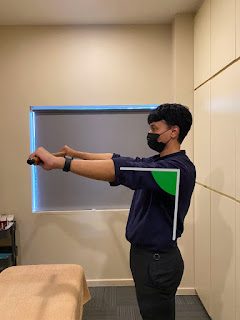
I show them the one arm shoulder frontal raise (pictured above), the lateral raise and a simple basic rowing exercise where the shoulder blade is retracted (or pulled back). In fact, the same few exercises and the single arm reverse fly (pictured below) were found to be effective for office workers to perform daily for 10 minutes to reduce neck and shoulder pain (Saterbakken et al, 2020). 
From Saterbakken et al (2020)
You can definitely stop doing those Codman pendulum exercises.

References

Cunningham G, Charbonnier C, Ladermann A et al (2020). Shoulder Motion Analysis During Codman Pendulum Exercises. Arthrosc Sp Med Rehab. 2(4): e339. DOI: 10.1016/j.asmr.2020.04.013

Gurney AB, Mermier C, LaPlante M et al (2016). Shoulder Electromyography Measurements During Activities Of Daily Living And Routine Rehabilitation. Ex J Orthop Sp Phy Ther. 46(5): 375-383. DOI: 10.2519/jospt.2016.6090.

Saterbakken AH, Makrygiannia P, Stien N et al (2020). Dose-response Of Resistance Training For Neck-and Shoulder Pain Relief: A Workplace Intervention Study. BMC Sp Sci Med Rehab. 12:8. DOI: 10.1186/s13102-020-0158-0

Sunday, May 29, 2022

This Is Not How You Treat Frozen Shoulder

My first thoughts (only my opinion) on seeing the picture above was, this is certainly not how you should be treating a patient with frozen shoulder or any problem for that matter. 

The photos above and below taken from  Twitter made me cringe. I am apalled at the amount of damage that had been done to the person's tissues. Manual treatment, at least at our clinics and most that I know, do not look at all like that. Now that patient has to also heal from the damage his therapist did on him!

There are already many physiotherapists worldwide saying there is no evidence supporting 'manual therapy' and that manual therapy does not work and is a waste of time and money

There are growing calls that physiotherapists should not be doing 'hands on' treatment. This will lend further support to what they believe. 

Everyone has a right to their beliefs and I always say that they just don't know what they don't know. For every physiotherapist that wants to be 'hands off' when treating their patients, there will be a physiotherapist (or more) wanting to do only 'hands on' treatment. 

If you really want to be pedantic, that's not the spiral line. I have attached a picture of the spiral line as intepreted by Tom Myers above. 

Reference

Kerry R (2019). "Hands-on, Hands Off: Is That Even A Thing?" Physio First

*The 'hands off ' approach usually means not doing manual therapy like mobilising (pressing, pushing) on joints, muscles, fascia etc on patients. It does not mean the physiotherapist does not touch the patient, assess or palpate the patient. They still do, it's just that after their assessment, they usually prefer to educate their patients (by talking) or teaching exercises to oversee a care management program that addresses thee patient's long term goals and needs.

Sunday, January 16, 2022

How To Improve Your Shoulder Range (If You Have Frozen Shoulder)

Last week, we wrote about how Covid-19 may cause frozen shoulder (also known as adhesive capsulitis), so I thought I'd follow up with a post on how we can increase or at least maintain shoulder flexion range during the first and second stage of frozen shoulder

Table slide
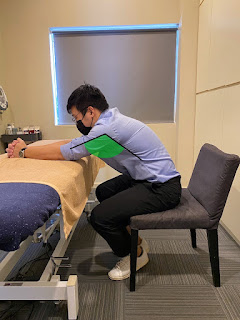
Research (Rabin et al, 2021) suggest that doing the 'table slide' and 'forward bow' rather than self assisted flexion will give better results for shoulder flexion and less pain. Byron demonstrates the table slide above. Seat slightly forward comfortably on a standard chair (ususally 45 cm high) with your forearms resting on a higher table (80cm). Interlock your hands together and lean forward by sliding your forearms until you reach your tolerable stretch.

Forward bow
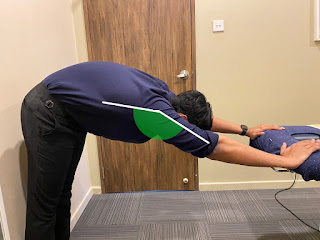
For the forward bow, in a standing position, you need to place both palms with elbows straight on a table. Next you need to step back slightly, lower your chest towards the floor until you reach maximum tolerable range.

Assissted flexion
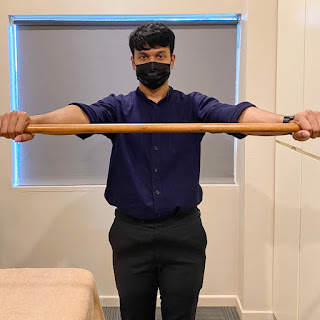
Of course you can still do the self assissted flexion. But it may elicit more pain and the range you attain is usually less. This can be done in standing or even lying down. Thiviyan (above) is holding a stick with both elbows straight while using the unaffected arm to lift the stick into maximum tolerable shoulder flexion. 

Some physiotherapists may suggest using a rope and pulley anchored over the top of a door using the unaffected arm to pull the affected side up. Research also suggests the rope and pulley method is less effective and more painful.

How do we, at Physio Solutions and Sports Solutions, treat frozen shoulder

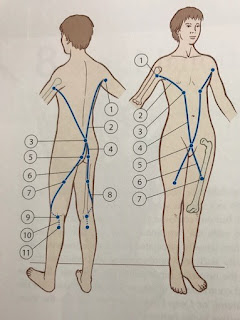
I already revealed this in a previous post. We get best results treating the hip and the arm lines. Remember I wrote previously that our arms and shoulders are connected to our hips?

Have a look at the connections again above and below.

Don't put up with pain and limited range. we are here to help you.


Reference

Rabin A, Maman E, Dolkart O et al (2021). Regaining Shoulder Motion Among Patients With Shoulder Pathology - Are All Exercises Equal? Shoulder and Elbow. 0(0): 1-8. DOI: 10.1177/17585732211067161

Sunday, January 9, 2022

Can Frozen Shoulder Be Caused By Covid-19?

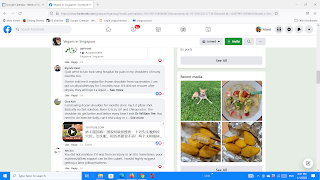
Aized was looking at her FB feed (pictured above) earlier this week when someone asked what else could be done for her frozen shoulder (or adhesive capsulitis). This lady was told by her doctor at Tan Tock Seng hospital that her frozen shoulder was possibly caused by her vaccination injections.

Then I recall reading a paper published last July 2021 that it may be Covid-19 that can cause frozen shoulder (rather than the vaccination injections). 

In that published paper (Ascani et al, 2021), 1120 patients were evaluated at the shoulder surgery unit. Of these, 146 were found to have frozen shoulder or adhesive capsulitis (AC). Of these 146 subjects, 12 had AC after contracting Covid-19, 8 female and 4 male. The patients were between 42-73 years. Frozen shoulder in the patients started 1.5 to 3 months after the Covid-19 diagnosis (mean onset was 2 months after Covid-19). 

Covid-19 symptoms were mild in 5 of the patients, were the other 7 were asymptomatic. None of the patients were severely or critically ill. 2 of the patients had diabetes that were well controlled. You can read more about that study and how the authors suggested AC can be caused by Covid-19 here.  

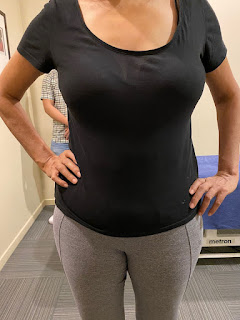
Can't do L hand on hip
With AC, there is pain and later lots of stiffness in the affected shoulder. First clue if you have AC, you cannot put your hands on your hips (the affected side of course, pictured above). That hand behind your back is definitely out of the question. You have difficulty bringing your arms overhead from the front and side (when your elbows are straight). The pain seems to worsen at night, disrupting sleep. Quality of life is definitely affected.

We really do not know what causes AC. Even doctors and research scientists are not sure either. However, we do know that AC afflicts women more commonly than men. Especially women above 50, more so if they are diabetic, had a prior stroke or thyroid disorders. Sometimes, it occurs after a recent shoulder surgery as well.

There seems to be some recent evidence that AC is a metabolic condition. Meaning if you're hypertensive, overweight, you drink, smoke, you have a poor diet and do little or no exercise, then you have a higher chance of getting AC.

There are usually 3 stages with AC. The first stage is the 'freezing' stage where pain is increasing with most shoulder movements. End range of motion in the shoulder starts to be limited. This stage can last from 3 to 6 months. 

The next stage is the 'frozen' stage. There usually isn't as much pain as the first stage but shoulder range is definitely more limited. Patients often complain of increasing 'stiffness' in this stage.

The last stage is known as the 'thawing' state where shoulder range starts to improve. There is usually much less pain during this stage.

AC can last between 9 to 18 months. I've seen some patients get a whole better after 6 months although it can drag for up to 24 months in other patients. 

I will write how we can help with AC in my next post. Stay tuned.


Reference 

Ascani C, Passaretti D, Scacchi M et al (2021). Can Adhesive Capsulitis Of The Shoulder Be A Consequence Of Covid-19? Case Series Of 12 Patients. 30(7): E409-413. DOI: 10.1016/j.jse.2021.04.024