Showing posts with label Achilles pain. Show all posts

Sunday, January 5, 2025

The Rise Of Padel

Picture from Temple of padel
Recently I have treated many patients who play padel and got injured. I think padel is definitely the latest 'flavour' of the month.

What is padel? It is a sport played with rackets that combines elements of tennis and squash. It takes place in an enclosed court (pictured below) about one third the size of a tennis court. Similar to squash, players can bounce the balls off the walls of the court allowing for rebounds. 

Picture from Demeco et al (2022)
Padel was invented in 1969 by *Enrique Corcuera when he and his wife Viviana were in their new vacation holiday home in Acapulco, Mexico. To pass time, the wealthy couple began throwing a ball at the wall and Viviana quickly fell in love with the easy version of the game. Enrique got builders to build a 20m by 10m cement court against the backdrop of the Pacific ocean. 

The court was closed completely to prevent the balls from falling outside due to the unpleasant memory Enrique had while attending boarding school in England. He said he suffered from being in the cold while looking for balls that fell outside the school court.

Over time glass walls and artificial turf replaced the concrete so spectators could watch the game.

Padel racquet picture from Decathlon
Played mostly in doubles (although singles can be played), with solid stringless racquets(above) and a similar tennis ball but with less pressure. Players serve underarm and the ball must bounce once before being returned. The scoring system is similar to tennis.

From the patients that I have seen, there has been little evidence of play patterns and training regimes. It is a high intensity intermittent sport with less demanding requirements when played in recreational settings, which can hide the risk of injury.

The majority of padel injuries I have seen are mostly in the lower limbs. Padel players usually have to shift their stance and require strong leg power to shift the upper body quickly. Achilles tendon injuries and ankle sprains are common when the patient executes a quick change in direction.

There were also upper limb injuries affecting the shoulder and elbow. This is not surprising due to the nature of overhead strokes (e.g. smashes). Since the court is smaller, this increases the frequency of shots taken. This greater repetition of the abduction-extention movements of the arm would explain the upper limb injuries.

A Swedish study (Thornland et al, 2021) suggested that the smaller size court along with the proximity of the players, the size and speed of the ball and the unpredictability of ball bounces would increase the risk of injuries.They proposed the use of protective eyewear.

Viviana Corcuera believes padel took off quickly because it can be enjoyed by the entire family. Grandparents can play with their children and grandchildren which brings the family together. There are estimated to be over 30 million players worldwide. 

Perhaps padel may even surpass Hyrox in terms of popularity in Singapore. This is my prediction for this year. Let's see ....

References

Demeco A, deSire A, Marotta N et al (2022). Match Analysis, Physical Training, Risk Of Injury, Risk Of Injury And Rehabilitation In Padel: Overview Of The Literature. Int J Environ Res Public Health. 19:413. DOI: 10.3390/ijerph19074153

Thornland C and Jakobsson G (2021).  Eye Injuries Related To Padel. Lakartidningen. 118:21001. PMID:34156668

*In the 1960's and 70's, Acapulco was a major destination for Hollywood's stars and that is probably where padel's popularity with celebrities began. Even the American diplomat Henry Kissinger played when he visited as did many high profile visitors. Prince Alfonso developed a passion for the game in 1974 after holidaying with the Corcueras. He built 2 padel courts in Marbella, that's how the game crossed the Atlantic.

David Beckham, Serena Williams and even French President Emmanuel Macron consider themselves fans of padel. Meanwhile in sunny Singapore, Ronaldo and two of our ministers share a padel moment.

Picture from the Daily Mail

Sunday, April 3, 2022

My Patient Has Os Trigonum Syndrome

Not her legs
My 11 year old patient came in complaining of pain at the back part of her ankle. She's an avid ballet dancer and tennis player and trains up to 4 times a week.

After examining her thoroughly, I found that her pain was reproduced at a very specific location, especially when she was pointing her foot. I explained to her mum that she probably has Os Trigonum syndrome.


The Os Trigonum is a small, extra accessory bone that is sitting at the back of the ankle joint. This extra bone may be present in up to 20 percent of the general population. It forms when one area of the bone fails to fuse with the rest of the bone (the talus in this case). Often people do not know if they have an Os Trigonum if it has not caused any problems. 

This is similar to the accessory navicular bone in the foot, which usually does not cause any problems. However, it can cause pain after twisting your ankle (just like it can cause pain in the accessory navicular bone in the foot). This happens when the Os Trigonum moves or breaks leading to pinching at the back of the ankle joint, causing what is known as a posterior impingement. 

It can also be caused by repeated downward pointing of the toes, which is especially common in ballet dancers (when assuming an en pointe position) and football players (when shooting).

Sometimes it can be mistaken for pain originating from the Achilles tendon. An x-ray is usually ordered by the doctor to show the Os Trigonum at the back of the ankle. A MRI scan is used occasionally to exclude articular cartilage damage in the ankle.


Reference

Skwiot M, Sliwinski Z, Zurawski W et al (2021). Effectiveness Of Physiotherapy Interventions For Injury In Ballet Dancers. PLoS one. 24(6): eo253437. DOI: 10.1371/journal.pone.0253437.

Thanks to Byron for the picture

Sunday, January 2, 2022

Pain Does Not Mean You're Injured

I had niggles most of the time when I was training seriously. Especially after a good block of training. If I tried running hard for consecutive days, my left knee usually would start to hurt a little.

Most elite athletes I treat are similar, always dealing with pain and niggles. Some pain would disappear while other pain tend to persist and linger.

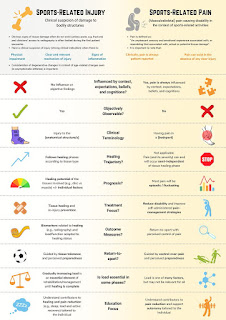
A recent article (Hoegh et al, 2021) suggests that in the context of sports medicine, pain and injuries are 2 different distinct entities and should not be lumped together.

That article (Hoegh et al, 2021) suggests that when pain is inappropriately labeled as an injury, it creates fear and anxiety. It may even change how we move the affected body part, creating further problems.

From Hoegh et al, 2021
An example given in the article is patellofemoral joint pain, an extremely common diagnosis assigned to runners by sports doctors, physiotherapists etc. This just means that there is pain around/ inside the knee joint but they cannot figure out exactly why it's hurting. Compare this to patella tendinopathy where there is a clinically identifiable cause for pain (wear and tear in the tendon).

Reading words like stabbing pain or burning sensations can affect how you feel. When we complain of pain, it may feel like something is damaged. However, as I often tell my patients, pain is subjective. To my patient it may feel like a 3 out of 10 kind of pain, but to me it may be an 8 out of 10 pain. Or vice versa. Pain can occur and exist even without an injury.

Pain can be influenced by beliefs, the process of cognition (knowing and perceiving), expectations and circumstances. Injuries are not. The onset of pain can be unpredictable, and how severe the pain is does not usually depend on the stage of healing.

Injuries can be identified by sight, orthopaedic tests and scans. The prognosis for an injury will depend on where the injury is. A muscle tear will usually heal faster than a bone fracture. 

After a sports injury, in order for the athlete to return to sport, we gradually increase their training load on their damaged tissue during rehabilitation until healing is complete and able to handle the demands of more strenuous training and competition.

With sports related pain, one cannot gradually increase training load and hope that the pain will go away. However, we can improve the patient's ability to manage the pain especially since pain is subjective.

If you have a bone stress fracture, you will have to take time off running until it heals and gradually increase load. Once healed, pain usually is no longer an issue. The injury and the associated pain are tightly connected. 

Other cases may not be as straight forward. An example would be patients who have chronic pain in their Achilles tendon with no damage on their MRI scans. There is no clear link between the physical state of their tendon and how it feels (or hurts). In such cases, surely we can manage and reduce their pain to allow them to run rather than waiting for their tendon to 'heal'. 

Another recent publication by Friedman et al (2021) warn of the dangers of diagnostic labels. Calling a patient's knee injury a meniscal tear rather than a meniscal strain may nudge the patient to opt for arthroscopic surgery even though that may not be considered the best approach.

According to the authors (Friedman et al, 2021), words chosen by medical professionals to describe injuries may present a situation as considerably worse than it actually is. This will increase anxiety and cause fear of movement.

Judging what pain to ignore and which ones to take seriously can be a delicate art rather than science and how we choose to label it can affect the outcome.

Sometimes pain is just pain.


References

Friedman DJ, Tulloch D, and Khan KM (2021). peeling Off Musculoskeletal Labels: Sticka and Stones May Break My Bones, But Diagnostic Labels Can Hamstring Me Forever. BJSM. 55: 1184-1185. DOI: 10.1136/bjsports-2021-103998.

Hoegh M, Stanton T, George S et al (2021). Pain Or Injury? Why Differentiation Matters In Exercise And Sports Medicine. BJSM. DOI: 10.1136/bjsports-2021-104633.

Thursday, October 10, 2019

Clam Shell Exercises?

Clam shell exercises?
My patient came in complaining of knee pain after running. She had seen another physiotherapist who after treating her knee, prescribed clam shell exercises for her to do as well. But she still had knee pain after running and climbing stairs despite doing them regularly.

How many of you have been asked to do clam shell exercises to make your Gluteus Medius (or hip) muscles stronger? If you have, maybe you need not bother any more.

Latest research (Moore et al, 2019) shows that clam shell exercises do not activate your Gluteus Medius as much as you think.
Right Gluteus Medius muscle
The Gluteus Medius muscle is very important for female runners, especially if they have knee pain. You can treat their knees but their pain will not go away until you have addressed the weakness  in their Gluteus Medius muscle.
View from the back, Left Gluteus Medius
In that small study, three sets of six common lower limb exercises were performed by ten healthy adults after a short warm up. They did single leg squats, single leg bridging, hip abduction (lifting) in side lying, clam shell exercise in side lying, running man exercise (simulates running motion of running one leg at a time) and resisted hip abduction-extension exercise.

The participants had electromyography or EMG electrodes to measure muscle activity attached to all three parts of the Gluteus Medius muscle (in front, middle and posterior).

Results showed that clam shell exercises were not effective in activating any part of the Gluteus Medius muscle. Highest levels of overall activity were seen in the single leg squat, single leg bridging and the resisted hip abuction-extension exercise.

Other than the knee, you need to know that weakness in your Gluteus Medius can also contribute to pain or problems in your Achilles. Make sure you are doing the strengthening correctly.


Reference

Moore D, Pizzari T et al (2019). Rehabiliation Exercises For The Gluteus Medius Muscle Segments: An Electromyography Study. J Sp Rehab. DOI: 10.1123/jsr.2018-0340.

Saturday, March 14, 2009

Do High Tech Running Shoes Work?

All you readers out there be ready for some shocking news from a study published in the latest issue of the British Journal Of Sports Medicine. I think all the shoe companies out there will not be too impressed with this paper with regards to their technical running shoes.

The researchers reviewed results since 1950 from controlled clinical trials and systematic reviews (the two highest levels in terms of quality with regards to research papers).

Their aim - to investigate if running shoes with highly cushioned heels or pronation controlled systems depending on the wearers foot type had any effect on running injury rates, risk of osteoarthritis, overall well being and of course running performance.


First let's review some background information.
American Frank Shorter won the marathon Olympic gold medal on September 10, 1972. It is believed that his victory ushered the start of the American running boom where millions of Americans took up running leading to a huge surge in running shoes being sold. This of course led to an explosion of a vast shoe industry.

Since the 1980's, the heels of running shoes are heavily cushioned and/or have features to control subtalar joint (also known as talocalcaneal joint; where the talus meet the calcaneus) motion. Prescribing such shoes along with orthotics are considered the gold standard for injury prevention. Depending on your foot type, overpronators, mild pronators and supinators are prescribed motion control, stability and cushioned shoes respectively.

The use of cushioning in running shoes are based on the following assumptions (1) impact forces while running is a significant cause of injury. (2) running on hard surfaces causes high impact forces. (3) a cushioned shoe reduces impact forces. (4) cushioning itself to cause injury is minimal.

Evidenced based facts (1) weak evidence to show that running on hard surfaces increases impact forces or injury rates. (2) weak or poor evidence to show that cushioning reduces impact forces or injury rates. (3) diminished proprioception (joint position sense) is a significant side effect of heavily cushioned shoes. (4) reduced ability to monitor impact and foot position carries a significant risk of harm.

Assumptions based on the use of pronation control systems (or motion control shoes) (1) helps to normalize subtalar joint
motion in the foot. (2) overpronation linked to overuse injuries. (3) limiting pronation will minimize this risk of overuse injuries. (4) montion control shoes are effective in reducing injuries via this approach.

The evidenced based facts (1) subtalar joint motion or foot types are not consistently associated with runners' injury rates. (2) both motion control and cushioning shoes are relatively ineffective and unreliable in changing subtalar joint motion. (3) b
oth motion control and cushioning shoes causes both small and inconsistent changes in subtalar joint alignment.

In addition it is suggested by shoe companies that raising the heel of a running shoe can minimize Achilles tendon strain and thus reduce Achilles tendon injuries. However the researchers found mixed results with this. In fact since the introduction of shoes with cushioned heels and pronation controlled systems, there has been in increase in Achilles tendon injuries rather a reduction.

Evidence also shows that foot placement on ground with the heel elevated causes the foot to be in a position of poor proprioception (or joint position sense). Read increase in injury as a result. Current levels of heel height in running shoes also been noted to increase pronation.


The researchers found no proof that high-tech running shoes reduce running injury rates, risk of osteoarthritis and overall well being. What about improving running performance? None as well!

The researchers mentioned that sports medicine professionals and not advertising was to blame for this myth regarding high tech running shoes. Why you may wonder? Sports Medicine Australia (SMA), the New Zealand Society of Podiatrists (PNZ) and the International Federation of Sports Medicine (FIMS) all have been endorsing shoes by ASICS despite no credible evidence was the reason given by the researchers. Also mentioned, these footwear recommendations made by SMA, PNZ and FIMS are as part of sponsorship arrangements with ASICS.

Well, here you go, not quite what you expected I'm sure. In my next post, I will discuss what we at Physio and Sports Solutions have been doing with regards to running for the past two years. Yes, we have actually not done what others have been doing with regards to running and running shoe selection. Now we have the evidence to back us up as well. Stay tuned.

Please email me if you want this article.

Reference
CE Richards, PJ Magnin and R Callister. (2009). Is Your Prescription Of Distance Running Shoe Evidenced Based. British Journal Of Sports Medicine. 43(3) pg 159-162.