Showing posts with label meniscus tear. Show all posts

Sunday, January 2, 2022

Pain Does Not Mean You're Injured

I had niggles most of the time when I was training seriously. Especially after a good block of training. If I tried running hard for consecutive days, my left knee usually would start to hurt a little.

Most elite athletes I treat are similar, always dealing with pain and niggles. Some pain would disappear while other pain tend to persist and linger.

A recent article (Hoegh et al, 2021) suggests that in the context of sports medicine, pain and injuries are 2 different distinct entities and should not be lumped together.

That article (Hoegh et al, 2021) suggests that when pain is inappropriately labeled as an injury, it creates fear and anxiety. It may even change how we move the affected body part, creating further problems.
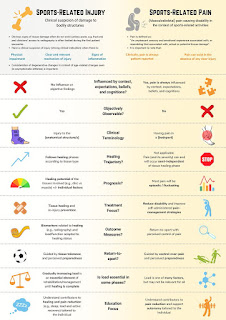
From Hoegh et al, 2021
An example given in the article is patellofemoral joint pain, an extremely common diagnosis assigned to runners by sports doctors, physiotherapists etc. This just means that there is pain around/ inside the knee joint but they cannot figure out exactly why it's hurting. Compare this to patella tendinopathy where there is a clinically identifiable cause for pain (wear and tear in the tendon).

Reading words like stabbing pain or burning sensations can affect how you feel. When we complain of pain, it may feel like something is damaged. However, as I often tell my patients, pain is subjective. To my patient it may feel like a 3 out of 10 kind of pain, but to me it may be an 8 out of 10 pain. Or vice versa. Pain can occur and exist even without an injury.

Pain can be influenced by beliefs, the process of cognition (knowing and perceiving), expectations and circumstances. Injuries are not. The onset of pain can be unpredictable, and how severe the pain is does not usually depend on the stage of healing.

Injuries can be identified by sight, orthopaedic tests and scans. The prognosis for an injury will depend on where the injury is. A muscle tear will usually heal faster than a bone fracture. 

After a sports injury, in order for the athlete to return to sport, we gradually increase their training load on their damaged tissue during rehabilitation until healing is complete and able to handle the demands of more strenuous training and competition.

With sports related pain, one cannot gradually increase training load and hope that the pain will go away. However, we can improve the patient's ability to manage the pain especially since pain is subjective.

If you have a bone stress fracture, you will have to take time off running until it heals and gradually increase load. Once healed, pain usually is no longer an issue. The injury and the associated pain are tightly connected. 

Other cases may not be as straight forward. An example would be patients who have chronic pain in their Achilles tendon with no damage on their MRI scans. There is no clear link between the physical state of their tendon and how it feels (or hurts). In such cases, surely we can manage and reduce their pain to allow them to run rather than waiting for their tendon to 'heal'. 

Another recent publication by Friedman et al (2021) warn of the dangers of diagnostic labels. Calling a patient's knee injury a meniscal tear rather than a meniscal strain may nudge the patient to opt for arthroscopic surgery even though that may not be considered the best approach.

According to the authors (Friedman et al, 2021), words chosen by medical professionals to describe injuries may present a situation as considerably worse than it actually is. This will increase anxiety and cause fear of movement.

Judging what pain to ignore and which ones to take seriously can be a delicate art rather than science and how we choose to label it can affect the outcome.

Sometimes pain is just pain.


References

Friedman DJ, Tulloch D, and Khan KM (2021). peeling Off Musculoskeletal Labels: Sticka and Stones May Break My Bones, But Diagnostic Labels Can Hamstring Me Forever. BJSM. 55: 1184-1185. DOI: 10.1136/bjsports-2021-103998.

Hoegh M, Stanton T, George S et al (2021). Pain Or Injury? Why Differentiation Matters In Exercise And Sports Medicine. BJSM. DOI: 10.1136/bjsports-2021-104633.

Sunday, August 29, 2021

Locking In Your Knee May Not Mean A Meniscus Tear

Picture from ScienceDirect

A discussion with our three new physios recently revealed that they were taught that whenever a patient has a meniscal tear on MRI with mechanical symptoms it would usually mean surgery is indicated.

Mechanical symptoms are described as 'locking' or 'catching' in the knee joint that is caused by something being trapped or stuck in the knee. They were taught that it can only be removed by surgery. If the mechanical symptoms present with a tear in the meniscus, that is confirmed by MRI, it is usually attributed to the tear. Hence the rationale for surgery to remove the tear.

However, mechanical symptoms in the knee can fluctuate. Other clinicians and patients may have different variations and definitions of such 'locking' and 'catching' in the knee.

I have come across many patients with locked knees (knees that cannot fully straighten or bend), but they are seldom 'locked' all the time. We always match such symptoms in our clinic with a patient's medical or injury history and with objective orthopaedic and functional tests. 

However a study by Thorlund et al (2019) investigated whether unstable meniscal tears are more likely to cause mechanical symptoms compared to other concurrent knee pathologies like articular cartilage damage, ACL tears etc.

A wide range of meniscal tear characteristics like tear pattern, location, size of tear were included in the study. However, no important relationships were found between any of the included factors and patients reported catching or locking in the knee or inability to straighten their knees.

These results question the logic that mechanical symptoms are caused by specific joint pathologies. The authors also compared the frequency of mechanical symptoms between patients with and without a meniscal tear after knee arthroscopy. They found that half of all patients reported catching or locking. They were also unable to straighten their knee fully. However, these mechanical symptoms were equally common among patients with or without a meniscal tear.

This is consistent with my previous post where bucket handle and complex meniscal tears (both of which are commonly operated on) were found in the patient's MRI, but these patients were asymptomatic.

So if you are currently having a 'locked' knee or cannot straighten or bend your knee fully, it does not necessarily mean you need surgery. Two large scale randomized trials referenced below confirm this too. Please come and see us in our clinic for another opinion.


References

Khan M, Evaniew N, Bedi A et al (2014). Arthroscopic Surgery For Degenerative Tears Of The Meniscus: A Systematic Review And Meta-analysis. CMAJ. 186: 1057-1064

Thorlund JB, Juhl CB, Roos EM et al (2015). Arthroscopic Surgery For Degenerative Knee: A Systematic Review And Meta-analysis Of Benefits And Harms. BMJ. 350: h2747

Thorlund JB, Pihl K, Nissen N et al (2019). Conundrum Of Mechanical Knee Symptoms: Signifying Feature Of A Meniscal Tear? BJSM. 53(5): 299-303. DOI: 10.1136/bjsports-2018-09943

Saturday, November 21, 2020

Abnormal Knee MRI, But No Pain

Knee MRI by Becky Stern from Flickr
Here's a piece of surprising news for everyone. In this recently published paper I read, nearly all patients who had abnormalities on their knee 
MRI were asymptomatic, meaning no pain despite having an "abnormal" MRI.

The main inclusion criteria for this study were sedentary adults. They did not do at least 30 minutes of moderate intensity physical activity 5 days a week or 20 minutes of more intense activities 3 days a week. They did not have any knee pain, no current or previous history of knee injury and surgery.

The authors reviewed 230 knees of 115 uninjured inactive adults (51 males and 64 females). Median age was 44 years (range was 25-73 years) and all the subjects had bilateral MRI's (3.0 Tesla, high resolution) done.

Here's what they found. Brace yourself as you read on. MRI showed abnormalities in a whopping 97% of knees. 30% of knees showed tears in the meniscus. Horizontal tears were most common, while bucket handle tears least common.

Articular cartilage (57%) and bone marrow abnormalities (48%) were common in the patellofemoral (knee) joint. Moderate (19%) intensity articular cartilage lesions and severe (31%) were observed.

Grade 4 means bone rubbing on bone

Articular cartilage injuries is my area of interest since I did my postgraduate research in that area. It is interesting to note that a quarter (or 25%) of the subjects had Grade 4 changes (see picture above) visible on MRI but did not complain of pain. Perhaps this is important to remember when imaging the knee since there seems to be more visible findings here compared to the rest of the knee (articular cartilage wise).

Moderate intensity lesions were found in 21% of knee tendons while there were high grade tendonitis found in 6% of knees reviewed. The patella and quadriceps tendons being the most affected.

3% partial ligament ruptures were found, of which 2% were of the Anterior Cruciate Ligament (ACL).

The authors concluded that nearly all knees of asymptomatic adults they studied show abnormalities in at least one knee structure on MRI. Meniscal tears, articular cartilage and bone marrow lesions in the patellofemoral joint were the most common pathological findings. 

They also reported finding bucket handle and complex meniscal tears (both of which commonly operated on) in asymptomatic knees. This interesting to note as bucket handle tears (as well as complex tears) would often cause 'locking' in the knee and therefore require surgery.

There you have it, the subjects were sedentary adults who did no exercise so no one can say that it was running or exercise that "wore out" their joints. And some these very same adults had "terrible" or abnormal MRI's, but were asymptomatic or did not have any pain.

So don't fret if your MRI is abnormal. You may not need any surgical intervention, especially if you do not have any pain or if that pain is easily treated.

Maybe these abnormalities should be just described as "wrinkles" on the inside. 


Reference

Horga LM, Hirschman AC, Henckel J et al (2020). Prevalence Of Abnormal Findings In 230 Knees Of Asymptomatic Adults Using 3.0 T MRI. Skele Radiol 49: 1099-1107. DOI: 10.1007/s00256-020-03394-z