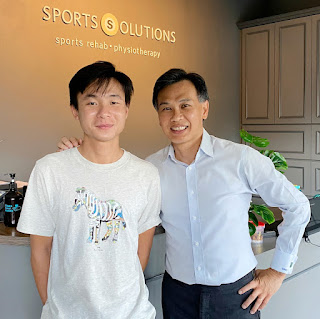
| The champ Donaben Goh Choon Huat |
| Giving him some grief |
| The champ Donaben Goh Choon Huat |
| Giving him some grief |
Then I recall reading a paper published last July 2021 that it may be Covid-19 that can cause frozen shoulder (rather than the vaccination injections).
Covid-19 symptoms were mild in 5 of the patients, were the other 7 were asymptomatic. None of the patients were severely or critically ill. 2 of the patients had diabetes that were well controlled. You can read more about that study and how the authors suggested AC can be caused by Covid-19 here.
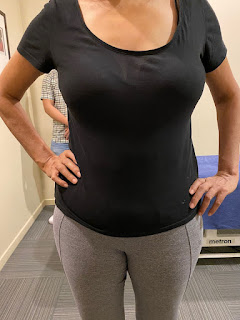
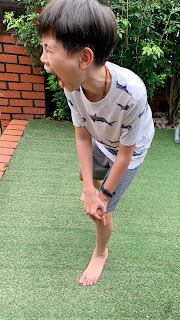
| Can't do L hand on hip |
We really do not know what causes AC. Even doctors and research scientists are not sure either. However, we do know that AC afflicts women more commonly than men. Especially women above 50, more so if they are diabetic, had a prior stroke or thyroid disorders. Sometimes, it occurs after a recent shoulder surgery as well.
There seems to be some recent evidence that AC is a metabolic condition. Meaning if you're hypertensive, overweight, you drink, smoke, you have a poor diet and do little or no exercise, then you have a higher chance of getting AC.
There are usually 3 stages with AC. The first stage is the 'freezing' stage where pain is increasing with most shoulder movements. End range of motion in the shoulder starts to be limited. This stage can last from 3 to 6 months.
The next stage is the 'frozen' stage. There usually isn't as much pain as the first stage but shoulder range is definitely more limited. Patients often complain of increasing 'stiffness' in this stage.
The last stage is known as the 'thawing' state where shoulder range starts to improve. There is usually much less pain during this stage.
AC can last between 9 to 18 months. I've seen some patients get a whole better after 6 months although it can drag for up to 24 months in other patients.
I will write how we can help with AC in my next post. Stay tuned.
Reference
Ascani C, Passaretti D, Scacchi M et al (2021). Can Adhesive Capsulitis Of The Shoulder Be A Consequence Of Covid-19? Case Series Of 12 Patients. 30(7): E409-413. DOI: 10.1016/j.jse.2021.04.024
Most elite athletes I treat are similar, always dealing with pain and niggles. Some pain would disappear while other pain tend to persist and linger.
A recent article (Hoegh et al, 2021) suggests that in the context of sports medicine, pain and injuries are 2 different distinct entities and should not be lumped together.
That article (Hoegh et al, 2021) suggests that when pain is inappropriately labeled as an injury, it creates fear and anxiety. It may even change how we move the affected body part, creating further problems.
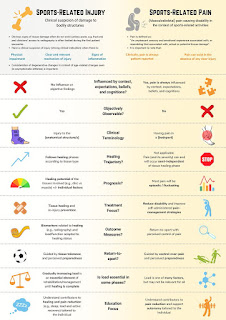
| From Hoegh et al, 2021 |
Reading words like stabbing pain or burning sensations can affect how you feel. When we complain of pain, it may feel like something is damaged. However, as I often tell my patients, pain is subjective. To my patient it may feel like a 3 out of 10 kind of pain, but to me it may be an 8 out of 10 pain. Or vice versa. Pain can occur and exist even without an injury.
Pain can be influenced by beliefs, the process of cognition (knowing and perceiving), expectations and circumstances. Injuries are not. The onset of pain can be unpredictable, and how severe the pain is does not usually depend on the stage of healing.
Injuries can be identified by sight, orthopaedic tests and scans. The prognosis for an injury will depend on where the injury is. A muscle tear will usually heal faster than a bone fracture.
After a sports injury, in order for the athlete to return to sport, we gradually increase their training load on their damaged tissue during rehabilitation until healing is complete and able to handle the demands of more strenuous training and competition.
With sports related pain, one cannot gradually increase training load and hope that the pain will go away. However, we can improve the patient's ability to manage the pain especially since pain is subjective.
If you have a bone stress fracture, you will have to take time off running until it heals and gradually increase load. Once healed, pain usually is no longer an issue. The injury and the associated pain are tightly connected.
Other cases may not be as straight forward. An example would be patients who have chronic pain in their Achilles tendon with no damage on their MRI scans. There is no clear link between the physical state of their tendon and how it feels (or hurts). In such cases, surely we can manage and reduce their pain to allow them to run rather than waiting for their tendon to 'heal'.
Another recent publication by Friedman et al (2021) warn of the dangers of diagnostic labels. Calling a patient's knee injury a meniscal tear rather than a meniscal strain may nudge the patient to opt for arthroscopic surgery even though that may not be considered the best approach.
According to the authors (Friedman et al, 2021), words chosen by medical professionals to describe injuries may present a situation as considerably worse than it actually is. This will increase anxiety and cause fear of movement.
Judging what pain to ignore and which ones to take seriously can be a delicate art rather than science and how we choose to label it can affect the outcome.
Sometimes pain is just pain.
References
Friedman DJ, Tulloch D, and Khan KM (2021). peeling Off Musculoskeletal Labels: Sticka and Stones May Break My Bones, But Diagnostic Labels Can Hamstring Me Forever. BJSM. 55: 1184-1185. DOI: 10.1136/bjsports-2021-103998.
Hoegh M, Stanton T, George S et al (2021). Pain Or Injury? Why Differentiation Matters In Exercise And Sports Medicine. BJSM. DOI: 10.1136/bjsports-2021-104633.
| Picture by Jeffrey Keng on 010119 |
Handling the extra social meetings, holiday shopping, festivities and of course, the extra eating while keeping your training intact is going to be challenging for many.
Here are some suggestions to keep your training intact if you keep your long term objectives in mind while keeping your expectations realistic.
I would usually have slightly more time to ride in the wee morning hours during the weekdays the last 2 weeks of the year. Not this year after my recent accident. My only time on a bike currently is on the stationary bike. Not that I have a choice, doctor's orders.
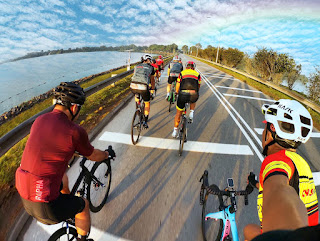
If you're a cyclist, early starts are great these 2 weeks since all school kids are on holidays. No need to drive your kids and definitely less morning traffic as well. Get your ride in early and have the rest of the day free for your family or other social engagements. Personally I find riding or running with your group of friends helpful as they help to make sure you turn up.
Whether it is cycling, triathlon or ultra running, consistency is key. You may not be able to fit in that extra long run or bike ride during this period. What matters more is you try to fit in a session on most days, i.e. cutting overall training time rather than reduce frequency of your sessions. So if you're running an hour most weekdays and 2-3 hours on the weekends, running 30 mins on most weekdays and an hour on the weekend may suffice to keep your running routines, habits and adaptations intact.
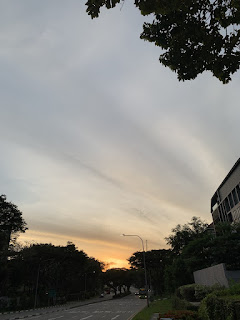
| Caught this view on my morning run |
Do leave room for days when you really cannot fit any exercise in. Your child or other loved ones may fall sick, your boss may give you no notice for a last minute project or other stuff can happen. Take a deep breath and tell yourself that you definitely will not win or lose a race later in the upcoming season by missing a workout in December. There will be many other opportunities to train specifically in the new year. You're only getting ready to train in January. Don't sweat the the fact that you are too busy and distracted to follow the strictest training plan.
When I was still competing, this would be the time when I took 2 weeks off training. No swimming, cycling, running or weights training. Just resting, chilling, time with family, eating etc. I'll be raring to go by the time the new year came round. You may want to take time off to recharge too.
The holiday period definitely brings another layer of complexity if you're still training. However, it also provides a chance to celebrate and connect with traditions and people that matter most to us. Personally, it has given me a chance to be thankful since Covid-19 has delivered more struggles than most of us admit.
We already squeeze our training into our typically demanding schedules and this time of the year provides us a chance to slow down and reflect. Merry Christmas to all our readers.
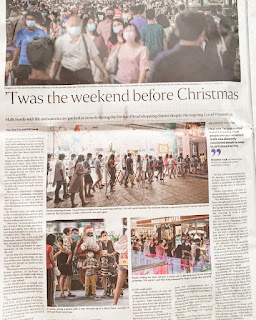
Well, at least they are out getting some 'exercise' while buying presents for their loved ones. Are you wondering how to motivate someone to exercise? Well, this week's post does exactly that. And yes, rewards are very important to get people to exercise.
Just like the proverbial dangling of the carrot in front of the donkey, evidence suggests that monetary rewards plays a big role in motivating one to exercise.
This mega study involved 61,293 gym members from the American 24 hour Fitness chain, 30 scientists from 15 universities and more than 50 motivational programs.
Incentives include a free audiobook for gym use, cheery instructions from instructors to reframe exercise as fun and reward points under an umbrella program called Step Up. After signing up, these gym members earned Amazon reward points worth US$1 (S$1.36) and new ways to motivate themselves to exercise.
The scientists divided these participants into 53 different groups. Each group had at least 455 participants. In an example group, members earned US$1.75 reward points each time they visited the gym. Other groups shared workouts on social media, signed fitness pledges etc. Each intervention lasted a month. Of course there was a separate control group that changed nothing about their daily lives or gym time.
Here are the results. The most successful intervention was giving people US$0.09! Yes, 9 cents worth of reward points if they returned to the gym after missing a planned workout. This increased visit rates by 16 percent compared to just planning in advance and text reminders. Giving participants US$1.75 everytime they worked out was almost as effective, it increased exercise participation by 14 percent.
So as we approach the coming new year with new fitness resolutions, other than planning a reasonable workout schedule, putting the program reminders into our phones or having a spouse/ training buddy, the above findings suggest finding a small way to reward ourselves when we do exercise, works best. Perhaps the shoppers in the above picture were also thinking of buying themselves a present after dealing with Covid-19 for almost 2 years now.
Ministry of Health officials reading this, can we reward participants with some monetary incentive from NTUC with every hour walked or a workout done? That may help with our growing diabetes problem too.What about you? Would a monetary incentive motivate you to workout more regularly? How much would it take before you proceed? Appreciate your comments please.
Reference
Milkman KL, Gromet D, Ho H et al (2021). Megastudies Improve The Impact Of Applied Behavioural Science. Nature. 600: 478-483. DOI: 10.1038/s41586-021-04124-4
| This was in Oct 2018 |
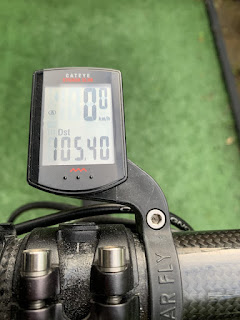
| 105 km before work |
Evidence regarding this has been mixed. Some studies show that prolonged and strenuous exercise tends to blunt one's appetite, sometimes for hours or even into the next day. Other studies suggest the opposite, finding that some people feel hungrier after workouts of any kind and quickly eat the calories they expended and continue to eat more at the next meal.
Consider the following study. Participants in this weight loss study did not feel like eating after running or strength training. The physical activity prevented them from overeating. But it was not the strenuous exercise that blunted their appetites.
In that study, 130 participants (between 18 to 70) were asked to exercise for one year. Other than light physical activity, the fitness program also had moderate to vigorous physical activities of up to 250 minutes a week. Each of them wore a fitness tracker and was given a daily calorie goal based on their body mass index (BMI).
Results showed that when the participants did not exercise, they were 12 percent more likely to overeat (or exceed their daily calorie goal). However, when the participants exercised for 60 mins, their risk of overeating was lessened to 5 percent. For every extra 10 minutes of exercise after 60 minutes, the chances the participants would overeat dropped by a further 1 percent.
To my surprise and the surprise of the researchers, light physical activity (walking at a slow leisurely pace) showed the strongest effects against overeating compared to moderate (brisk walk) to vigorous physical activity (running or strenuous fitness class).
The researchers explained that exercise causes peptide YY, a hormone which suppresses appetite to spike, while causing grehlin (which stimulates appetite) to drop. This led to the participants not feeling hungry after exercise.
Another possible reason is that exercise boosts mood and self esteem, which may improve one's motivation not to overeat.
Also note that participants in the study had participants with BMI values between 27 to 50 (overweight or obese) and they were looking to lose weight. What they perceived as moderate physical activities may be different to what you and I may perceive.
For most of us, exercise can affect our hunger and weight in unexpected and contradictory ways. So during this holiday season, do not worry that if you exercise you will overeat. A short period of indulgence should not affect your weight in the long term if you exercise regularly .
Reference
Crochiere RJ, Kerrigan SG, Lampe EW et al (2020). Is Physical Activity A Risk Or A protective Factor For Subsequent Dietary Lapses Among Behavioral Weight Loss Participants? Health Pysch 39(3): 240-244. DOI: 10.1037/hea0000839.
Many patients tell me that with WFH, they end up sitting for hours at a go. We know that prolonged sitting is the new smoking, that prolonged sitting without regular movement may lead to low back pain, other musculoskeletal problems and other lifestyle diseases.
The results showed that prolonged sitting without regular movement significantly increase stiffness in our back muscles. This may explain why prolonged periods of chair sitting increase chances of low back pain. There was no mention that poor posture or slouching contributed to this.
The good news is that with regular movement (through regular muscle contractions), stiffness in your lower back can be prevented.
The researchers concluded that it is important that we move regularly and consistently throughout the day.
If I had to be sitting in front of a computer, I will get up and move around as often as I can. Otherwise, I will do so with one or two trigger balls at my low back area (see picture right at the top) since it reminds me to move more frequently.
Reference
Kerr AR, Milani TL and Sichting F (2021). Sitting For Too Long, Moving Too Little: Regular Muscle Contractions Can Reduce Muscle Stiffness During Prolonged Periods of Chair-sitting. Front Sp Act Living. 03 Nov 2021. DOI: 10.3389/fspo.2021.760533