Sunday, April 10, 2022

We Don't Just Treat Sports Injuries

Many new patients who call our clinic often tell us that they don't play any sports and wonder if they can still see us. To which we reply, "Most definitely!"

As all our physiotherapists are trained to read your body to ascertain how it's positioned in various postures and during movement. We work like detectives, finding the main cause of your problem. We know exactly what we can change to make a difference to your problem and when we might need to refer a patient out to a specialist e.g. neurosurgeon etc.

We specialize in spinal pain and problems, joint pain, muscle strains, joint sprains, nerve related problems (where you might experience pins and needles, numbness or reduced sensation or strength), headaches, and of course injuries that you sustain during sports.

So exactly how different is a sports physiotherapist and a musculoskeletal (meaning muscle and bones) physiotherapist? Having worked in a professional sports setting, treating elite athletes for 10 years, traveling with Team Singapore athletes to the Olympics, SEA, Commonwealth, Asian Games and others and now being in private practice for 12 years , I will attempt to explain the main differences..

The biggest difference would be the time allocated to the athletes and patients. When treating athletes at a professional level, we may sometimes see the athlete 3 times a day. 

Say we have a badminton player who has a niggle in his foot, we get to experiment with taping the player's foot with rigid or Kinesio tape. How can I change his navicular bone position? That alone may determine how well the player trains that morning. Or, if there's a match later that evening we can trial any tape, shoe, or racket earlier in the week before the actual game. 

Oftentimes, the head coach will request specific sessions with injured players to get them up to speed with recovery.

Taping with rigid tape
In an actual game, the physiotherapist has to be paying attention and watching to get clues about the mechanisms of injury. We often need to assess and treat our player ASAP usually within the minute.  I will have in my kit bag, different types of tapes ready, blister kit. splints, nail cutter, scissors, lotions, painkilling sprays etc. in case I need them. We try to be the 'magic' healer, asking questions, cleaning sweaty areas to treat, to allow them to play again.

Yes, Treating elite athletes can be very time consuming and labor intensive.

In a private practice setting (like Physio Solutions and Sports Solutions), the patients are just as eager to be pain free, to get better and to return to exercise. Unlike a competition setting, we get much more time to ask questions and assess thoroughly. Finding and treating the cause of the problem becomes easier. The hands-on, manual therapy we do has huge benefits in changing a patient's condition. However, we may only get to see patients once or twice a week. 

It is, therefore, important to educate patients on what they have to do in the time between appointments. We may teach them self tests and exercises on e.g. their calf range to see how they're progressing. We are easily contactable via text, email or phone if you need to ask questions between your sessions.

In summary, when you become our patient, WE GOT YOU.

Sunday, April 3, 2022

My Patient Has Os Trigonum Syndrome

Not her legs
My 11 year old patient came in complaining of pain at the back part of her ankle. She's an avid ballet dancer and tennis player and trains up to 4 times a week.

After examining her thoroughly, I found that her pain was reproduced at a very specific location, especially when she was pointing her foot. I explained to her mum that she probably has Os Trigonum syndrome.


The Os Trigonum is a small, extra accessory bone that is sitting at the back of the ankle joint. This extra bone may be present in up to 20 percent of the general population. It forms when one area of the bone fails to fuse with the rest of the bone (the talus in this case). Often people do not know if they have an Os Trigonum if it has not caused any problems. 

This is similar to the accessory navicular bone in the foot, which usually does not cause any problems. However, it can cause pain after twisting your ankle (just like it can cause pain in the accessory navicular bone in the foot). This happens when the Os Trigonum moves or breaks leading to pinching at the back of the ankle joint, causing what is known as a posterior impingement. 

It can also be caused by repeated downward pointing of the toes, which is especially common in ballet dancers (when assuming an en pointe position) and football players (when shooting).

Sometimes it can be mistaken for pain originating from the Achilles tendon. An x-ray is usually ordered by the doctor to show the Os Trigonum at the back of the ankle. A MRI scan is used occasionally to exclude articular cartilage damage in the ankle.


Reference

Skwiot M, Sliwinski Z, Zurawski W et al (2021). Effectiveness Of Physiotherapy Interventions For Injury In Ballet Dancers. PLoS one. 24(6): eo253437. DOI: 10.1371/journal.pone.0253437.

Thanks to Byron for the picture

Wednesday, March 30, 2022

We Went Bowling For Team Building

We went to the Escape Room during our last team building session. And we were going to playing indoor games (Charade, Monopoly or card games perhaps) for our team building event this quarter.


However since restrictions were lifted for Covid-19, the younger members of our team decided we should go bowling. 

And so we did. It was nice to be able to hang out in a bigger group. You get hungry after some exercise. So of course we had to get something to eat after bowling.

Mark your calenders for the next team building event on June 3rd. Stay tuned.

Sunday, March 27, 2022

What Is Ergodicity?

Ice baths for recovery
I did not know what the word 'ergodicity' meant. I had to look it up. It means when you do a test or research on a whole group, you assume the result applies to everyone. Say you get a hundred gorrillas to flip a coin 10 times. All 10 flips ends up with a head. You then conclude that all gorillas can always flip 10 heads in a row with 10 coin flips.

Can you see the error with this conclusion? Neumann and colleagues (2021), sugests that sports scientists may inadvertently be making errors like this frequently. Their research studied the relationship between training load and recovery. If you're into endurance sports, you know recovery is really crucial.

When you train more, your fitness improves, however, it also increases your chances of injury and burnout. This has led to all sorts of research to investigate how we handle different training loads and how quickly we recover so that we can train harder without breaking down.

So, is there a link between training load and recovery? Is it possible to measure training load and subsequent recovery in a large group of people and use those results to recommend or predict how you and I or any individual would respond?

Neumann and colleagues (2020) studied footballers from a top Dutch football league club, over 2 seasons. Daily training and recovery data were collected from footballers of their under-17, under-19 and under-23 teams.

The most basic question to address is if total training load in a workout affect how recovered the footballers feel before the next day's training session? This is done in 2 ways. 

For the whole group analysis, an average training load is calculated on a given day. The analysis is repeated for each workout day and you can average the results.

For each individual analysis, you monitor every pair of workout/ recovery scores for each individual over the course of the data. This data is then averaged. 

If both group and individual data produce identical results, then the training and recovery is ergodic, meaning the results of the group studies can be applied to individuals (like you and I). If results aren't identical then oops.....

Well, sure enough, the group and individual analyses produced different results. The correlations between training load and recovery did not match up. training loads varied far more for a given individual footballer over time than they did between individual footballers on a given day. How a bunch of people respond to a single workout session does not always tell how you respond to a series of workouts. 

I recall when running cross country in secondary school how all of us in the school team were given the same workout session and each of us responded differently.

You must be wondering now if all the previous research done on training and  on large groups apply to you, or whether they are invalid. Researchers use randomized placebo controlled trials to normalise the effects of individual variation. They also report individual results to group averages. 

Read and understand the recommendations from researchers to improve your personal training/ performance and recovery. But bear in mind that we are all an experiment of one (or n = 1). Age is also a confounder. What hurts now after a certain workout did not hurt when I was 28.


Reference

Neumann ND, Yperen NWV, Brauers JJ et al (2021). Nonergodicity In Load And Recovery: Group Results Do Not Generalize To Individuals. Int J Sp Physiol Perform. 17(3): 391-399. DOI: 10.1123/ijspp.2021-0126

Sunday, March 20, 2022

Are You Still Stretching?

I was just talking to a physiotherapist about teaching static stretching to his patient. I had written many articles about why static stretches are a big no-no especially before exercise. 

I thought it's common knowledge by now that just one static stretch of 30 seconds can reduce your maximum strength. You're more likely to get injured if you do static stretching before exercising.

Maybe that physiotherapist is not alone. An article published in 2020 found that 80 percent of 605 personal trainers surveyed in the United States of America still prescribed traditional static stretching to their clients. 

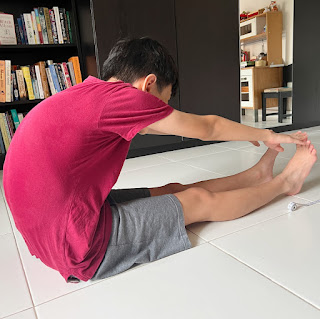
Static stretching is prescribed to help static flexibility. Some readers will recall doing the sit-and-reach test in the NAPFA test in our schools. This is done sitting on the floor with legs out straight and they measure how far beyond your heels you can reach. Best way to improve static flexibility? To do more static stretching. You can go to the end of your available range and hold that for say, 10 seconds and repeat.

If you read that article (Nuzzo, 2020), having good flexibility will not help you live longer. It does not help prevent falls. 

Good static flexibility also does not help prevent injuries. This topic has been the studied widely, a few studies have found that there are some benefits, while a few other studies have found that being too flexible is associated with injury. Most do not seem to make much difference.

Static flexibility is not associated with non sports related problems like low back pain.

Most importantly for the readers of this blog, having better static flexibility does not improve your sporting performance. Unless your sport requires a certain range like in gymnastics or if you are trying to become a ballerina. Donaben, our champion cyclist will tell you that time trialling on a bike will require some flexibility to hold that aerodynamic tuck and still pedal with power. The rest of us? Probably not.

If you are a runner, you are unlikely to get injured if you cannot touch your toes. A study found that amongst elite runners (with an average VO2 max of 73 mL/kg/min), the runners who were the least flexible (in the sit-and-reach test) were the most economical runners (better running economy). This suggests that being less flexible is better as this allows your legs to store and return energy (like a coiled spring) with each running stride (Jones, 2002)

So take note that static flexibility is not that important, unless your specific sport requires it. Stretching before, during or after a workout does not prevent subsequent muscle soreness. It does not reduce inury risk either (Herbert et al, 2011).

So what do you do to warm up before your exercise if you do not stretch? The goal of warming up is to physically warm your muscles to make them more pliable as well as get your heart rate up to be ready to deliver oxygen to your working muscles. 

Before my run, I'll ride a stationary bike for 10 minutes or just run the first kilometer real slow before picking up the pace. If you're playing badminton or tennis, I'll suggest some lunges, side to side movements, i.e. sport specific movements that you may use while playing.

Want to improve your range of motion? Try strength training instead.


References

Jones AM (2002). Running Economy Is NegativelyRelated To Sit-and-reach Test Performance In International-standard Distamce Runners. Int J Sp Med. 23(1): 40-43. DOI: 10.1055/s-2002-19271

Nuzzo JL (2020). The Case For Retiring Flexibility As A Major Component Of Physical Fitness. Sports Med. 50(5): 853-870. DOI: 10.1007/s40279-019-01248-w

Herbert RD, Noronha MD and Kamoer SJ (2011). Stretching To Prevent Or Reduce Muscle Soreness After Exercise. Cochrane Reviews. DOI: 10.1002/14651858.CD004577.pub3

Sunday, March 13, 2022

Train Your Tendons

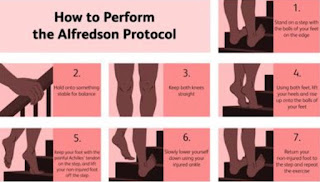
If you are a runner and have had pain in your Achilles tendon, you know it takes a long time for it to get better. Compared to muscles, our tendons and ligaments have much poorer blood supply so they take a longer time to heal. Currently, most healthcare professionals recommend the Alfredson protocol (up to 180 eccentric heel drops a day) to get your Achilles tendon better.

Trained runners have been found to have a thicker Achilles tendon, stiffer and better structure compared to novice runners. A longer, stiffer tendon stores more energy and releases that energy when you push off with each step. It has also been speculated that the dominance of international running races by Kenyan runners are due to their long and springy Achilles tendon (Tawa and Louw, 2018).

Can you then train your tendons? Consider the following study. 40 pairs of identical twins were asked about their physical activity and sports habits to determine how active they were. Researchers then measured the stiffness of their Achilles tendons.

Results show that when one twin is active and the other inactive, the active twins have tendons 28 percent stiffer. Since identical twins start with identical genes, this shows that long term training can change the structure of the Achilles. It also fits in with previous studies that trained runners have thicker and stiffer tendons. These runners were not elite runners so you don't need excessive training levels to change your tendons. But these runners have been running for an average of 15 years, so there's plenty of time for change to occur.

Another point to note from the study. Those who did activities that involve an aerial phase with both feet off the ground (running, basketball or tennis etc) had a stiffer TA compared to those with no aerial phase (cycling, walking and swimming). This suggests that jumping and landing may hold clues to getting your Achilles tendon stiffer and stronger.

Tendons may be slow to heal and adapt to load, but for those of you who run, surely this is an incentive to keep on running. Those who play football, basketball or tennis, please carry on too.

Currently, when you visit your current healthcare provider for treatment, most will just recommend the Alfredson protocol (up to 180 eccentric heel drops a day) to get your Achilles tendon better. That you can do yourself (picture below).

In our clinics, after we assess you thoroughly, we mostly use our hands to treat what we find, no ultrasound, no orthotics, no shockwave (ESWT), no electrotherapy. And we get very good results. We DO NOT get you to do exercises DURING the time you have with us. We do treatment that you cannot do yourself.

Previously, I've written that there is some evidence that gelatin (or jell-o) can help tendons heal. Perhaps that is an area you may also want to explore? And do take note that some antibiotic medications can damage your tendons.


References

Sichting F, Kram NC and Legerlotz K (2022). An Identical Twin Study On Human Achilles Tendon Adaptation: Egular Recreatinal Exercise At Comparatively Low Intensities Can Increase Tendon Stiffness. Front. Physiol. DOI: 10.3389/fphys.2021.777403

Tawa N and Louw Q (2018). Biomechanical Factors Associated With Running Economy And The Performance Of Elite Kentyan Distance Runners: A Systematic Review. J Body Mvt Ther. DOI: 10.1106/j.bmt.2017.11.004


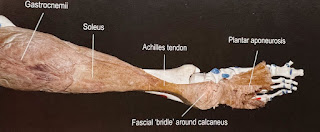
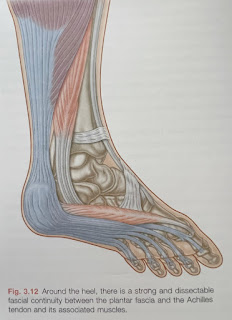
See how closely the Achilles and plantar fascia are related. In order to get the Achilles tendon better, you need to treat the plantar fascia as well.

Friday, March 4, 2022

Hydrotherapy/ Deep Water Running Again!

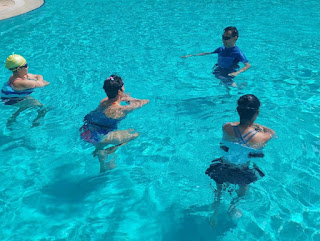
Since Covid started, we have not been able to bring our patients to the pool for hydrotherapy or aqua-based rehabilitation. 

The public pool we were using is only opened for lap swimming now. We are very grateful to The Ripple Club. It was with their help that we got access to a pool for our post-op patients today.

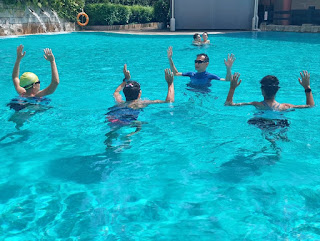
They are all surrendering....
This is not a typical hydrotherapy session in a shallow pool like what hospitals may have. Those are often indoor sessions in waist or chest deep, warm water. Range of motion exercises and light strengthening exercises are normally done then.

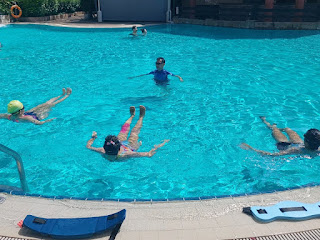
For our sessions, the pool is usually 1.8 metres deep. The patients use an aqua running belt to keep them afloat.

One patient had her hip labrum repaired recently while another (a triathlete) had an OCD bone fragment removed surgically. I often include aqua running techniques (or deep water running) to produce a training effect for them since they definitely cannot run on land yet. 

If done correctly, the arms, shoulders, lower limbs and abdominal muscles are involved. For those who cannot take too much impact, this is a very good alternative since water is 773 times more resistant than air. The harder you move your arms or legs, the more drag force or resistance you encounter.

Sculling with aqua belts off
This is a very useful session for rehabilitation work and training for athletes and patients. It allows injured athletes or post operative patients to recover quicker and allows others to undertake higher intensity (water based) training, with lower incidence of injury. 

It will not do the aqua training technique justice for me to describe how you do it in just a few short sentences, please contact us if you need more information on this.


References
Davidson, K (2000). Deep Water Running Training Improve V02 max in Untrained Women. Journal of Strength and Conditioning Research. 14 (2) 191-195

Dowzer, CN and Reilly, T (1998). Deep Water Running. Sports Exercise and Injury. 4: 56-61

A big thank you to Alicia and Yannick from The Ripple Club for letting our patients try their water bikes.

*Thanks to Edmund Miranda from The Ripple Club for taking the pictures too.