Showing posts with label osteochondritis dissecans. Show all posts

Sunday, September 10, 2023

Avascular Necrosis

Picture by Frank Gillard from Radiopaedia
Seeing this x-ray reminds me of what I was suspected of having when I started having persistent knee pain back in early 2002, which then led me to having 3 knee surgeries. A doctor I consulted suspected I had early avascular necrosis in my lateral femoral condyle. 

Avascular necrosis (also know as osteonecrosis) is the dying of bone tissue due to lack of blood supply. Depending on where it is, it can lead to tiny breaks in the bone and cause the bone to collapse. This process can take years to occur.

A dislocated joint or a fracture in parts of the bone can also hinder or stop blood flow to a section of the remaining bone. This commonly occurs at the epiphysis (end part) of long bones at weight bearing joints. Some common sites include the femoral head, talus, humeral head, knee and the scaphoid bone (in the wrist).

Avascular necrosis is associated with long term use of steroid medications and injections and too much alcohol. Anyone can be affected. It tends to be most common in people between the ages of 30 and 50.

Repetitive trauma can also cause avascular necrosis. This is not as commonly discussed in the medical journals. This form of avascular necrosis is most common in athletes. Rafael Nadal has a chronic left foot ailment, Mueller-Weiss syndrome where there is avasular necrosis in his navicular bone. Young gymnasts that I have previously treated are also prone to this in the wrist, knee and hips.

The doctor I consulted for my persistent knee pain back then felt that my super high mileage  (I was training for the 100 km Trailwalker event in Hong kong and the full Ironman) caused my knee pain.

The cause of avascular necrosis brought on by trauma (or repetitive stress like running and jumping) is not fully understood. Genetics combined with certain medication (like corticisteroids), excessive alcohol intake and other diseases like sickle cell anemia and Gaucher's disease can play a role as well.

Fatty deposits (or lipids) in blood vessels can block blood vessels and reduce blood flow to bone as well. There are suggestions that long term and high doses of corticisteroids (like prednisone) can increase lipid levels in blood, reducing blood flow to the bones.

Some people have no pain or symptoms at all in the early stages of avascular necrosis. As it worsens, the affected joints may hurt when weight bearing. Eventually there may be pain even at rest. Pain can be mild or severe and develops gradually. 

Having too many alcoholic drinks over several years can also cause fatty deposits to form in blood vessels.

Certain medical treatments like radiation therapy for cancer can also weaken bone. Kidney transplant patients have also been known to be associated with avascular necrosis.

To reduce the risk of avascular necrosis, please limit your alcohol intake since heavy drinking is one of the top risk factors for developing avascular necrosis. 

Keep your cholesterol levels low as tiny bits of fats (lipids) are the most common substance blocking blood supply to bones. Stop smoking as smoking narrows blood vessels which will reduce blood flow.

For those doing repetitive sports, I always suggest running on softer surfaces like grass or sand. Do not be in a hurry to increase your mileage, your bones and joints need time to get used to the load.

Lessen the junk miles or better still ride the stationary bike or use the elliptical trainer to target different areas. Strength training is very important for your bone health.


Reference

Shah KN, Racine J, Jones LC et al (2015). Pathophysiology And Risk Factors For Osteonecrosis. Curr Rev Muscu Med. 8(3): 201-209. DOI: 10.1007/s12178-015-9277-8

Friday, March 4, 2022

Hydrotherapy/ Deep Water Running Again!

Since Covid started, we have not been able to bring our patients to the pool for hydrotherapy or aqua-based rehabilitation. 

The public pool we were using is only opened for lap swimming now. We are very grateful to The Ripple Club. It was with their help that we got access to a pool for our post-op patients today.

They are all surrendering....
This is not a typical hydrotherapy session in a shallow pool like what hospitals may have. Those are often indoor sessions in waist or chest deep, warm water. Range of motion exercises and light strengthening exercises are normally done then.

For our sessions, the pool is usually 1.8 metres deep. The patients use an aqua running belt to keep them afloat.

One patient had her hip labrum repaired recently while another (a triathlete) had an OCD bone fragment removed surgically. I often include aqua running techniques (or deep water running) to produce a training effect for them since they definitely cannot run on land yet. 

If done correctly, the arms, shoulders, lower limbs and abdominal muscles are involved. For those who cannot take too much impact, this is a very good alternative since water is 773 times more resistant than air. The harder you move your arms or legs, the more drag force or resistance you encounter.

Sculling with aqua belts off
This is a very useful session for rehabilitation work and training for athletes and patients. It allows injured athletes or post operative patients to recover quicker and allows others to undertake higher intensity (water based) training, with lower incidence of injury. 

It will not do the aqua training technique justice for me to describe how you do it in just a few short sentences, please contact us if you need more information on this.


References
Davidson, K (2000). Deep Water Running Training Improve V02 max in Untrained Women. Journal of Strength and Conditioning Research. 14 (2) 191-195

Dowzer, CN and Reilly, T (1998). Deep Water Running. Sports Exercise and Injury. 4: 56-61

A big thank you to Alicia and Yannick from The Ripple Club for letting our patients try their water bikes.

*Thanks to Edmund Miranda from The Ripple Club for taking the pictures too.

Sunday, January 30, 2022

OCD

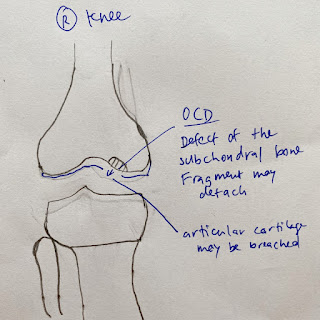
Kindly drawn by my older son
In case you're wondering about the title, it's not obsessive compulsive disorder, I definitely can't write a post on that. But I do know about osteochondritis dissecans (OCD). In fact when I kept having recurrent knee pain back in 2002 (which subsequently led to 3 knee operations), I initially thought I had OCD myself, before MRI scans suggested otherwise.

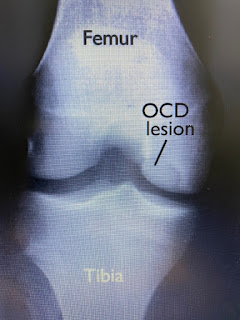
OCD occurs when part of a bone within a joint dies due to lack of blood flow and partially or fully separates from the joint. This separated bone piece can cause pain and subsequently restrict movement in that joint. Meaning you cannot fully straighten or bend that joint.

The cause of OCD is unknown. It is suggested that reduced blood flow to the bone may occur from repetitive trauma like excessive running and jumping. Or small, multiple episodes of minor unknown injury that damage the bone over time. Some studies suggest that there may be a genetic component involved too.

OCD occurs most frequently in children and adolescents, most commonly in the knee, but can also occur in the elbow and ankle. 

Doctors stage OCD according to how big the bone fragment is, whether the bone fragment is totally or partially separated or whether it stays in place. If that loosened piece of bone is not detached, then there may be few or no symptoms. For younger children whose bones are still growing and developing, there is a chance that it can heal.

So it was a total surprise to me when my adult patient was diagnosed with OCD 2 days ago. 

She was in the process of sitting down on her sofa and slightly twisted her knee. She could not extend or bend her knee fully nor put weight on her foot after that. She went to the hospital and was told it might be a meniscus tear and may need surgery. The surgeon suggested an MRI to confirm his hypothesis.

Hence, when the MRI results came out it was a big surprise that there was a bone fragment dislodged. That's the reason why she could not straighten or bend her knee fully.

The only incident my patient could think of was during gymnastics, when she was 12, that her knee started to hurt (possibly from the impact of repeated running and landing). Her knee would 'lock' occasionally for a few days at a time. It gradually resolved and she would occasionally have some knee pain on that same left knee while she competed in triathlons. Otherwise, there was no other clue that she would have OCD.

Now my patient has to decide how she would like to proceed to get the bone fragment out after discussion with her surgeon.


Reference

Kocher MS, Tucker R, Ganley TJ et al (2006). Management Of Osteochondritis Dissecans Of The Knee: Current Concepts Review. AJSM. 34(7): 1181-1191. DOI: 10.177/0363546506290127.

Picture from RadioGraphics