![]() |
| Collagen liquid used in the study |
Sunday, February 12, 2023
New Evidence That Collagen May Help Your Tendons
Sunday, March 13, 2022
Train Your Tendons
Trained runners have been found to have a thicker Achilles tendon, stiffer and better structure compared to novice runners. A longer, stiffer tendon stores more energy and releases that energy when you push off with each step. It has also been speculated that the dominance of international running races by Kenyan runners are due to their long and springy Achilles tendon (Tawa and Louw, 2018).
Can you then train your tendons? Consider the following study. 40 pairs of identical twins were asked about their physical activity and sports habits to determine how active they were. Researchers then measured the stiffness of their Achilles tendons.
Results show that when one twin is active and the other inactive, the active twins have tendons 28 percent stiffer. Since identical twins start with identical genes, this shows that long term training can change the structure of the Achilles. It also fits in with previous studies that trained runners have thicker and stiffer tendons. These runners were not elite runners so you don't need excessive training levels to change your tendons. But these runners have been running for an average of 15 years, so there's plenty of time for change to occur.
Another point to note from the study. Those who did activities that involve an aerial phase with both feet off the ground (running, basketball or tennis etc) had a stiffer TA compared to those with no aerial phase (cycling, walking and swimming). This suggests that jumping and landing may hold clues to getting your Achilles tendon stiffer and stronger.
Tendons may be slow to heal and adapt to load, but for those of you who run, surely this is an incentive to keep on running. Those who play football, basketball or tennis, please carry on too.
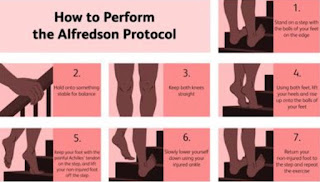
Currently, when you visit your current healthcare provider for treatment, most will just recommend the Alfredson protocol (up to 180 eccentric heel drops a day) to get your Achilles tendon better. That you can do yourself (picture below).
In our clinics, after we assess you thoroughly, we mostly use our hands to treat what we find, no ultrasound, no orthotics, no shockwave (ESWT), no electrotherapy. And we get very good results. We DO NOT get you to do exercises DURING the time you have with us. We do treatment that you cannot do yourself.
Previously, I've written that there is some evidence that gelatin (or jell-o) can help tendons heal. Perhaps that is an area you may also want to explore? And do take note that some antibiotic medications can damage your tendons.
References
Sichting F, Kram NC and Legerlotz K (2022). An Identical Twin Study On Human Achilles Tendon Adaptation: Egular Recreatinal Exercise At Comparatively Low Intensities Can Increase Tendon Stiffness. Front. Physiol. DOI: 10.3389/fphys.2021.777403
Tawa N and Louw Q (2018). Biomechanical Factors Associated With Running Economy And The Performance Of Elite Kentyan Distance Runners: A Systematic Review. J Body Mvt Ther. DOI: 10.1106/j.bmt.2017.11.004
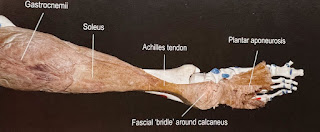
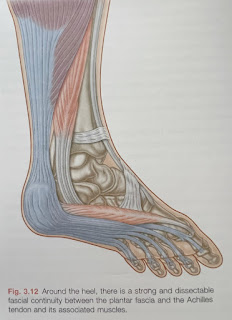
See how closely the Achilles and plantar fascia are related. In order to get the Achilles tendon better, you need to treat the plantar fascia as well.
Sunday, June 9, 2019
How Gelatin (Jell-O) May Help Healing
![]() |
| Home made soursop flavoured |
Professor Baar and his colleagues at UC Davis have been growing "engineered ligaments" in the university lab, subjecting them to all sorts of loads/ abuse) to understand what factors affect injury risk and healing. They may also have found how to train and feed (yes, you read correctly) connective tissue like ligaments, tendons, bones and cartilage.
We've always thought that connective tissue does not heal well. But Professor Baar's "engineered ligaments" grown from remnants of ruptured ACL's collected during reconstructive surgeries showed that it may not be totally true.
When ligaments are "exercised" by movement/ stretching, they respond by forming new collagen fibers (these are the building blocks for new ligaments and tendons). However, this process peaks in about ten minutes and begins to switch off if exercise is continued. Exercising for three hours may be good for your heart and muscles, but not great at all for your tendons, ligaments and other connective tissue.
The "engineered" ligaments also respond to proline, an amino acid. Professor Baar found that best way to ingest proline was taking gelatin. Their study showed that blood test of participants in a skipping rope test for six minutes, three times a day doubled the rate of collagen growth. When the participants consumed 15 grams of gelatin with Vitamin C an hour before each skipping rope session, collagen growth doubled again.
Now, I'm not asking all of you to run out and buy all the gelatin you can get, cook and eat it an hour before doing the specific exercises you need. Skeptics among you readers (myself included) will probably scoff at the idea of eating gelatin and hoping that it will specifically go to strengthen the injured ligaments and tendons in your body.
Professor Baar himself has said that as word of his research spreads, some athletes may develop unrealistic expectations. Eating gelatin without doing the specific strengthening exercises to help new collagen fibers grow in the stressed areas is one. The optimal exercises will depend on what type of connective tissue you're trying to strengthen.
For the injured and non injured athletes that are reading this, I've read that hydrolyzed collagen powder is easier to use compared to gelatin as it does not require boiling and cooling down. It also seems to be equally effective for tendons based on preliminary research in Professor Baar's lab.
For those of you who torn your ACL fully, no amount of gelatin plus specific exercises would help. This is more for patients who have strained (not totally torn) ligaments and tendons.
References
Lis DS and Barr K (2018). Effects Of Different Vitamin C-enriched Collagen Derivatives On Collagen Synthesis. Int J Sp Nutr Ex. DOI: 10.1123/ijsnem.2018-0385
Shaw G, Lee-Barthel A et al (2017). Vitamin C-enriched Gelatin Supplementation Before Intermittent Activity Augments Collagen Synthesis. Am J Clin Nutrition. 105(1): 136-143. DOI: 10.3945/ajcn.116.138594.
*picture by Smabs Sputzer (1956-2017) from Flickr