Showing posts with label Personal trainers. Show all posts

Sunday, March 22, 2026

New Strength Training Guidelines From ACSM

Earlier this month the American College of Sports Medicine (ACSM) revised its strength training guidelines for the first time since 2009. Needless to say there are plenty of changes after 17 years.

Especially since strength training is still treated like a recipe by many healthcare professionals. Sets, reps, rest periods, percentage of 1RM (rep max).

This new stand came from a review of 137 systematic reviews and data from more than 30,000 participants making it the most comprehensive evidenced based review on strength (or resistance) training prescription.

Strength training definitely works. It improves strength, power, hypertrophy, muscular endurance, walking speed, balance and daily tasks.

Also an update that many forms of strength training can be effective. Not just lifting weights in a gym, but also elastic bands, circuit training, home based and speed based training.

To improve strength, the evidence suggests that one needs to strength train at least 2 times a week using heavier loads. Exercise through a meaningful range of motion with 2-3 sets doing the key lifts (exercise) at the start of the session.

For hypertrophy, what matters most is doing enough work. High volume weekly, especially more than 10 sets per muscle group each week. Eccentric overload would be most effective to enhance growth.

If you are training for power, moderate loads of 20 to 70 percent of 1RM max moved fast with low to moderate volume are suggested. Olympic style lifting and power focused training seems to be most effective.

Just as interesting to note is what did not consistently matter. Time of muscle under tension, training to failure, equipment type, set structure, periodization and blood flow restriction did not consistently show improvement across the studies reviewed.

Surprised? The best strength training program is definitely not the most complex or complicated one. It is one that you can do consistently and progress reasonably and sensibly over time. And to be able to do it long term.

No need to obsess over set structure, exercise selection, home gym or public. There is no perfect strength training program, the results come from what you can do regularly over time and not what looks best on paper. Adherence is what helps you progress.

Reference

Currier BS, D'Souza AC, Singh MAF et al (2026). American College Of Sports Medicine Position Stand. Resistance Training Prescription For Muscle Function, Hypertrophy, And Physical Performance In Healthy Adults: An Overview Of Reviews. Med Sci Sports Ex. 58(4): 851-872. DOI: 10.1249/MSS.0000000000003897.

You can read the whole article here.

Sunday, March 20, 2022

Are You Still Stretching?

I was just talking to a physiotherapist about teaching static stretching to his patient. I had written many articles about why static stretches are a big no-no especially before exercise. 

I thought it's common knowledge by now that just one static stretch of 30 seconds can reduce your maximum strength. You're more likely to get injured if you do static stretching before exercising.

Maybe that physiotherapist is not alone. An article published in 2020 found that 80 percent of 605 personal trainers surveyed in the United States of America still prescribed traditional static stretching to their clients. 

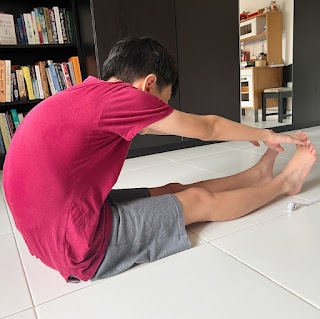
Static stretching is prescribed to help static flexibility. Some readers will recall doing the sit-and-reach test in the NAPFA test in our schools. This is done sitting on the floor with legs out straight and they measure how far beyond your heels you can reach. Best way to improve static flexibility? To do more static stretching. You can go to the end of your available range and hold that for say, 10 seconds and repeat.

If you read that article (Nuzzo, 2020), having good flexibility will not help you live longer. It does not help prevent falls. 

Good static flexibility also does not help prevent injuries. This topic has been the studied widely, a few studies have found that there are some benefits, while a few other studies have found that being too flexible is associated with injury. Most do not seem to make much difference.

Static flexibility is not associated with non sports related problems like low back pain.

Most importantly for the readers of this blog, having better static flexibility does not improve your sporting performance. Unless your sport requires a certain range like in gymnastics or if you are trying to become a ballerina. Donaben, our champion cyclist will tell you that time trialling on a bike will require some flexibility to hold that aerodynamic tuck and still pedal with power. The rest of us? Probably not.

If you are a runner, you are unlikely to get injured if you cannot touch your toes. A study found that amongst elite runners (with an average VO2 max of 73 mL/kg/min), the runners who were the least flexible (in the sit-and-reach test) were the most economical runners (better running economy). This suggests that being less flexible is better as this allows your legs to store and return energy (like a coiled spring) with each running stride (Jones, 2002)

So take note that static flexibility is not that important, unless your specific sport requires it. Stretching before, during or after a workout does not prevent subsequent muscle soreness. It does not reduce inury risk either (Herbert et al, 2011).

So what do you do to warm up before your exercise if you do not stretch? The goal of warming up is to physically warm your muscles to make them more pliable as well as get your heart rate up to be ready to deliver oxygen to your working muscles. 

Before my run, I'll ride a stationary bike for 10 minutes or just run the first kilometer real slow before picking up the pace. If you're playing badminton or tennis, I'll suggest some lunges, side to side movements, i.e. sport specific movements that you may use while playing.

Want to improve your range of motion? Try strength training instead.


References

Jones AM (2002). Running Economy Is NegativelyRelated To Sit-and-reach Test Performance In International-standard Distamce Runners. Int J Sp Med. 23(1): 40-43. DOI: 10.1055/s-2002-19271

Nuzzo JL (2020). The Case For Retiring Flexibility As A Major Component Of Physical Fitness. Sports Med. 50(5): 853-870. DOI: 10.1007/s40279-019-01248-w

Herbert RD, Noronha MD and Kamoer SJ (2011). Stretching To Prevent Or Reduce Muscle Soreness After Exercise. Cochrane Reviews. DOI: 10.1002/14651858.CD004577.pub3

Sunday, June 20, 2021

Are S&C Coaches Or Physiotherapists The Real Exercise Professionals?


This week's post is on an article I read in the blog from the British Journal of Sports Medicine where the author asked whether physiotherapists or strength and conditioning (S&C) coaches are the real pros when it comes to prescribing rehabilitation exercises and getting patients/ athletes to return to sport (RTS).

The author compared physiotherapists and strength and conditioning (S&C) coaches working with athletic populations (in the UK). His view was that the physiotherapist has always been the decision maker or 'top dog' when it comes to managing the injured athlete or any patient that needed exercise to rehabilitate or improve physical function. 

He feels that the physiotherapy profession has not kept up to date with professional developments in exercise science and S&C, even falling behind and out of step in some aspects. This is despite the fact that there has been an increase in demand by physiotherapists in the UK for weekend courses in S&C training to fill in gaps in expertise and knowledge. 

The author thinks these short 2 day courses is "really an insult to those S&C professionals that have devoted time, effort and financial resources to their expertise" as they have studied exercise science, S&C at undergraduate level and gone on to postgraduate study and even advanced professional accreditation to work.

He also feels that the undergraduate training program for physiotherapists in the UK does not provide enough basic grounding in exercise prescription and training science despite claims by the physiotherapy profession that they have a firm grounding in basic clinical sciences so they can circumvent the need for extensive training in S&C.

This has then led to a deficit in rehabilitating athletic populations such that it even slows an athlete's full RTS. The athlete is usually handed to the S&C team or left to their own devices. He concludes that rehabilitation of recreational and professional athletes must be recognized as an advanced practiced skill requiring specialist training. If these gaps/ deficits in both under and post graduate training are not addressed, then physiotherapists will be relegated to technicians in the restoration of the patient/ athlete.

My thoughts? I used to work at the *Singapore Sports Council in the Sports Medicine department (the current Singapore Institute of Sport). The doctors, physiotherapists, S&C coaches and other sports science staff (nutrition, biomechanics, psychology) all have degrees and/ or postgraduate qualifications and definitely had a good working relationship. We had a weekly case discussion where the athletes who were not progressing well after injury were brought up and analyzed.

Other than that sort of setting and perhaps in the Singapore Sports School and Football Association of Singapore, I think that physiotherapists in  hospitals and private practices that treat sporting populations may differ in their ability to enable these patients to RTS. It boils down to the interest and exposure of each physiotherapist. Whether they had any previous sports/ athletic background, how interested they are in sports, and most importantly, their tenacity to want to better themselves. 

There will be S&C coaches, sports and functional trainers, CrossFit coaches and personal trainers who, with their interests and commitment to improve themselves, will be superior to some physiotherapists with regard to rehabilitation and returning patients to sport. Likewise, there will be physiotherapists who can more than hold their own. 

It is, ultimately, up to each individual in their respective line of work to keep themselves up to date, to keep improving to help athletes recover better and faster. And also to recognize when they aren't the best person to return an athlete to sport and refer them out to someone who is.

Here's another sugggestion for physiotherapists not working in those sort of sports settings. If, most if not all undergraduate physiotherapy courses does not provide enough basic grounding in exercise prescription (like the author writes), then perhaps we, as physiotherapists should be doing what we are trained best at. To use our hands! All the manual assessing, mobilizations, manipulations etc, that other heatlhcare professionals can't do. Why are we not doing more of what we are best trained for?

Instead of giving patients exercises to do during treatment sessions, physiotherapists should be doing things that the patients cannot do themselves. Now, the robots or other healthcare professionals cannot replace that type of physiotherapist.

Reference

Blog article from British Journal of Sports Medicine, published on May 2, 2021.

* Thanks to my former colleagues and former S&C coaches Todd Vladich and James Wong (also multiple SEA Games gold medalist and discus throw record holder), whom guided my S&C program when I was still competing. James, a few other colleagues and I used to train at the old KATC gym at the old National Stadium 3 mornings a week at 7:30 am before we started work when we were not traveling or competing. We did this year round, especially in the off season. Those sessions and attending a Level 1 Australian Weightlifting Federation course while working there definitely made me competent at getting patients to return to sport quickly and most importantly, safely.

Thursday, January 22, 2015

Core Work On Stable Or Unstable Surfaces?

Taken by my wife for a talk she did way back in 2005!
Many of my patients engage personal trainers to help them with their workouts regularly. Out of curiosity, I always ask them to tell me what sort of exercise routine they go through with their trainers. Turns out that "core strength workouts" are a very popular choice amongst personal trainers.

Well, here's a post on whether your "core strength" workout is giving you the workout you want.

A group of researchers studied a group of subjects doing core strength workouts. At the start of the study, the subjects performed fitness tests including tests for core muscular endurance, flexibility, balance and a 20 metre sprint.

The subjects trained twice a week for six weeks. Each session was a 30 minute circuit session rotating among three exercises : cross curl-ups, side bridging and bird dogs. One group did the session on a stable surface while group did the same exercises on unstable surfaces.

For example while doing bird dogs (starting on hands and knees and reaching alternate limbs horizontally), a basketball was placed under the supporting hand. As the study progressed, this group added additional elements of instability to each exercise. Example : putting a squishy ball/ balance cushion under the supporting knee and lifting the foot of supporting knee off the floor.

After six weeks, both groups improved significantly.Despite what the researchers thought would be the case, the group who did their exercises on unstable surfaces did not outperform the stable group.

The researchers reported that core strength training is feasible and safe and it produces marked increases in strength, flexibility and skill related components such as balance, coordination and speed.

They concluded that if the goal is to enhance physical fitness, core strength workouts on unstable surfaces has no advantage over the same exercises on stable surfaces.

Reference

Granacher U, Schellbach J et al (2014). Effects Of Core Strength Training Using Stable Versus Unstable Surfaces On Physical Fitness In Adolescents: A Randomized Controlled Trial. BMC Sports Sci Med Rehab. 6(1): 40. doi: 10.1186/2052-1847-6-40. eCollection 2014.

Another look - 10 years ago....