Friday, January 1, 2021

Health Trends For 2021

Straits Times 1/1/21

Great suggestion in today's Straits Times article on the back page (B16, under Sports section) where the author suggested having more local running events for women.

I say not just more races for women only, but men and those under 21 too. In a year where most if not all running races were cancelled, runners are starved for social interaction and a chance to clock a personal best time for some or be quick enough for that elusive Boston qualifying (or BQ) time.

Perhaps with the rollout of the vaccines making exercising in enclosed spaces safe again, people may still want to go back to gyms, yoga studios and fitness centers etc.

I'm hope I'm wrong for the sake of those businesses, but I think gyms, yoga, Pilates studios may not be totally out of the woods yet. Bike shops, cheap dumbbells and other home exercise equipment will definitely continue to be in hot demand. Since March 2020, where most the world started lockdowns, too many people have learnt how simple, cheap and safe training at home is. 

I'm predicting that running, cycling, long walks and roller blading will continue to be popular in this new year. Let's all recognize the benefits of our local parks, bike lanes, park connectors and green spaces. All these spaces definitely impact our health.

A lot of us started baking, cooking and even growing our own food since the lockdown. All are healthy trends and may we continue to do that.

Let's continue to support our own local communities, the smaller shops and restaurants as they battle to carry on. We bought all our Christmas and birthday gifts from Everyday Vegan Grocer and Le Matin.

Here's wishing all of you a safe, healthy and wonderful year ahead.

Thursday, December 24, 2020

Not On The Surgeon's Birthday

Picture from Pinterest

It's Christmas Eve and I've just finished my day at the clinic when I happened to see this article.

The authors of this study analyzed 9,800,876 surgical procedures performed by 47,489 surgeons over four years. The surgeries were all emergency procedures to prevent selection bias (patients choosing their preferred surgeons and surgeons choosing patients based on illness severity).

Four common heart surgeries, hip, thigh fractures, lung resection, appendectomy, amputation of lower extremity were among the 17 surgeries performed by these surgeons.

0.2% (2064 surgeries) were performed by the surgeons on their birthdays. These surgeons who worked on their birthdays were on average older and more likely to be men. 

Here's the shocking news. Patients had a higher chance of dying (7%) within 30 days after surgery while operated by a surgeon on the surgeon's birthday compared to other days (5.6%).

This was after adjusting for patient characteristics and surgeon fixed effects (i.e. comparing outcomes of patients treated by the same surgeon on different days).

The authors suggest that surgeons may be distracted by other life events unrelated to work when they operated on their birthdays!

Perhaps from 2021 onwards we too should give our staff the day off on their birthdays so that they will not be distracted.

Here's hoping this post finds you resting and/ or enjoying time with your loved ones after one long, unprecedented year. Merry Christmas and happy holidays from all of us at Physio Solutions ad Sports Solutions.


Reference

Kato H, Gena AB et al (2020). Patient Mortality After Surgery On The Surgeon's Birthday. BMJ: 371: m4381. DOI : 10.1136/bmj.m4381.

Friday, December 18, 2020

Patient Waited 5 Hours For Appointment


Has this happened to you before? The patient above, mentioned that there was a waiting time of about three and five hours respectively during the last two visits to see the eye doctor.

I've had many of my friends and family tell me about the same thing happening to them. Attending a medical appointment would often take up a whole day. 

On a personal note, I remember having to accompany my mother for a doctor's visit and we had to wait for over two hours as well. Such a waste of time.

At our clinics, we promise you will never have to wait more than five minutes. We will try our utmost to see you on time. We never ever book two patients or more for the same slot. 

You will not be attended by a therapy assistant if you're seeing the physiotherapist. We do not employ any therapy assistants in our clinics. If you're seeing us for an hour, you will have our undivided attention. We will not put you on a machine and attend to another patient. 

The first session with us is longer as we take the time to ask questions and assess you thoroughly to find the cause of your problem. We treat the cause of the problem and not just treat your pain. If you get better after one session, we will not ask you to come for another session.  

Rest assured, you would never have to put aside a day to see us for physiotherapy. We respect your time.

Sunday, December 13, 2020

Be Patient So You Don't Become A Patient


Maybe the best thing to do now is nothing. To not change anything. My friend, whom I shall not name is always drawn to bright, new and shiny things. He is always after the latest fads. Especially when it comes to health and fitness.

Consider his diet. He is always following the latest 'flavour of the month'. Whether it's low carb, high fat, Atkins, South Beach, intermittent fasting etc, he's tried them all. I often tell him that his quickness in switching diets (due to not seeing results quickly enough) is probably detrimental to him losing weight.

I quoted him a study done by researchers comparing low fat and low carb diets. Participants were randomly tracked for a year. Those who lost the most weight were those who adhered to that diet. Being on either diet didn't matter as much. Slow and steady wins all the time in the long haul.

I would say this is exactly the same for fitness too. A paper published in the British Journal of Sports Medicine found that the best way to avoid getting injured is to slowly increase your training volume over time. Excessive and rapid increases in training loads are responsible for a large proportion of non-contact soft tissue injuries.

I travelled extensively with our Singapore badminton players and went to two Olympic Games with Team Singapore. The players had training camps and competitions all over the world and I've had the privilege of seeing world class badminton players like Lin Dan, Lee Chong Wei, Taufik Hidayat, Peter Gade and Singapore's own Ronald Susilo  train. (Below is a picture of him beating Lin Dan at the Athens Olympics).

I'm more excited than Ronald!
They all employ different strategies to build fitness and hone their court skills. Different coaches have different coaching styles. But all lead to the same objective, to be able on put the shuttlecock where they want to on court, be it with a smash or drop shot to win the point. To win the badminton match.

Sitting on court in Beijing 2008
And the key to success is that the players stick to the plan. There are many roads leading to Rome, and they get there only if they stick to their path.

If the training you did this week was twice as much as what you average over the past four weeks, you're 5 to 10 times more prone to getting injured compared to 10 percent increases in training volume and intensity.

This is especially true when my patients are returning from injury. I always tell them to err on the side of caution. Doing too much too soon may get them injured again. Our bodies need time to adapt to training loads after injury.

So as this strange, unprecedented year draws to a close, hang in there if your diet or fitness routine hasn't gone exactly to plan. Be patient, keep at it, remember it's slow and steady that always wins in the end. Patience is really a virtue.


References

Gabbett TJ (2016). The Training - Injury Prevention Paradox: Should Athletes Be Training Smarter And Harder? BJSM. 50(5): 273-280. DOI: 10.1136/bjsports-2015-095788.

Gardner CD, Trepanowski JF et al (2018). Effect Of Low-fat Vs Low-carbohydrate Diet On 12-month Weight Loss In Overweight Adults And the Association With Genotype Pattern Or Insulin Secretion. JAMA. 319(7): 667-679. DOI: 10.1001/jama.2018.0245.

Sunday, December 6, 2020

Patient Says She Has Sciatica

Check out her hip range
Recently, a patient came in to see me with pain down her buttocks and leg saying that she has "sciatica". The lower levels of the lumbar spine are notorious for referring pain down to the buttocks and the outside and/ or back of the leg. This is commonly known as 'sciatica' since that is the path of the sciatic nerve, the largest nerve in our bodies. 

Typically sciatica usually affects only one side of the body. She thought she must have hurt her back recently before this buttock pain started. I checked her lower back and it was fine.

Distribution of Sciatic nerve
However, I hit the jackpot when I checked her hip. It reproduced all her 'sciatica' symptoms she was complaining of. 
Femoral and Obturator nerves
How did I know to check her hip? The hip joint is also known to refer pain to the groin and to the front of the thigh, more commonly in the groin due to its nerve supply from the obturator, femoral and sciatic nerves. This is from previous anatomical studies and analysis of pain patterns in patients waiting for hip replacements.

I recall reading an article where researchers did a fluoroscopic guided injection to map out pain referral patterns from the hip. A fluoroscopic injection allows exact locations in the body to be located (under x-ray imaging). Fluoroscopy injections can be used to alleviate pain or in this study's case to identify the origin of pain.  

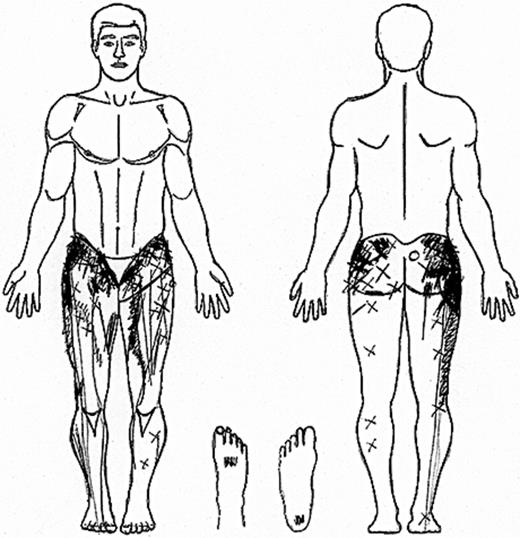
The researchers had 51 patients (28 female, 23 male) for their study. These patients had hip pathology as evidenced by x-ray or MRI. Pre injection, these patients marked out on a body chart where their pain was (see picture below).

Pain referred from the hip 
The patients were then given a fluoroscopically guided intra-articular (FGIA) injection. There was only local anesthesia and no oral or intravenous sedation for the patients to avoid confounding of results. Only when their pain was reduced by 90% before the FGIA injection was deemed effective. 

Long needle to reach the hip
The researchers found that referred pain to the buttock was the most common (71%). Traditionally accepted referral to the thigh (57%) and groin (55%) were less common. 22% of patients had referred pain to the legs (below the knee).

The referred pain areas in this study (from the hip joint) were similar to previously reported pain patterns observed from the lumbar spine and sacro iliac joints.

This is a very useful study for knowing referral patterns of the hip joint. When a patient complains of pain in their buttocks, groin, thigh or even in the foot, one must not rule out the hip. It is important to note that there is no lumbar spine referral in this study.

Note to self (and other physiotherapists reading this), not all radiating leg pain is 'sciatica'.

Reference

Lesher JM, Dreyfuss P, Hager N et al (2008). Hip Joint Pain Referral Patterns: A Descriptive Study. Pain Med. 9(1): 22-25. DOI: 10.1111/j.1526-4637.2006.00153.x

Sunday, November 29, 2020

Arch Supports And Iliotibial Band (ITB) Pain


A patient came in this week after being diagnosed with Iliotibial band (ITB) syndrome. The outer part of his right knee would hurt badly after running about 1.5 km. After stopping to walk, he would be able to run for a few minutes before having to stop again. 

He had been running 4-5x each week, clocking about 50 km weekly. He had just seen a sports doctor who first referred him to a podiatrist to get orthotics as he 'pronated' badly.

After getting his orthotics, he 'pronated' less according to the prodiatrist who filmed him while running on a treadmill. But, alas, his ITB/ knee pain didn't change. Since I'd treated a fellow runner he knew, he came to see me, hoping I could help him run pain free.

The ITB starts from the TFL
I've written previously about the ITB and you can read more about it here (anatomy) and here. If you look at the picture above, you can see it starts from Tensor Fascia Lata (TFL) muscle and runs down the outer thigh before finishing just at the outer part of the knee (picture below). This is usually where runners experience a sharp pain.

Also know as iliotibial tract (bottom R of pic)
Studies show that when the hip rotates medially or drop inwards, a strain is placed on the ITB . This also causes the tibia (or shin bone) to rotate inwards causing the foot to pronate (or ankle eversion). 

Researchers have attempted to correct this by changing ankle pronation to see if this might relieve the strain on the ITB.

In this published paper, 30 runners (15 males, 15 females) with no ITB insertion pain were prescribed orthotic wedges to put into their own running shoes. The wedges were 7 degrees lateral, 3 degrees lateral, no wedges, 7 degrees medial and 3 degrees medial. A total of five running trials were done.

The runners were analyzed by video motion analysis while running at their self selected running pace to calculate motion forces and ITB strain.

The orthotic wedges significantly changed ankle eversion (or pronation) angles compared to no wedges. However, the strain rates did not differ between conditions. There was no change in knee joint angles and tibial rotation under all orthotic wedge conditions. 

The researchers concluded that orthotic wedges may not change forces acting on the ITB, even though they altered foot pronation while female runners had greater strain forces acting on their ITB's potentially due to increased internal hip rotation.

It is interesting to note that the female runners demonstrated significantly greater peak ITB strain and strain rates compared to the male runners, potentially due to increased hip internal rotation (because of wider hips and pelvises for child bearing purposes). I have written at length before that for female runners, their knee pain is coming from their hips. Always treat the cause of the problem. Do not treat the pain alone.

Take home message is that even though orthotic wedges can correct your foot's pronation, it may not alter forces acting on your ITB. This means that your knee pain may not get better using orthotic wedges.

Of course any one reading this may say that these off the shelf orthotic wedges are not customized and that the subjects were all wearing different running shoes. Personally I feel that the different shoes are not an issue as these orthotic wedges used in the study did significantly change ankle pronation so they did what they were supposed to do. 

Would this then be fair to say that using orthotics to change ankle pronation or eversion angles does not seem to benefit those with ITB pain at the knee? Perhaps any podiatrists reading this would like to comment.

Reference

Day EM and Gillette JC (2019). Acute Effects Of Wedge Orthoses And Sex On Illotibial Band Strain During Overground Running In Nonfatiguing Conditions. JOSPT. 49(10): 743-750/ DOI: 10.2519/jospt.2019.8837

ITB attachments at the knee

Saturday, November 21, 2020

Abnormal Knee MRI, But No Pain

Knee MRI by Becky Stern from Flickr
Here's a piece of surprising news for everyone. In this recently published paper I read, nearly all patients who had abnormalities on their knee 
MRI were asymptomatic, meaning no pain despite having an "abnormal" MRI.

The main inclusion criteria for this study were sedentary adults. They did not do at least 30 minutes of moderate intensity physical activity 5 days a week or 20 minutes of more intense activities 3 days a week. They did not have any knee pain, no current or previous history of knee injury and surgery.

The authors reviewed 230 knees of 115 uninjured inactive adults (51 males and 64 females). Median age was 44 years (range was 25-73 years) and all the subjects had bilateral MRI's (3.0 Tesla, high resolution) done.

Here's what they found. Brace yourself as you read on. MRI showed abnormalities in a whopping 97% of knees. 30% of knees showed tears in the meniscus. Horizontal tears were most common, while bucket handle tears least common.

Articular cartilage (57%) and bone marrow abnormalities (48%) were common in the patellofemoral (knee) joint. Moderate (19%) intensity articular cartilage lesions and severe (31%) were observed.

Grade 4 means bone rubbing on bone

Articular cartilage injuries is my area of interest since I did my postgraduate research in that area. It is interesting to note that a quarter (or 25%) of the subjects had Grade 4 changes (see picture above) visible on MRI but did not complain of pain. Perhaps this is important to remember when imaging the knee since there seems to be more visible findings here compared to the rest of the knee (articular cartilage wise).

Moderate intensity lesions were found in 21% of knee tendons while there were high grade tendonitis found in 6% of knees reviewed. The patella and quadriceps tendons being the most affected.

3% partial ligament ruptures were found, of which 2% were of the Anterior Cruciate Ligament (ACL).

The authors concluded that nearly all knees of asymptomatic adults they studied show abnormalities in at least one knee structure on MRI. Meniscal tears, articular cartilage and bone marrow lesions in the patellofemoral joint were the most common pathological findings. 

They also reported finding bucket handle and complex meniscal tears (both of which commonly operated on) in asymptomatic knees. This interesting to note as bucket handle tears (as well as complex tears) would often cause 'locking' in the knee and therefore require surgery.

There you have it, the subjects were sedentary adults who did no exercise so no one can say that it was running or exercise that "wore out" their joints. And some these very same adults had "terrible" or abnormal MRI's, but were asymptomatic or did not have any pain.

So don't fret if your MRI is abnormal. You may not need any surgical intervention, especially if you do not have any pain or if that pain is easily treated.

Maybe these abnormalities should be just described as "wrinkles" on the inside. 


Reference

Horga LM, Hirschman AC, Henckel J et al (2020). Prevalence Of Abnormal Findings In 230 Knees Of Asymptomatic Adults Using 3.0 T MRI. Skele Radiol 49: 1099-1107. DOI: 10.1007/s00256-020-03394-z