Showing posts with label PFP. Show all posts

Sunday, December 14, 2025

Running Injuries Recovery Time Lines

Picture from Interplay
I feel that we live in an instantaneous society now where you snap your fingers and you want things done. Fast food, fast internet and fast access to pretty much everything. 

I have many patients who are new to running and want to be a great runner, fast. Many runners expect to improve their times with short periods of training and end up doing too much too soon.

Then there are those who are injured and try to accelerate rehabilitation and recovery beyond normal time lines. I would like to caution that effective recovery will take time and cannot be rushed or forced. 

The 2 times that I fractured my spine, I too hoped to heal faster. However, I cannot accelerate healing and rehabilitation beyond what biology will allow. I can only optimize it.

Back to running injuries. I looked at a study that studied average recovery times for common running injuries. When you look at the study the numbers may surprise you and many of the healthcare professionals that read this.

140 runners out of 839 sustained a running injury in this 24 week study (Mulvad et al, 2018). Runners in the study reported levels of pain in different body parts on a weekly basis. The injured runners attended a physical examination by a physiotherapist who provided a diagnosis. Examples are medial tibial stress syndrome (MTSS or shin splints), Achilles tendinopathy (AT), patellofemoral pain (PFP), Iliotibial band syndrome (ITBS) and plantar fascia pain (PF).

The median time to recovery for ALL types of injuries was 56 days. Yes, you read correctly. Actually let me show you the average recovery times the study found.

Plantar fascia - 35 days
Calf injury - 49 days
PFP - 49 days
AT - 56 days
ITB - 56 days
Gluteus medius tendinopathy - 56 days
Shin splints - 70 days
Hamstring - 74 days
Medial meniscus - 89 days

Surprised or shocked? You should know that effective recovery takes time. Tendons, cartilage, muscle  and especially bone will nor respond to any "magic recovery hacks" or when you try do more. They will respond to patience and appropriate loading

When you try to rush your rehab, it usually does not shorten the time line. It will increase the risk of flare ups, setbacks and recurrence.

Now please take note that good and correct rehab is not slow, just appropriately paced. Not everyone will take the same time to recover like those quoted in the study. Recovery is not passive, you can still train. Can't run, stationary cycling should be fine. The healthcare professional treating you should be able to give you alternatives, otherwise you should find another. It is definitely not one size fits all. 

The devil is always in the details. Only 140 out of 839 runners got injured. "Recovery" was self reported by the runners based on return to running without symptoms not performance goals.

The study did not review load management, rehab quality or whether the injuries presented early or late. Neither was training age, sleep, stress levels, nutrition nor psychology taken into account.

The goal is to work within and with the time line, not to beat it. You want the recovery to be boring but steady.

Do not believe anyone who tells you they can give you a short cut.

Reference

Mulvad B, Nielsen RO, Lind M et al (2018). Diagnoses And Time To Recovery Among Injured Recreational Runners In The RUN CLEVER Trial. PLoS One. 13(10): e0204742. DOI: 10.1371/journal.pone.0204742

Sunday, August 28, 2022

It's The Hip Not The Knee

My patient came with anterior (or front) knee pain yesterday. She had been to see another physiotherapist who said she needed to strengthen her quadriceps muscle. Who says physios can't prescribe exercises compared to strength and conditioning coaches

Pardon the link - it seems that almost every single patient that comes to our clinic (after seeing another physiotherapist) had been given exercises to do during the treatment session itself. Maybe that's why the general public thinks all a physiotherapist does is teach exercises.

In our clinics, we may give an exercise or two to our patients near the end of the session, for them to do at home. However, we do not make our patients do any exercises DURING the treatment session. We treat them, mostly using our hands. We do treatment that the patients cannot do themselves, while they are in the clinic. 

Anyway back to my patient with knee pain who was asked to strengthen her quads. I've written a few times since 2009 that treating (or strengthening the hip) is much more important than strengthening the knee (quadriceps). Well, here is further proof.

In this systematic review referenced below, researchers studied data from 14 suitable studies (out of 119) that were found between 1994 and September 2019. Results from all 14 studies demonstrated that strengthening the hip 2-4 times a week (for 3-8 weeks) effectively relieved pain and improved knee function compared to quadriceps stengthening and no exercise. This lasted for up to 12 months post intervention.

The researchers recommended that hip muscle strengthening be a standard clinical practice while treating patients with anterior knee pain. So if the physiotherapist that you're seeing gets you to do quadriceps strengthening for your anterior knee pain, you need to tell them that hip strengthening is superior to quadriceps exercise. Please note that hip strengthening does not mean clam shell exercises.

Please also note that this present review included  randomized clinical trials that also got their subjects to do both hip plus quadriceps strengthening exercises over just the quadriceps alone. All except one study showed that hip and quadriceps strengthening exercises over just quadriceps alone. There were no no hip plus quadriceps strengthening versus hip exercises alone study done.

Perhaps a combination of hip-quadriceps strengthening may be a more effective strategy in the treatment of anterior knee pain? We can certainly try that in our clinic before more studies are done. It would depend on what we find to be weak at your objective examination ;)


Reference

Alammari A, Spence N, Narayan A et al (2022). Effect Of Hip Abductors And Lateral Rotators' Muscle Strengthening On Pain And Functional Outcome In Adult Patients With Patellofemoral Pain : A Systematic Review And Meta-analysis. J baxk Muscl Rehab. Pre-press. pp 1-26. DOI: 10.3233/BMR-220.

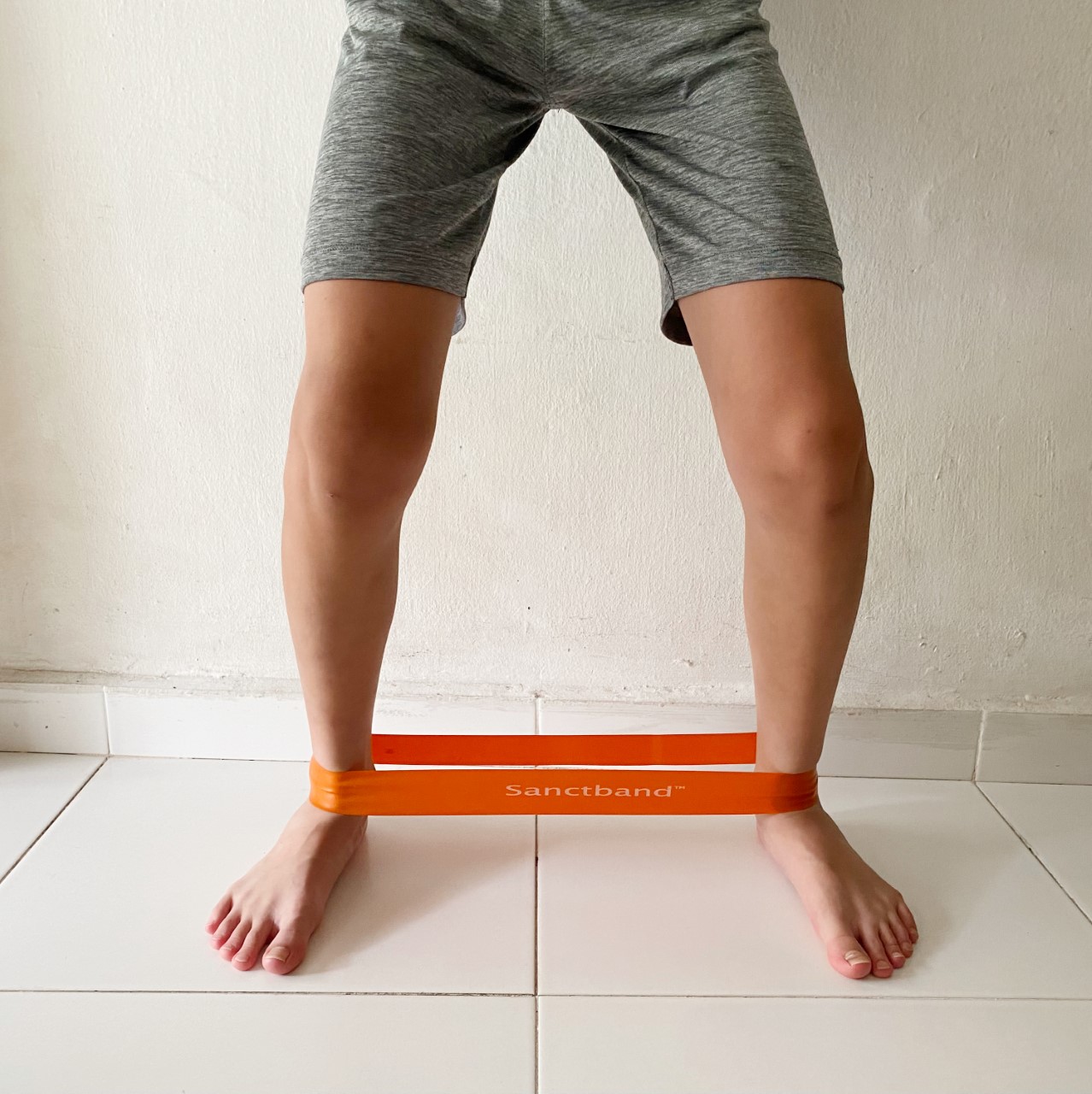
** For those of you wondering, there were no standardized protocol for hip and knee exercises in the various studies. The common hip exercise protocol included hip abduction against an elastic band while standing and with weights in a side-lying position coupled with hip lateral rotation against an elastic band while seated and hip extension (3 sets of 10 repetitions). 

Conversely, quadriceps strenthening in all studies generally involved weight bearing and non weight bearing exercises such as closed kinetic chain exercises, seated knee extension, leg press, squatting and stretching of hamstrings and quadriceps (3 sets of 10 repetitions). 

Tuesday, January 1, 2013

Knee Pain In Female Runners


More evidence that your knee pain (especially in female runners) is a result of weakness in your hip/ gluteus (or buttock) muscles in a recently published paper (Wilson et al, 2012). Also have a look here.

In the paper, the researchers studied twenty male and twenty female healthy runners. The runners all ran regularly and had 5-6 years of running under their belts. The female runners were found to have 40 percent greater peak gluteus maximus (or buttock) muscle activation and 53 percent higher average gluteus activation compared to the male runners.

The researchers concluded that with the greater gluteus activation, fatigue will set in faster (in the glutes) such that it alters the lower extremity running biomechanics (greater hip adduction and less knee internal rotation) leading to knee pain.

Come see us at Physio Solutions or Sports Solutions, we'll help you run without knee pain.

Reference

Wilson JD, Petrowitz I et al (2012). Male and Female Gluteal Activity and Lower Extremity Kinematics during Running. Clinical Biomechanics. 27(10): 1052-1057.

* Picture from Flickr.com