Sunday, November 6, 2022

Only Some Runners Ran Faster Using Carbon Plated Shoes

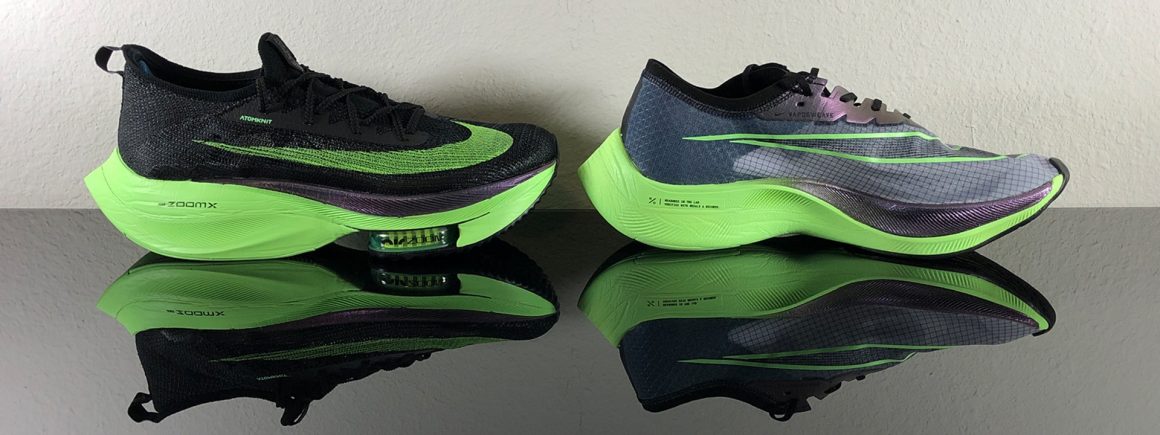
Alphafly (L) and Vaporfly from weartesters.com
Ever since Kipchoge ran a sub-2 hour marathon in the carbon plated Nike Alphafly in 2019, every single of my patients who participate in running races want to race in a pair too. Back then, those super shoes were really hard to get a hold of, for almost a year. If you did get your hands on a pair, they cost a bomb too.

Now that these super shoes are more easily available (since many other brands other than Nike also make carbon plated shoes), is it worth splurging on them? Especially if you're trying to clock a personal best timing in your next race.

How does the original Nike super shoe (the Vaporfly) work? There are 2 novel components to this question. First, the super thick cushioned midsole Nike calls ZoomX. This new foam is super light, 31 millimeters high at the heel, which is 50 percent thicker than comparable shoes without being heavier. You can squish it and it springs back to shape quickly. This means it returns all the energy you applied to squish it. 

Next is the curved carbon fiber plate inside the midsole (pictured above). It is thought that the carbon fiber plate(s) acts like a spring, bending as your foot lands and then catapulting you forward as it springs back into position. This helps running economy (reduces energy expenditure) so you can run faster.

Ever since Nike launched their Vaporfly in 2017, which has since been updated a few times, there have been calls and debates to have the shoe disallowed in competition. Opposers have labelled the shoe as technical 'doping'. When subsequent studies showed that these Nike shoes gave up to a 4 percent advantage (Barnes and Kilding, 2019), other runners were obviously upset

Especially after two Nike sponsored runners in the United States used the prototype version at the 2016 Olympic trials (women's 1st and 3rd places) and qualified for the Olympics.

Shalaya Kipp felt that the prototype Vaporfly's kept her training partner, Kara Goucher (4th place), off the Olympic team after signing up with Skechers. She left Nike in 2014 beacause of the infamous Alberto Salazar "Oregon project". Had Goucher stayed with Nike, she may have qualified for her third Olympics in 2016. At the actual 2016 Olympics, the top 3 male finishers all wore the same Nike prototype shoe.

In fact Nike scored a major coup when they offered all other runners who qualified in the 2020 USA marathon Olympic trials a pair of the Alphafly's to level the playing field.

Before you buy a pair of carbon plated shoes, consider the following study. It was published just last month looking at 96 runners using 2 different prototypes of carbon plated  shoes. The shoes differed only by the forefoot bending stiffness. The runners were first assessed for their VO2 max and maximum aerobic speed. Running economy and stride kinematics were also recorded during the trials. 

The researchers did not find any significant difference in running economy between the 2 different shoe stiffness for the group as a whole. Some runners' running economy improved when the carbon fiber plate was stiffer while in other runners, their running economy deteriorated. To be more specific, the faster runners took advantage of the increased stiffness (carbon fiber plates) while the slower runners did not.

The authors emphasized the importance of individual response to using carbon fiber plates to enhance running performance is runner specific. 

For now, the carbon plates remain street legal for us mortal runners in competition. If you do get them, remember to break them in with a few runs instead of just saving them for race day. The midsole thickness definitely makes your foot more unstable especially when going around sharp corners or while making a u-turn in an out and back route.


References

BarnesKR and Kilding AE(2019). A Randomized Crossover Study Investigating The Running Economy Of Highly-Trained Male And Female Distance Runners In Marathon Racing Shoes Versus Track Spikes. Sports Med. 49(2): 331-342. DOI: 10.1007/s40279-018-1012-3.

Beck ON, Golyski PR and Sawiki GS (2020). Adder Carbon Fiber To Shoe Soles May Not Improve Running Economy: A Muscle-level Explanation. Sci Rep. 10: 17154. DOI: 10.1038/s41598-020-74097-7

Chollet M, Michlet S, Horvais N et al (2022). Individual Physiological Responses To Changes In Shoe Bending Stiffness: A Cluster Analysis Study On 96 Runners. Eur J Appl Physiol. DOI: 10.1007/s00421-022-05060-9

Sunday, October 30, 2022

Is It Really Your Piriformis?

A patient came in to our clinic this week complaining of deep buttock pain and sciatica - pain along the path of the sciatic nerve, the largest nerve in our bodies.
The sciatic nerve starts from the lower back through the hips and buttock down the back of our leg. See picture above.

The sciatic nerve usually travels from within the hip to the deep gluteal space (buttocks) via the greater sciatic notch. It's pathway is most commonly beneath the piriformis muscle (90 percent). Sometimes it goes through the piriformis muscle (7 percent). See picture below.

Right Piriformis muscle and the sciatic nerve

Because of this, the pirifomis muscle is often blamed to be the cause of the pain, which is known as piriformis syndrome.
The nerve then travels over the obturator internus muscle and gemellus superior, inferior muscles (gemellei) to exit that area. Picture above.

The sciatic nerve can get encroached or irritated by the piriformis and adjacent structures in that deep gluteal space which may result in pain at the area of irritation or along the path of the sciatic nerve - this is true sciatica pain.

After assessing my patient, there was no pain nor tenderness in her piriformis. Instead, her obturator internus reproduced her buttock pain. 

Coincidently, I was fortunate to have read a recently published article exploring the relationship of the sciatic nerve and the deep hip external rotator muscles in the deep gluteal space (Balius et al 2022).

The authors recruited 58 healthy volunteers, 30 males and 28 females with an average age of 20.4 years plus or minus 7 years using real time ultrasound to quantify nerve action.

The sciatic nerve was found to be compressed (and moved forward and laterally) during passive hip internal rotation and isometric external rotation contraction (obturator internus and gemelli muscles working). Not the piriformis muscle, which the authors wrote were often over diagnosed.

During passive hip external rotation and isometric contraction of internal hip rotators, the sciatic nerve moved back into place and medially.

The obturator internal-gemellus syndrome may be a more accurate term than piriformis syndrome for my patient. 

Interestingly, the same lead author, Balius and colleagues, published an earlier article in 2018 where they studied 6 fresh cadavers and 31 healthy volunteers. This study revealed the presence of connective tissue (or fascia) attaching the sciatic nerve to the obturator internus-gemellus tendons. The sciatic nerve was also affected similarly in the cadavers and subjects during passive hip internal rotation. 

This newer study (Balius et al, 2022) provides further evidence that stretch or contraction of the obturator internus-gemellei complex will create some compression of the sciatic nerve at this level in the deep gluteal space. Definitely worth considering for those with buttock pain and sciatica.

The next time you have buttock pain or sciatica and the health practitioner treating you tells you that you have piriformis syndrome you may suggest it's not always the piriformis ;)


Reference

Balius R, Pujol M, Perez-Cuenca D et al (2022). Sciatic Nerve Movements In the Deep Gluteal Space During Hip Rotations Manuevers. Clinical Anatomy. 35(4): 482-491. DOI: 10.1002/ca.23828

Balius R, Sussin A, Morros C et al (2018). Gamellei-obturator Complex In the Deep Gluteal Space: An Anatomic And Dynamic Study. Skeletal Radiol. 47: 763-770. DOI: 10.1007/s00256-017-2831-2


Monday, October 24, 2022

The Big Picture

I was away on holiday with my family last week and I had some time to think. Instead of a regular post, I came up with the following questions and some answers.

My main questions were, "How can I make myself better as a physiotherapist?", "How can I ensure that all the physios in my team get better?", "How can I make our clinics better for our patients?"

My thoughts were that I always have to keep up with the research that's out there, the solid ones of course. I keep my mind open to new ways of reading the human body and what is "normal". I look out for courses to upgrade my skills. These answers were just some of ones that came to mind.

I will of course be consulting with Aized and other colleagues for their thoughts of my questions. I'm curious to hear how they would answer my many questions. That's why I value my team. We see the world through different lenses, so I learn from their views too.

A very important group of people to consult too would be our patients. I want to find out what they think about their experiences at our clinics, and act upon them wherever needed.

This journey of life, of being a physiotherapist, of running our clinics is full of ups and downs. I keep my eyes on the big picture. The big picture is that each and every person who comes to our clinics feel heard, helped, understood and hopeful. That's really at the centre of all we do.

Sunday, October 16, 2022

My Patient Was Asked To Go For Functional Training

My patient said her friend told her she should attend a 'functional training' (FT) class in order to regain her strength and mobility after she broke her ankle. 

She was also told that that FT would improve her neuromuscular adaptations (increasing the efficiency the way her body moves and safety during activities related to daily living, work and sports). Other terms include high intensity functional training (HIFT) and functional fitness (FF).

I shared with her what I read regarding a review on whether FT programs are different from traditional strength, power, flexibility and endurance training programs that are already being used in the physical training of professional, recreational athletes, healthy adults and geriatric populations.

The authors focused on the FT definitions, exercises employed and the neuromuscular adaptations reported. Firstly, they found that there is no agreement on a universal definition for FT. 

FT programs hope to improve the same neuromuscular adaptations similar to traditional strength, power and endurance training programs. The exercises employed are in fact the same. 

The main confusion with these 'new' training programs is that (other than the new fancy names) they often always overlap with traditional strength, power, endurance and flexibility programs. There is also no precise definition of functional movements. Do our muscles perform any non functional functions?

Some studies have classified that FT involves resistance training while FF has been defined as a trend using strength training. So, both FT and FF can be easily described as strength training programs.

HIFT was defined as high intensity and high volume exercises with short rest intervals. This is similar to a strength, power, and endurance session elite athletes use during specific phases of training. In fact FF has also been known as HIFT. So FF is actually HIFT. Since exercise intensity is a training variable and not an exercise type, FT and HIFT is the same training program performed at different intensities.

The authors concluded that FT has no consistent and universal definition. FT programs and exercises are not different from those already used in sports training since the neuromuscular adaptations are the same. The authors concluded that FT is not different from traditional strength, power and aerobic endurance training.

In short, there is no "non-functional" or "traditional" training. There is no real need or rationale in classifying exercise training programs as FT.

The names of these new training progams may sound cool and fancy, but you now know that they are in fact similar to weight training. 

The authors also recommended that the terms FT, HIFT and FF no longer be used to describe any training program. These can be easily classified as strength, power, endurance and flexibility programs. I found that a little too harsh since they are just names to describe training programs. At least now you know.


Reference

Ide BN, Silvatti AP, Marocolo M et al (2022). IS There Any Non-functional Training? A Conceptual Review. Frontiers Sport Active Living.3: 803366. DOI: 10.3389/fspor.2021.803366.

Sunday, October 9, 2022

Thoracic Outlet Syndrome

picture from mountainhp
We had a Team Singapore cyclist who came to our clinic complaining of arm weakness, tingling sensations, pins and needles in his biceps and forearms after full on sprints. This did not happen during the sprints, but after. He also complained of neck pain and some sensations of electric currents in his neck region when he tried looking upwards.

picture from J Manip Phy Therapeutics
The doctor he saw at the Singapore Sports Institute diagnosed him with compartment syndrome in his arms. With compartment syndrome, as physical activity ceases, all symptoms should start to ease. My patient's discomfort and symptoms only started after he stopped sprinting.

Individuals with compartment syndrome will usually complain of pain, paraesthesia (or pins and needles), their limbs (usually legs) being very tight, tense and full of pressure during training or doing the offending activity. Temporary paralysis can occur sometimes. It usually happens to athletes at the start of the season, after their break when they train too hard, too soon. 

During exertion, the muscles expand and they fill up the space in the legs and "squeeze" the nerves and blood vessels there leading to sensations of tightness, pressure or pins & needles as the connective tissue that separates each section or compartment does not stretch hence leading to the term.

My patient probably has thoracic outlet syndrome (TOS) instead of compartment syndrome. TOS occurs when blood vessels or nerves in the space between the collar bone and first rib (this space is known as the thoracic outlet) are compressed causing neck, shoulder and arm pain and numbness in the arms and fingers.

There are a few types of TOS. My patient probably has the most common version known as neurological TOS, when the brachial plexus is compressed. The brachial plexus is a big network of nerves from the spinal cord and it controls muscle movements in the shoulder, arm and hand.

A common area where TOS occurs is in the interscalene triangle (formed by the brachial plexus, the subclavian artery exiting the neck area between the anterior and medial scalene muscles and the inner surface of the first rib). 

Brachial plexus
Entrapment in the interscalene triangle may be due to brachial plexus passing through the anterior scalene (especially when the anterior scalene is larger). In my patient's case, since he is a track cyclist (with bulging neck and arm muscles) who sprints in a velodrome with excessive traction forces while sprinting plus deadlifting and snatching the Olympic bar during weight training, all these factors could very well contribute to his TOS.

After a detailed questioning and physical assessment, we managed to treat his spine and and the nerves in that region. That cyclist was able to train without the accompanying pain and symptoms after.


Reference

Dahlstrom KA, and Oliver AB (2012). Descriptive Anatomy Of The Interscalene Triangle And The Costoclavicular Space And Their Relationship To Thoracic Outlet Syndrome: A Study of 60 Cadavers. J Manip Physiol Therapeutics. 35(5): 396-4001. DOI: 10.1016/jmpt.2012.04.017

Sunday, October 2, 2022

Coffee's Performance Enhancing Powers

I remember reading about how drinking coffee can help improve sporting performance in endurance races when I was 17 and competing in track and field races back then. I was not a regular coffee drinker then (nor now). I made myself a cuppa before a track race held at the NUS track (1500m) and ran a personal best!

Back then, I read that the caffeine in coffee was a stimulant and that it enhanced fat burning to give nuscles more energy. Another theory was that caffeine acts in the brain to make  physical exertion feel easier (by blocking receptors that detect adenosine, a molecule that detects fatigue). This also helps in all out bursts of strength, prolonged endurance and cognitive effects like enhanced attention and vigilance.

Fast forward to a recent study that involved cyclists who completed time ridden to exhaustion tests at a predetermined intensity. They could sustain that intensity for around 5 minutes on 9 separate occasions. They were wired up with electrodes and other equipment before and after the rides to assess brain function, circulatory system efficiency and muscle function.

The cyclists did similar rides each time. Either 5 miligrams per kilogram body weight of caffeine was ingested an hour before the ride, or a placebo was taken. In some rides, they stopped the ride prematurely at either 50 percent or 75 percent of the time achieved in the baseline test to assess mid ride neuromuscular function.

In the final ride, the riders were given caffeine but were stopped at the exact time they had given up in the previous placebo trial to get a similar comparison of the effects of riding at a given power for a given duration with or without caffeine.

Here's a summary from the fairly complex analysis by the authors. Caffeine works! The cyclists lasted 14 percent longer (5:55 min) with caffeine compared to the placebo (5:14 min). This is equivalent to a 1 percent gain if the riders did a race or time trial.

Caffeine did help the muscles delay loss of power. Those taking the placebo at the 75 percent mark of the test had lost 40 percent of muscle power compared to less than 35 percent for those who had taken caffeine. At exhaustion those taking the placebo could generate only 60 percent less force than when they were fresh. With caffeine, the loss was 45 percent at the exact same time, pace and power.

The brain (or central nervous system) sent weaker signals to get the muscles to work when the cyclists got more tired when they ingested the placebo. With caffeine, the signals never declined, even when the cyclists reached exhaustion. Their brains were still enthusiastically getting their muscles to contract.

Caffeine also kept oxygen flowing through their arteries, as measured by a pulse oximeter attached to the cyclists' right fingers. There was only a mild decrease at exhaustion compared to a steady decline seen in those who took the placebo. The authors suggested that having more oxygen available may be one of the reasons the muscles kept working better during caffeinated rides.

This study also shows that caffeine also reduced perceived effort - just like what I read when I was 17. The pace you're holding definitely seems easier.

For those of you that are keen to try caffeine, the authors suggest 3 to 6 milligrams of caffeine per kilogram of your body weight taken an hour before your event starts. Higher doses may speed up your heart rate, not what you need during your race. Regular coffee drinkers may get a slight gain if you stop drinking coffee for a week to get that boost.


Reference

Cristina-Souza G, Santos PS, Santos-Mariano AC et al (2022). Caffeine Increases Endurance Performance Via Changes In Neural And Muscular Determinants  Of Performance Fatigability. Med Sci Sports Ex. 54(9): 1591-1603. DOI: 10.1249/MSS.0000000000002944

Sunday, September 25, 2022

More Sugar More Pain?

Many patients tell me they have a high threshold for pain. Until I start to work on them. Then they change their mind (not everyone of course).

Being in the pain business (i.e. finding the cause of patients' pain and treating it), I've always been intrigued about how we tolerate pain. Some patients can definitely tolerate pain better than others.

The article referenced below (Ye et al, 2022) definitely caught my eye. The researchers investigated the effects of high blood sugar on pain sensitivity and pain inhibition (the act of stopping or slowing down pain) in healthy adults with normal and excess body fat.

The researchers found that ingesting just 75 grams of glucose (2 standard cans of soft drink) in the overweight group of subjects caused the subjects more pain when both their feet were submerged in cold water for 1 minute.

In addition, having acute hyperglycaemia (high blood sugar levels) also suppressed resting heart rate variablity (HRV) in the group with excess fat mass. *HRV is where the amount of time between your heart beats fluctates slightly.These fluctuations can indicated current or future health problems like heart conditions or anxiety and depression.

Regardless of blood sugar levels, the group with excess fat mass could not tolerate the pain from a pin prick after cold water immersion. This group also reported higher pain levels during a 5-minute period of blood flow occlusion.

In addition to the effects of high blood sugar on pain sensitivity and pain inhibition, effects on HRV and reactive hyperaemia (increase of blood flow) after arterial occlusion were also investigated. Both high blood sugar and excess body fat affected HRV and reactive hyperaemia only in people with extra fat mass.

Interpreted together, the researchers concluded that high blood sugar levels affected pain processing levels and autonomic function, especially in people with excess body fat mass. 

So, if you are overweight and consume more than 75 grams of sugar (2 standard cans of soft drinks) you will more likely feel more pain compared to someone who is not overweight.

The authors added that since both hyperglycaemia (high blood sugar levels) and being overweight are risk factors for diabetes, further research should be done on whether and how these sources of pain affects people with diabetes.


Reference

Ye D, Fairchild TJ, Vo L et al (2022). High Blood Glucose And Excess Body Fat Enhance Pain Sensitivity And Weaken Pain Inhibition In Healthy Adults: A Single-blind And Cross-over Randomised Controlled Trial. J of Pain. In Press, published 16 Sep 2022. DOI: 10.1016/j.pain.2022.09.006

*HRV responds uniquely for everyone. As a rule of thumb, values under 50 ms are unhealthy, 50-100 ms signal compromised health and readings above 100 ms are healthy.