Showing posts with label Alphafly. Show all posts

Sunday, November 6, 2022

Only Some Runners Ran Faster Using Carbon Plated Shoes

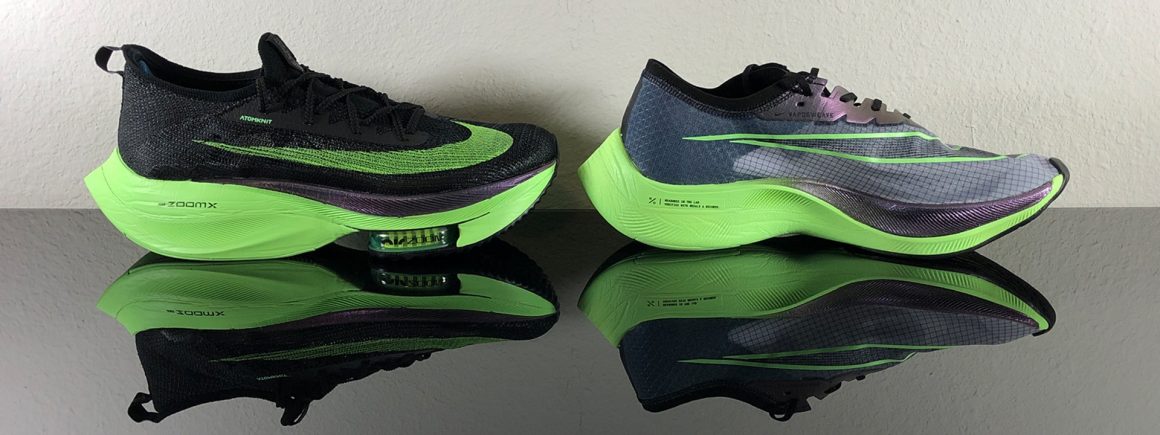
Alphafly (L) and Vaporfly from weartesters.com
Ever since Kipchoge ran a sub-2 hour marathon in the carbon plated Nike Alphafly in 2019, every single of my patients who participate in running races want to race in a pair too. Back then, those super shoes were really hard to get a hold of, for almost a year. If you did get your hands on a pair, they cost a bomb too.

Now that these super shoes are more easily available (since many other brands other than Nike also make carbon plated shoes), is it worth splurging on them? Especially if you're trying to clock a personal best timing in your next race.

How does the original Nike super shoe (the Vaporfly) work? There are 2 novel components to this question. First, the super thick cushioned midsole Nike calls ZoomX. This new foam is super light, 31 millimeters high at the heel, which is 50 percent thicker than comparable shoes without being heavier. You can squish it and it springs back to shape quickly. This means it returns all the energy you applied to squish it. 

Next is the curved carbon fiber plate inside the midsole (pictured above). It is thought that the carbon fiber plate(s) acts like a spring, bending as your foot lands and then catapulting you forward as it springs back into position. This helps running economy (reduces energy expenditure) so you can run faster.

Ever since Nike launched their Vaporfly in 2017, which has since been updated a few times, there have been calls and debates to have the shoe disallowed in competition. Opposers have labelled the shoe as technical 'doping'. When subsequent studies showed that these Nike shoes gave up to a 4 percent advantage (Barnes and Kilding, 2019), other runners were obviously upset

Especially after two Nike sponsored runners in the United States used the prototype version at the 2016 Olympic trials (women's 1st and 3rd places) and qualified for the Olympics.

Shalaya Kipp felt that the prototype Vaporfly's kept her training partner, Kara Goucher (4th place), off the Olympic team after signing up with Skechers. She left Nike in 2014 beacause of the infamous Alberto Salazar "Oregon project". Had Goucher stayed with Nike, she may have qualified for her third Olympics in 2016. At the actual 2016 Olympics, the top 3 male finishers all wore the same Nike prototype shoe.

In fact Nike scored a major coup when they offered all other runners who qualified in the 2020 USA marathon Olympic trials a pair of the Alphafly's to level the playing field.

Before you buy a pair of carbon plated shoes, consider the following study. It was published just last month looking at 96 runners using 2 different prototypes of carbon plated  shoes. The shoes differed only by the forefoot bending stiffness. The runners were first assessed for their VO2 max and maximum aerobic speed. Running economy and stride kinematics were also recorded during the trials. 

The researchers did not find any significant difference in running economy between the 2 different shoe stiffness for the group as a whole. Some runners' running economy improved when the carbon fiber plate was stiffer while in other runners, their running economy deteriorated. To be more specific, the faster runners took advantage of the increased stiffness (carbon fiber plates) while the slower runners did not.

The authors emphasized the importance of individual response to using carbon fiber plates to enhance running performance is runner specific. 

For now, the carbon plates remain street legal for us mortal runners in competition. If you do get them, remember to break them in with a few runs instead of just saving them for race day. The midsole thickness definitely makes your foot more unstable especially when going around sharp corners or while making a u-turn in an out and back route.


References

BarnesKR and Kilding AE(2019). A Randomized Crossover Study Investigating The Running Economy Of Highly-Trained Male And Female Distance Runners In Marathon Racing Shoes Versus Track Spikes. Sports Med. 49(2): 331-342. DOI: 10.1007/s40279-018-1012-3.

Beck ON, Golyski PR and Sawiki GS (2020). Adder Carbon Fiber To Shoe Soles May Not Improve Running Economy: A Muscle-level Explanation. Sci Rep. 10: 17154. DOI: 10.1038/s41598-020-74097-7

Chollet M, Michlet S, Horvais N et al (2022). Individual Physiological Responses To Changes In Shoe Bending Stiffness: A Cluster Analysis Study On 96 Runners. Eur J Appl Physiol. DOI: 10.1007/s00421-022-05060-9

Tuesday, February 25, 2020

Thinking Of Changing To Maximalist Running Shoes?

Picture from Nike
I received an email recently on what shoes top Japanese runners want to be wearing. I'm sure not only the top Japanese runners want the shoe, I bet all the top runners in the world would dearly love to get a pair of Nike's Vaporfly.

Better still if they can get a pair Kipchoge's prototype shoe dubbed the Alphafly that he wore during the sub 2 hour marathon in Vienna.
Picture from Nike
Consider Reid Coolsaet, a 2-time Canadian Olympic marathoner who let his shoe contract with New Balance expire in 2019 so he can use the Nike Vaporfly to try and qualify for a third Olympics. He has been sponsored by New Balance and wearing their running shoes since 2008.

If you compete in running races or support your friends or loved one at their races you will surely notice that ultra thick, super cushioned shoes are quite the norm now. This is different from the minimalistbarefoot style shoes that were popular just a few years ago.

Some runners definitely got hurt wearing the barely there, minimalist type running shoes, while others did not like the skimpy feel which probably contributed to the wide swing towards the maximalist  running shoes that are popular now.

Running in these thickly cushioned shoes can affect running form in surprising ways as found by researchers on recreational athletes. As I wrote before in a previous post, these recreational runners pound harder and pronate more in thickly cushioned shoes compared to standard running shoes (Pollard et al, 2018).

In a follow up study to Pollard et al's study (2018), the researchers had the runners run in the maximalist shoes for six weeks (so the runners get used to them) before they repeated the testing.

The runners somehow did not adjust to the shoes. Interestingly, the runners still landed with greater force and pronated more in the maximalist shoes compared to their initial test run (Hannigan and Pollard, 2019).

There was a yet another follow up study which was just published last month on a new group of male and female recreational runners (Hannigan and Pollard, 2020). The researchers got New Balance to custom make a pair of their neutral running shoes to allow them to alter the shoe by adding or removing foam. This shoe can then serve as minimalist, traditional or maximalist shoes to allow the researchers to focus solely on the role of cushioning in the runners' form.

This time, a few of the runners in this study were found to land heavily in the minimalist and maximalist shoes, but they pronated most in the maximalist shoes.

The authors commented that looking at the three studies as a whole would suggest that extra cushioning does influence several aspects of the way we run. The thickly stacked soles of maximalist shoes seem to subtly affect balance, making the shoe more unstable. This is then likely to increase ankle movement and pronation.

With the extra layers of foam, it also affects the way our legs feel the ground when we land. This affects our muscles, brains and our nervous system in coordinating and anticipating foot fall when we walk or run.

Points to note are the researchers did not look at how fast the runners ran nor did they ask how the runners felt in the maximalist shoes. They also did not track actual running injuries in the runners studied so they cannot say if the extra cushioning contributes to or reduces injury.

Even though I have treated runners who have gotten seriously injured while wearing maximalist running shoes, I'm definitely not against any runners switching to them. Provided they have tested them and ease into training with them slowly and finding them suitable.

Reading the 3 articles and interpreting their results has made me wonder if the thicker soled models are right for recreational runners since comfort and injury risks are different compared to elite runners.


*Note -In the 2018 and 2019 running studies, the runners wore Hoka running shoes and not the Nike Vaporfly.

References

Hannigan JJ and Pollard CD (2019). A 6-Week Transition To Maximal Running Shoes Does Not Change Running Biomechanics. AJSM. 47(4): 968-973. DOI: 10.1177/0363546519826086.

Hannigan JJ and Pollard CD (2020). Differences In Running Biomechanics Between A Maximal, Traditional And Minimal Running Shoe. J Sci Med Sp. 23(1): 15-19. DOI: 10.1016/j.jsams.2019.08.008

Pollard CD Ter Har JA et al (2018). Influence Of Maximal Running Shoes On Biomechanics Before And After A 5k Run. Orth J Sp Med. 6(6): 2325967118775720. DOI: 10.1177/2325967118775720.