Showing posts with label Nike Vaporfly. Show all posts

Sunday, January 18, 2026

Super Shoes Or Super Placebo?

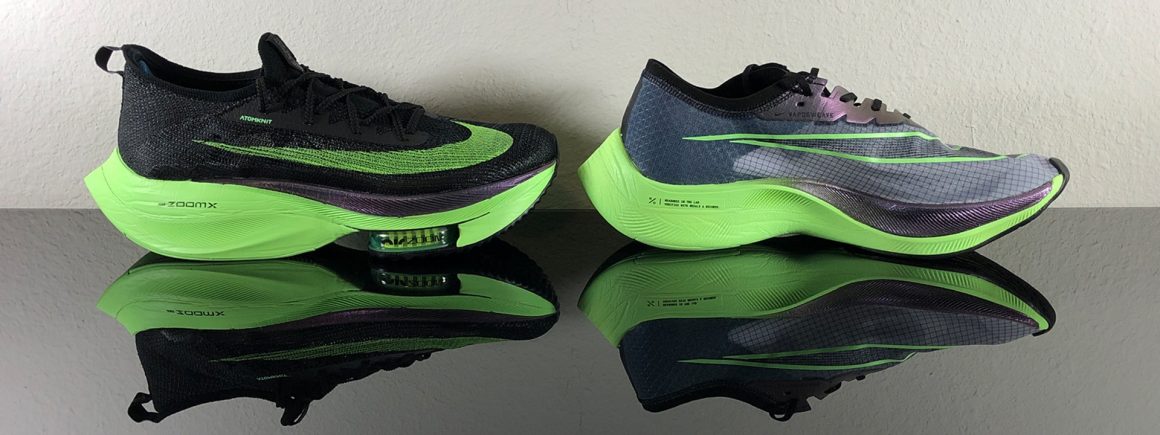
Thinking of buying a pair of Nike Vaporfly's (pictured above) for your next racing shoe? Or another super shoe from another brand? Here's a really interesting study I read on super running shoes.

Researchers in that study (Hebert-Losier et al, 2025) recruited 24 female recreational runners. All ran in Nike's Vaporfly Next% 2.

Here is what is so interesting, the shoe was not changed or manipulated. It was how the shoe was described. For the first shoe, the narrative was a "super shoe" description. carbon platedenergy return foam, elite level technology and expensive ($400).

For the other pair, a "basic/ knock-off" (or counterfeit) description with  no carbon plate, standard foam, lower price, ($100) and the idea that elite runners will not race in them.

Nothing changed in the shoe, just the "story" or description of the shoe.

All the participants did four 6-minute treadmill runs at 10km/h on a 1 percent incline. The researchers measured their running economy (V02 and energy cost). Cadence and contact time on the ground and perceptual responses were also investigated. These include comfort, enjoyment of run, ease, expected performance and perceived injury risk.

When the runners thought they were running with the Super shoes, perception changed noticeably. Reported comfort was significantly higher. They also felt running was easier and more enjoyable. Expected performance was higher and their perceived injury rate was lower.

To summarize, the subjective experience of running improved even though the shoes used were exactly the same.

What about the objective measures? There were NO significant differences in running economy, oxygen consumption, lactate responses or even biomechanically.

Whilst running at 10 km/h pace for 6 minutes, belief alone did nothing to translate into measurable physiological or even biomechanical differences.

Does this mean you don't have to buy super shoes for your next attempt to beat your marathon personal best? 

Personally I don't think so. 6 minutes at 10 km/h pace using recreational runners may not be totally accurate. It shows that expectation plays a big role in how running feels even though performance metrics remained unchanged.

Comfort, confidence, enjoyment and perceived safety matter so one can train consistently and push themselves harder when there is less fear of injury. These may not show in data measuring running economy, but may still influence outcomes over time.

The message for runners is NOT that they do not need to buy super shoes. Instead it's that shoes cannot replace training and price tags do not guarantee performance. Perception changes a runner's experience, even when physiology does not change.

Technology helps sometimes. Sometimes the story helps too.

So are you buying Nike's Vaporfly or Decathlon's Kiprun (pictured above)?

Reference

Hebert-Losier K, PfisterA, Finayson SJ et al (2025). Are Super Shoes A Super Placebo? A Randomised Crossover Trial In Female Recreational Runners. Footwear Sc. 17(2): 79-88. DOI: 10.1080/19424280.2025.2458330

Sunday, November 6, 2022

Only Some Runners Ran Faster Using Carbon Plated Shoes

Alphafly (L) and Vaporfly from weartesters.com
Ever since Kipchoge ran a sub-2 hour marathon in the carbon plated Nike Alphafly in 2019, every single of my patients who participate in running races want to race in a pair too. Back then, those super shoes were really hard to get a hold of, for almost a year. If you did get your hands on a pair, they cost a bomb too.

Now that these super shoes are more easily available (since many other brands other than Nike also make carbon plated shoes), is it worth splurging on them? Especially if you're trying to clock a personal best timing in your next race.

How does the original Nike super shoe (the Vaporfly) work? There are 2 novel components to this question. First, the super thick cushioned midsole Nike calls ZoomX. This new foam is super light, 31 millimeters high at the heel, which is 50 percent thicker than comparable shoes without being heavier. You can squish it and it springs back to shape quickly. This means it returns all the energy you applied to squish it. 

Next is the curved carbon fiber plate inside the midsole (pictured above). It is thought that the carbon fiber plate(s) acts like a spring, bending as your foot lands and then catapulting you forward as it springs back into position. This helps running economy (reduces energy expenditure) so you can run faster.

Ever since Nike launched their Vaporfly in 2017, which has since been updated a few times, there have been calls and debates to have the shoe disallowed in competition. Opposers have labelled the shoe as technical 'doping'. When subsequent studies showed that these Nike shoes gave up to a 4 percent advantage (Barnes and Kilding, 2019), other runners were obviously upset

Especially after two Nike sponsored runners in the United States used the prototype version at the 2016 Olympic trials (women's 1st and 3rd places) and qualified for the Olympics.

Shalaya Kipp felt that the prototype Vaporfly's kept her training partner, Kara Goucher (4th place), off the Olympic team after signing up with Skechers. She left Nike in 2014 beacause of the infamous Alberto Salazar "Oregon project". Had Goucher stayed with Nike, she may have qualified for her third Olympics in 2016. At the actual 2016 Olympics, the top 3 male finishers all wore the same Nike prototype shoe.

In fact Nike scored a major coup when they offered all other runners who qualified in the 2020 USA marathon Olympic trials a pair of the Alphafly's to level the playing field.

Before you buy a pair of carbon plated shoes, consider the following study. It was published just last month looking at 96 runners using 2 different prototypes of carbon plated  shoes. The shoes differed only by the forefoot bending stiffness. The runners were first assessed for their VO2 max and maximum aerobic speed. Running economy and stride kinematics were also recorded during the trials. 

The researchers did not find any significant difference in running economy between the 2 different shoe stiffness for the group as a whole. Some runners' running economy improved when the carbon fiber plate was stiffer while in other runners, their running economy deteriorated. To be more specific, the faster runners took advantage of the increased stiffness (carbon fiber plates) while the slower runners did not.

The authors emphasized the importance of individual response to using carbon fiber plates to enhance running performance is runner specific. 

For now, the carbon plates remain street legal for us mortal runners in competition. If you do get them, remember to break them in with a few runs instead of just saving them for race day. The midsole thickness definitely makes your foot more unstable especially when going around sharp corners or while making a u-turn in an out and back route.


References

BarnesKR and Kilding AE(2019). A Randomized Crossover Study Investigating The Running Economy Of Highly-Trained Male And Female Distance Runners In Marathon Racing Shoes Versus Track Spikes. Sports Med. 49(2): 331-342. DOI: 10.1007/s40279-018-1012-3.

Beck ON, Golyski PR and Sawiki GS (2020). Adder Carbon Fiber To Shoe Soles May Not Improve Running Economy: A Muscle-level Explanation. Sci Rep. 10: 17154. DOI: 10.1038/s41598-020-74097-7

Chollet M, Michlet S, Horvais N et al (2022). Individual Physiological Responses To Changes In Shoe Bending Stiffness: A Cluster Analysis Study On 96 Runners. Eur J Appl Physiol. DOI: 10.1007/s00421-022-05060-9

Sunday, May 22, 2022

Do Softer Running Shoes Cause More Injuries?

Vaporfly from Nike
Let's say you have been chosen as a volunteer in a running shoe study. The researcher assigns you a pair of running shoes with very thick midsoles to run with. Your expectations may be affected by how you run compared to being assigned an ultra thin and ultra light shoe.

It will also affect how you perceive aches and pain received from running during the study. It will probably not be possible to tell whether it was the softer midsoles, heel droplightness or other differences that gave you grief.

To avoid this, researchers in this study collaborated with Decathlon to make custom running shoes that cannot be visually distinguished and only has one single technical detail different for each experiment. Both researcher and subject were not aware (double blind) which type of shoe was used.

I have written before that runners, new to wearing shoes with thicker midsoles, tend to land more heavily and with greater force. This is even after running with the shoe for more than 6 weeks. This has become what is known as the shoe cushioning paradox, where more cushioning leads to runners landing more heavily, with a lesser chance of getting injured.

Decathlon made 2 prototypes, each with an inch thick of midsole. Half the soles had soft cushioning while the other half had firmer midsoles, which were randomly assigned to 848 runners. These runners completed a treadmill test to assess stride characteristics and were then monitored for 6 months.

Stride analyses showed that runners land more heavily when wearing the shoes with the softer midsoles.This is similar to other studies, which may cause more injuries (not less).

However, the runners wearing the shoes with firmer midsoles were 52 percent more likely to get injured during the follow up period (perhaps to suggest injury protection offered by the softer cushioning). This is similar to the shoe cushioning paradox. How is this so?

What the researchers found was the timing of impact matters. When your foot strikes the ground, there are 2 distinct impacts. The first impact occurs when your lower leg slows down suddenly after striking the ground. The second impact which occurs a few milliseconds later is the larger force caused by the rest of your body. The first impact is the one researchers suspect is linked to injuries. 

This force is greater in runners with the softer midsoles, but the softer midsoles slow down that first jolt and spreads it out over a longer period of time causing it to overlap with the second impact. This combined impact makes the total force appear greater thus giving the impression that softer midsoles cause runners to land harder.

After separating the first and second impacts into 2 differerent values, the authors found that the first impact (the one linked to injuries) was actually smaller with the softer midsoles.

Does this mean we should now run with shoes with the thickest and softest midsoles? Afterall, they do lighten the load on your joints and reduce injury risk. At least that's what the study by Malisoux et al (2022) suggest.

Do note that these Decathlon made shoes for the study are different from the ones available in stores. Morever, with each different brand, they have different technologies and use different materials. 

Just like the newest generation of Vaporfly (with its super thick soles and carbon plate), it still remains questionable whether it reduces injury risk, with the carbon fiber plate(s) still untested.

The midsole thickness definitely makes your foot more unstable especially when going around sharp corners or while making a u-turn in an out and back route. Only time and another specifically designed study can tell us more.

Even the authors concede that very little is known about the complex links between running shoes and injuries. I do like their suggestions, that is to stick with whatever you're running with, if you are happy with them. If you do switch shoes, consider carefully why you're switching, do try several designs  and take you time making the switch. Also consider alternating types of running shoes to vary the stress on your body. 

Just like what I've been telling my patients.


Reference

Malisoux L, Gette P, Backes A et al (2022). Lower Impact Forces But Greater Burden For The Musculoskeletal System In Running Shoes With Greater Cushioning Stiffness. Eur J Sp Sci 19: 1-11. DOI: 1080/17461391.2021.2023655

Sunday, February 27, 2022

Super Pants Instead Of Super Shoes?

When someone mentions exoskeletons, I immediately think of 'Robocop', a film from 1987 (film poster below). Those of you who are old enough to remember watching Robocop starring Joel Kinnaman will understand what I'm trying to write. 

Why am I writing about exoskeletons? Well, it seems they may be the next big thing for runners after super shoes like Nike's Vaporfly came onto the market in 2017.

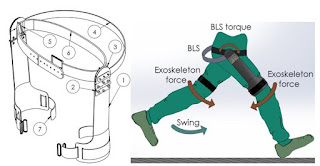
Wearable exoskeletons were invented to assist walking or running, especially to help carry heavy loads. Here's an early invention from a paper published in 2018 (Nasiri et al 2018). A spring loaded exoskeleton (pictured above the movie poster) worn around the waist and clamped to the upper legs that helps the rear leg forward with each stride. The researchers showed an improvement of 8 percent (compared to 4 percent with the Vapourfly).

However, if you looked at the design, it looks too cumbersome to run with. Probably it would be banned by World Athletics too.

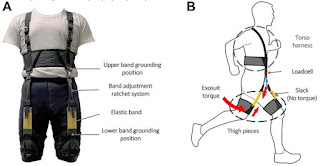
A more recent paper published last year by South Korean researchers showed how a relatively simple design can improve running economy by 2.5 to 4.7 percent. 

There is a band around your torso, held up by suspenders (pictured above).There is also one compression band around each thigh, which is connected to the torso by an elastic. It weighs just 1.3 pounds and sticks out from your body by not more than an inch. Surely that can pass off as a pair of compression tights that will not be deemed illegal by World Athletics standards?

There was also another paper from a group of researchers in China that studied a unpowered exoskeleton that improved running economy by 7.2 percent (Zhou et al, 2021)

Rememeber so many world swimming records were broken after the now infamous polyurethane Speedo Fastskin LZR 'super suits' were introduced in 2009 and FINA (World Swimming Federation) subsequently banned them. Well, some of those timings still stand. 

Similarly, road running/ racing shoes cannot be used (for World Athletics races) if the midsole is thicker than 40 mm or if the shoes contain more than 1 carbon plate. Running spikes can only be 20 millimeters (mm) thick (down from 25) with effect from 2024. 

This may have led to the 400m hurdles men's world record By Karsten Warholm at the Tokyo Olympics last year. That world record and any other records set by these super spikes may last a whole lot longer when the super spikes are outlawed in 2024. Just like the swimming world records set wearing those 'super suits'.

Perhaps World Athletics should write some rules with these soon to be developed super pants. Remember you read about the 'super pants' here first.

References

Nasiri R, Ahmadi A and Ahmadabadi MN (2018). Reducing The Energy Cost Of Human Running Exoskeleton. IEEE Trans Neural Sys Rehab Eng. 26(10): 2026-2032. DOI: 10.1109TNSRE.2018.2872889

Yang JH, Park JI, Kim JH et al (2021). Reducing The Energy Cost Of Running Using A Lightweight, Low-profile Elastic Exosuit. J NeuroEngineering Rehab. 18, 129. DOI: 10.1186/s12984-021-00928-x

Zhou T, Xiong C, Zhang J e al (2021). Reducing The Metabolic Energy Of Walking And Running Using An Unpowered Hp Exoskeleton. J NeuroEngineering Rehab.18, 95. DOI: 10.1186/s1298-021-0093-5