Monday, April 29, 2019

Shoulders And Arms

Really heavy ....
It's back to learning as I attend another course with Anatomy Trains. This time as you can see it's on the Shoulders and Arms.
How do all the scapulars compare?
It's fairly intense in terms of theory, videos to watch and lots of practical as well. Looks like the next couple of days will pass fairly quickly.

New vocabulary
New participants to meet, new terms to get used too and new ways to "body read" each other. Looks like I may have to burn midnight oil to review everything we've done today.

Sunday, April 21, 2019

What Happens When Patients Find Out How Good Their Doctors Really Are?


Looks like doctors and mercenary medical agents are back in the news for all the wrong reasons again in yesterday's Straits Times article.

While we are on doctors, I came across this interesting article on "The Bell Curve: What happens when patients find out how good their doctors really are?"

It gave me a totally different perspective on the medical world. Be it in medicine, physiotherapy or any other health related field, it is now fashionable to say we're practicing evidenced-based medicine, evidenced-based physiotherapy etc. This simply means whatever we do or use to treat patients is backed by research rather than our own instincts or ad-hoc experimentation.

The article documented the results of a Cleveland pediatrician named LeRoy Matthews in the 1960's. Due to his persistent efforts, his hospital's mortality rates for cystic fibrosis was less than two percent compared to higher than twenty percent for the rest of the country (USA). What made his program different was that he started aggressive treatment long before his patients became sick.

Warren Warwick, the pediatrician who conducted the study of LeRoy Matthews much higher than normal success rate, now heads the Minneapolis cystic fibrosis program. Ever since that study, Warwick has tried to do better than everyone else. It currently has the best results in the country.

What makes him and the hospital's program different is his combination of focus, aggressiveness and being inventive. He thinks hard about his patients, pushes them and always improvises.

From the article, "We are used to thinking that a doctor's ability depends on mainly science and skill. The lesson from Minneapolis is that these may be the easiest parts of care. Even doctors with great knowledge and technical skill can have mediocre results; the more nebulous factors like aggressiveness and consistency and ingenuity can matter enormously."

The first question that comes to my mind after reading the article is where Sports Solutions and Physio Solutions stand on a bell curve for Physiotherapy? We need to push ourselves to make us the best at making patients get better fastest. To always learn, to be consistent, to innovate. That is our promise to you.

Here's the link to the article. It takes fairly long to read, but definitely worth your time.

Sunday, April 14, 2019

It May All Be In The Hips

*Very nice hip extension, Prefontaine leading Viren
Last week article was all about reducing your injury risk to stay healthy so you can keep training consistently.  Training consistently allows you to improve. For those of you who participate in races, this week's article will discuss how to improve your athletic performance with another simple exercise.

The biggest muscle we have in the human body is the big and very strong gluteus maximus muscle (there are also two smaller gluteus medius and gluteus minimus muscles). The gluetus maximus muscle extend our hips. This is evident when we're climbing stairs, running up slopes and especially if you're having to sprint for the finish line.

My patients who run tell me they often go to the gym to do strengthening exercises as well to get stronger. Often they are told by their personal trainers to make their quadriceps stronger. Nothing against making the quads stronger, but if you're hoping to improve your sprint performance by doing lots of squats then you should consider another exercise.

Researchers studied whether training the gluteus maximus or the quadriceps stronger was more effective for performance found that the hip thrust exercise (for gluteus maximus) more specific and better gains transferred to running/ sprinting (Gonzalez-Garcia et al, 2019).
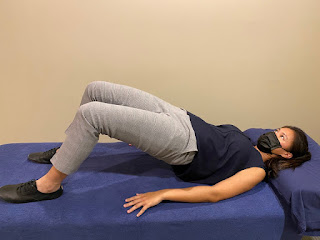
Hip thrust (also called bridging)
What exactly is a hip thrust? The easiest way to do it is lying on a firm surface with your knees bent and lift your buttocks (also known as bridging). You can add resistance by doing it with a elastic band around your waist to make it more difficult. In the hospitals, this exercise is often given to patients who are recuperating from surgery.
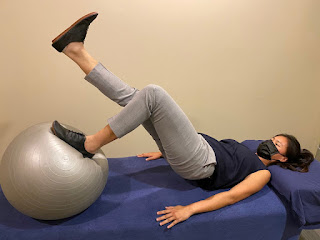
Single leg version on unstable surface
To progress, you can bridge on an unstable surface like a gym ball with both legs followed by single leg (picture above).

If you're in the gym, while facing upwards, you can rest your arms and neck on a bench and bridge with your knees bent. I've also seen gym rats resting a loaded barbell on the hips to make it more difficult.

All the above described exercises are all suitable and good if you want to make your hip extensors (gluteus maximus) stronger. However, they are all done lying down, i.e. in a non weight bearing position. In running, you are definitely upright and not lying down.
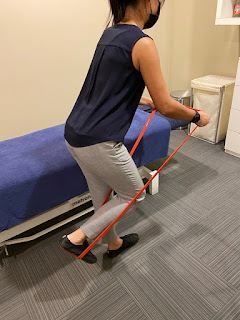
Starting position
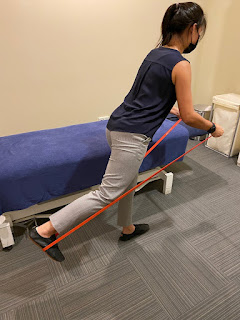
Hence, my preferred way to make the gluteus maximus stronger is in a standing position with an elastic band. Lean forward slightly with your back straight and straighten your right leg against the resistance of the elastic band. Repeat with good form until fatigue and do the same with your left leg.
Extending the R hip
I find that this way of strengthening the gluteus maximus is more specific and mimics the running posture. Strength gains are more easily transferred.


Reference

Gonzalez-Garcia J, Morencos E et al (2019). Effects Of 7-Week Hip Thrust Versus Back Squt Resistance Training On Performance In Adolescent Female Soccer Players. Sports. 7(4): 80. DOI: 10.3390/sports7040080.
*Taken from page 46 and 47 with my iPhone X from one of my favorite books "The Olympians" by Sebastian Coe with Nicholas Mason.

You see Steve Prefontaine leading Lasse Viren in the 1972 Munich Olympics with brilliant form! Excellent hip extension, Viren with his R hip, Prefontaine with his L hip. Both were wearing Adidas at this Olympics.

Prefontaine would later be the poster boy for Nike while Viren would do the same for Asics.

Sunday, April 7, 2019

How To Reduce Your Injury Risk By Half

Starting position
Want to reduce your risk getting a running injury by half with no equipment needed? It takes less than ten minutes a week. It also helps you become a stronger and faster runner. What's the catch? Some of you will already be asking.


It almost sounds to good to be true, but this has well documented research to back it up. Researchers reviewed 15 studies (8459 male and female subjects) across different sports with subjects ranging from 18 to 40 years old. Those that did the Nordic hamstring exercises (also know as Icelandic curls) decreased their injury rates by 51 percent.
Lean forward and hold
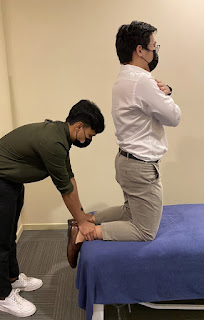
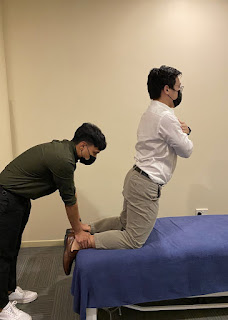
My patients often struggle when I show them how to do it. We get the patient to kneel at the edge of our treatment bed with both ankles secured. The patient then progressively leans forward from the knees while keeping their back straight. When they can't hold the position any longer, they just use the hands to catch themselves as they fall forward.

Please bear in mind that the Nordic hamstring exercise (NHE) is extremely difficult to do. Some of my patients who had their anterior cruciate ligament (ACL) reconstructed can barely manage one rep before their hamstrings start to fatigue/ cramp. It's also quite common to get delayed onset of muscle soreness (DOMs) after attempting the NHE.

To progress, you can slowly increase the number of repetitions over two to three months. You can also lean forward further and hold that position longer before you fall forward.

Arabesque
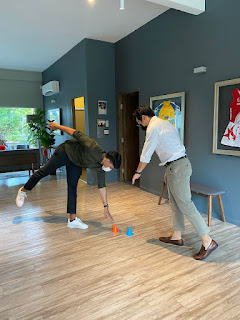
For patients who struggle to do a single repetition, I'll get them to start with another similar exercise to the NHE that lengthens the hamstring at the same time while it's contracting. I get my patients to do the Arabesque first. The patient stands on one straight leg with the other leg behind while attempting to reach forward to touch a bottle or a cone etc. This movement is repeated until fatigue sets in.

When the Arabesque becomes easy, they can progress to doing the NHE.

The above two exercises are also very useful in Australian Rules football, soccer and rugby since the hamstrings are commonly injured in these sports too.

One last tip, if you can't find anyone to hold your ankles while doing the NHE, try putting your feet under a couch with a mat in front to cushion your landing.


Reference

van Dyk N, Behan FP et al (2019). Including The Nordic Hamstring Hamstring Exercise In Injury Prevention Programmes Halves The Rate Of Hamstring Injuries: A Systematic Review And Meta-analysis Of 8459 Athletes. BJSM. DOI: 10.1136/bjsports-2018-100045.

Sunday, March 31, 2019

No Pain No Gain

Every now and then we get patients with chronic pain in our clinic, so I was really interested when I saw this case report about a 71 year old woman who feels no pain. I was hoping to find ways to really help these chronic pain patients.

She was found to have two notable gene mutations, FAAH-OUT  which researchers know to have links to pain sensitivity. The second was a microdeletion in the FAAH gene which reduces pain sensation, accelerated wound healing, reduced anxiety and enhanced fear-extinction memory.

This lady sought treatment for a hip issue and was found to have severe degeneration in the hip despite feeling no pain. When researchers looked into her case file, they found that she never reported experiencing pain or needed pain medication after surgery. Even during childbirth, after broken bones and cuts. She was burnt once, but only realized it after smelling her flesh burning!

I was then thinking, if an elite athlete had that sort of mutation and felt no pain, would that be a real major performance enhancer? That would surely not be considered as doping.

Think of how it would affect you if you were running and attempting to beat your personal best in the marathon. If you didn't feel any pain, nor the burn of accumulating lactate in your muscles when you were clicking out each kilometer at your goal pace. Surely you would be able to keep pace to beat your target time.

After thinking about it for a while, I realized that it is not possible. If you experience no pain while training, it would definitely expose you to injuries. Pain is necessary during training to help provide feedback and modulation and of course for adaptation to training.

During races, your performance is affected because pain impacts pacing. If you can't feel pain, you wouldn't know how to back off, when to slow down. You will purely be running by numbers (time) and not physiology.  That means you wouldn't know when to rest. Over training will become common. Mild injuries will then become severe.

Like what I always tell the athletes that I treat, "make pain your best friend". If you can tolerate pain, you will be able to perform your best.


Reference

Habib AM, Okorokov AL, Hill MN et al (2019). Microdeletion In A  FAAH Pseudogene Identified In A Patient With High Anadamide Concentrations And Pain Sensitivity. Br J Anaesthesia. DOI: 10.1016/j.bja.2019.02.019

Signed by David Butler himself in 2003.

Sunday, March 24, 2019

Still Can't Run 6 Months After An Ankle Sprain


R ankle
My last patient yesterday suffered an osteochondral injury in her right ankle last July after spraining her ankle while taking part in a trail running camp. Part of the reason may be wearing a new pair of shoes she wasn't used to.

Almost half a year later, she was still hoping to do a 50 km trail race earlier this month, but she definitely wasn't even ready to be running yet.

Many of her running friends and colleagues (she works in a hospital) can't believe an osteochondral injury can be that serious. In fact, some of the physiotherapists in her hospital don't even know what an osteochondral injury to her talus means. They definitely do not know how to treat her.

Hence, you have a runner who works in a hospital, yet comes to Sports Solutions to get treatment.  Just like the physiotherapist from another hospital who sees us after her microfracture surgery.

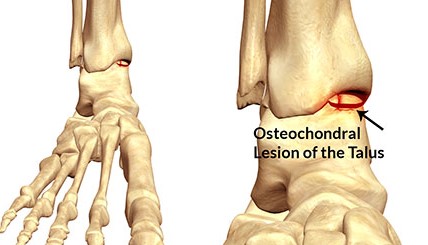
In the picture above, you can see where the talus is in the ankle. It is the bone that is below your tibial (shin bone). In the scenario where there is an injury to the articular cartilage (which lines the end of our bones to allow for load bearing and friction free movement), there will be both swelling and pain.

The main goal of non operative treatment is to allow the injured bone and articular cartilage to heal. Since articular cartilage has poor blood supply, this is not going to happen quickly.

Sometimes, crutches or a rocker boot may be necessary to take load off weight bearing. In severe cases, surgery is needed to ensure recovery. After three articles on the operative management on articular cartilage injuries, I think I've covered the topic enough. Just in case you're keen, drilling can be done like the picture you see below to stimulate healing.
Drilling is done
I've told my patient she can still volunteer at the race whether it's manning a water station, handing out medals or directing runners at checkpoints in the race. She can also lend support and cheer for her friends at the race. Meanwhile, she has also found "a distraction" or another way to motivate herself. She's been going to the gym regularly and her upper body is much more muscular than before.

I've told her to keep the long view in mind. If she wants to keep running for the rest of her life it's not worth risking it now. There will be other races for her in future definitely.

Have an osteochondral injury? Come see us in our clinics.

Sunday, March 17, 2019

High Intensity Interval Training (HIIT) Reduces Cancer Cell Growth?

Picture by richseow from Flickr
I've written positively before about the effects of running on cancer a few years ago. Now there seems to be more evidence that even a single session of high intensity interval training (HIIT) may significantly slow the growth of colon cancer cells.

Researchers had male colorectal cancer survivors perform either a single HIIT session or do HIIT regularly for a month.

After a ten minute warm up, the single HIIT group did four intervals of four minutes cycling (at 85to 95 percent maximum heart rate) with three minutes of recovery in between. The other group did this same session three times a week for a month.

Picture by jungle jim3 from Flickr
Blood samples were taken from these subjects before and after the HIIT sessions. Blood samples before exercise had no effect whatsoever on the cancer cells. Blood samples after the HIIT sessions showed a decrease in the cancer cells immediately.

While comparing the single session HIIT group with the other, there was no significant difference in the blood samples.

During high intensity exercises, our muscles releases lots of myokines (inflammatory cytokines) compared to moderate intensity exercises.

The researchers attributed the cancer cells reduction to cytokines (or inflammatory markers) found in the bloodstream after exercise.

The researchers suggested that the reduction in cancer cells in the colon is not specific to those who had cancer before. Other studies have found similar reductions in prostate cancer cells in healthy individuals as well.

Every individual tolerates and responds differently to exercises, especially HIIT sessions. Train don't strain is important too.


Reference

Devin JL, Hill MM et al (2019). Acute High Intensity Interval Exercise Reduces Colon Cancer Cell Growth. J Physiol. DOI: 10.1113/JP277648.