Showing posts with label Rugby Injuries. Show all posts

Sunday, April 7, 2019

How To Reduce Your Injury Risk By Half

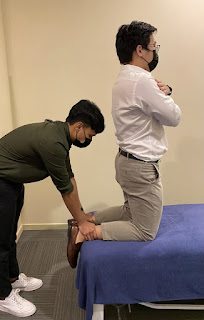
Starting position
Want to reduce your risk getting a running injury by half with no equipment needed? It takes less than ten minutes a week. It also helps you become a stronger and faster runner. What's the catch? Some of you will already be asking.


It almost sounds to good to be true, but this has well documented research to back it up. Researchers reviewed 15 studies (8459 male and female subjects) across different sports with subjects ranging from 18 to 40 years old. Those that did the Nordic hamstring exercises (also know as Icelandic curls) decreased their injury rates by 51 percent.
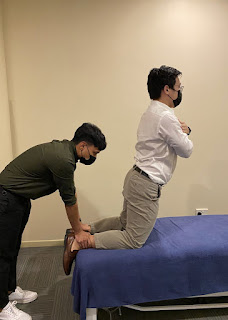
Lean forward and hold
My patients often struggle when I show them how to do it. We get the patient to kneel at the edge of our treatment bed with both ankles secured. The patient then progressively leans forward from the knees while keeping their back straight. When they can't hold the position any longer, they just use the hands to catch themselves as they fall forward.

Please bear in mind that the Nordic hamstring exercise (NHE) is extremely difficult to do. Some of my patients who had their anterior cruciate ligament (ACL) reconstructed can barely manage one rep before their hamstrings start to fatigue/ cramp. It's also quite common to get delayed onset of muscle soreness (DOMs) after attempting the NHE.

To progress, you can slowly increase the number of repetitions over two to three months. You can also lean forward further and hold that position longer before you fall forward.
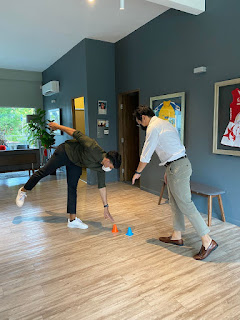
Arabesque
For patients who struggle to do a single repetition, I'll get them to start with another similar exercise to the NHE that lengthens the hamstring at the same time while it's contracting. I get my patients to do the Arabesque first. The patient stands on one straight leg with the other leg behind while attempting to reach forward to touch a bottle or a cone etc. This movement is repeated until fatigue sets in.

When the Arabesque becomes easy, they can progress to doing the NHE.

The above two exercises are also very useful in Australian Rules football, soccer and rugby since the hamstrings are commonly injured in these sports too.

One last tip, if you can't find anyone to hold your ankles while doing the NHE, try putting your feet under a couch with a mat in front to cushion your landing.


Reference

van Dyk N, Behan FP et al (2019). Including The Nordic Hamstring Hamstring Exercise In Injury Prevention Programmes Halves The Rate Of Hamstring Injuries: A Systematic Review And Meta-analysis Of 8459 Athletes. BJSM. DOI: 10.1136/bjsports-2018-100045.

Wednesday, April 21, 2010

Rugby Injuries

Rugby has been in the news (even in the front page of our Straits Times) recently for many reasons the last week or so especially since the fight that broke out in the National Schools 'B' division final which sparked comments even from politicians and newspaper editors (who normally would not even watch rugby).

Well, I'm not about to join in the fray. I am actually going to write about rugby injuries that we've been treating as we've been seeing quite a few patients who play rugby as well in the last month or so (we had a player tearing the ACL representing Singapore at the Hong Kong 7's tournament).

I went to do some research to see if there are any published similarities with our local rugby injuries and here's what I found (although articles were mainly on professional rugby players).

Here's what some of the published papers found. Rugby union is a high risk sports for players' knees, highest among all other football, rugby codes (which supported previous research findings). Medical personnel at clubs reported knee injuries on a weekly basis. Knee injuries accounted for the highest number of days for injury absence (21% of all injury absence days) and were characteristically severe, with a disproportionately high number of days injured per injury.

ACL (anterior cruciate ligament) injuries accounted for the greatest proportion of days missed (255 days or 29% of all knee injury days), followed by MCL (medial collateral ligament). Injuries tended to be more common among the back row. This is fairly similar to what we saw, although we saw many shoulder injuries among the rugby players as well.

Most severe injuries occurred during contact (being tackled rather than tackling). More significant for coaches and medical personnel to take note, usually in the final 20 minutes of a match.

The physical nature of rugby makes contact injuries fairly difficult to prevent although coaches, physios can put in place a number of conditioning (or prehab) measures to help ensure players are properly prepared for the demands of the sport.

Please also see this.

References

Dallalana RJ, Brooks JH et al (2008). The Epidemiology of Knee Injuries in English Profesional Rugby Union. Am J Sports Med. 35(5) : 818-830.

Quarrie KL and Hopkins WG (2008). Tackle Injuries in Professional Rugby Union. Am J Sports Med. 36(9) : 1705-1716

*Picture by Rich Seow