Showing posts with label ACL Reconstruction. Show all posts

Friday, December 22, 2023

Still Walking With Crutches After One Month?

Picture from Goal.com
Neymar Junior is definitely a world class footballer who just had an ACL reconstruction after tearing his anterior cruciate ligament (ACL) on 181023. However, his rehabilitation does not seem world class at all. 

You can hear him yelling when his knee is being forced to bend (knee flexion) with 3 people involved. I am not sure if the video was put up just to garner more views, but that is not what to do if you want to improve knee bending range. Getting full extension (knee straightening) is more important early on to avoid any chance of getting a cyclops lesion

And still walking with crutches after one month? Our patients are sometimes discharged and walking with no crutches from the hopsital or our clinic after a few days.

Come see us in our clinics if you need rehabilitation after your your ACL reconstruction.

Sunday, June 20, 2021

Are S&C Coaches Or Physiotherapists The Real Exercise Professionals?


This week's post is on an article I read in the blog from the British Journal of Sports Medicine where the author asked whether physiotherapists or strength and conditioning (S&C) coaches are the real pros when it comes to prescribing rehabilitation exercises and getting patients/ athletes to return to sport (RTS).

The author compared physiotherapists and strength and conditioning (S&C) coaches working with athletic populations (in the UK). His view was that the physiotherapist has always been the decision maker or 'top dog' when it comes to managing the injured athlete or any patient that needed exercise to rehabilitate or improve physical function. 

He feels that the physiotherapy profession has not kept up to date with professional developments in exercise science and S&C, even falling behind and out of step in some aspects. This is despite the fact that there has been an increase in demand by physiotherapists in the UK for weekend courses in S&C training to fill in gaps in expertise and knowledge. 

The author thinks these short 2 day courses is "really an insult to those S&C professionals that have devoted time, effort and financial resources to their expertise" as they have studied exercise science, S&C at undergraduate level and gone on to postgraduate study and even advanced professional accreditation to work.

He also feels that the undergraduate training program for physiotherapists in the UK does not provide enough basic grounding in exercise prescription and training science despite claims by the physiotherapy profession that they have a firm grounding in basic clinical sciences so they can circumvent the need for extensive training in S&C.

This has then led to a deficit in rehabilitating athletic populations such that it even slows an athlete's full RTS. The athlete is usually handed to the S&C team or left to their own devices. He concludes that rehabilitation of recreational and professional athletes must be recognized as an advanced practiced skill requiring specialist training. If these gaps/ deficits in both under and post graduate training are not addressed, then physiotherapists will be relegated to technicians in the restoration of the patient/ athlete.

My thoughts? I used to work at the *Singapore Sports Council in the Sports Medicine department (the current Singapore Institute of Sport). The doctors, physiotherapists, S&C coaches and other sports science staff (nutrition, biomechanics, psychology) all have degrees and/ or postgraduate qualifications and definitely had a good working relationship. We had a weekly case discussion where the athletes who were not progressing well after injury were brought up and analyzed.

Other than that sort of setting and perhaps in the Singapore Sports School and Football Association of Singapore, I think that physiotherapists in  hospitals and private practices that treat sporting populations may differ in their ability to enable these patients to RTS. It boils down to the interest and exposure of each physiotherapist. Whether they had any previous sports/ athletic background, how interested they are in sports, and most importantly, their tenacity to want to better themselves. 

There will be S&C coaches, sports and functional trainers, CrossFit coaches and personal trainers who, with their interests and commitment to improve themselves, will be superior to some physiotherapists with regard to rehabilitation and returning patients to sport. Likewise, there will be physiotherapists who can more than hold their own. 

It is, ultimately, up to each individual in their respective line of work to keep themselves up to date, to keep improving to help athletes recover better and faster. And also to recognize when they aren't the best person to return an athlete to sport and refer them out to someone who is.

Here's another sugggestion for physiotherapists not working in those sort of sports settings. If, most if not all undergraduate physiotherapy courses does not provide enough basic grounding in exercise prescription (like the author writes), then perhaps we, as physiotherapists should be doing what we are trained best at. To use our hands! All the manual assessing, mobilizations, manipulations etc, that other heatlhcare professionals can't do. Why are we not doing more of what we are best trained for?

Instead of giving patients exercises to do during treatment sessions, physiotherapists should be doing things that the patients cannot do themselves. Now, the robots or other healthcare professionals cannot replace that type of physiotherapist.

Reference

Blog article from British Journal of Sports Medicine, published on May 2, 2021.

* Thanks to my former colleagues and former S&C coaches Todd Vladich and James Wong (also multiple SEA Games gold medalist and discus throw record holder), whom guided my S&C program when I was still competing. James, a few other colleagues and I used to train at the old KATC gym at the old National Stadium 3 mornings a week at 7:30 am before we started work when we were not traveling or competing. We did this year round, especially in the off season. Those sessions and attending a Level 1 Australian Weightlifting Federation course while working there definitely made me competent at getting patients to return to sport quickly and most importantly, safely.

Sunday, April 11, 2021

Can Your Menstrual Cycle Make You More Prone To Injury?

Ladies, it's true that sometimes men don't get it, but not the way you think. Not when it comes to injury risk anyway. 

I've written way back in 2009 that women are more prone to ACL injuries compared to men during the time of the month because changing hormone levels affect ligament strength. The bad news is it's not just ligaments. Researchers found evidence that muscles, tendons, joint and ligaments were more affected across the menstrual cycle.

The English women's national football team (from under-15's to the senior squad) were studied over a four-year period for this study. Injuries during training camps and competitions were tracked. Only players with regular menstrual cycles and not on hormonal contraceptives were included in the analysis. 156 injuries from 113 players were recorded.

The key finding seems to be that estrogen has broad effects on decreasing stiffness of ligaments and tendons. While this is may be helpful during childbirth, it also make your knees, ankles and other joints less stable when estrogen levels are higher.

My wife explains that at the start of menstruation (which is the follicular phase), estrogen is lowest.  Estrogen levels begin to rise to a peak shortly before ovulation (luteal phase). It then drops sharply, before rising again to a gentler peak during the luteal phase.

Bearing the above in mind, ACL injuries tends to be more likely during the late follicular phase where estrogen levels tend to be highest and ligaments tend to be loosest. During this phase, knee joints get one to five millimeters looser (Chidi-Ogbolu and Baar, 2018). 

It can be that tendons that have became looser or more lax may actually decrease injuries to the muscles since they may be able to absorb some of the impact from forces that may strain or tear a muscle (Chidi-Ogbolu and Baar, 2018). 

The analysis showed that muscle and tendon injuries were about twice as likely during the late follicular phase (higher estrogen levels leading to lax muscles and tendons) compared to other phases.

Joint and ligament injuries were significantly less during the late follicular phase (24 in total). Quite the opposite of the study's hypothesis (lax ligaments bad, lax tendons good).

An interesting note was that 20 percent of the injuries happened when a player's menstrual cycle was late or overdue (based on when the players expected their next period to start). This may be due to the "female athlete triad", which involves persistent calorie deficits and can lead to missed or irregular periods, lower bone density and increased overall injury risk.

Some of you reading this may be planning to avoid contraceptives during training and then using them during during the competition season since hormonal contraceptives can be protective of ligaments (since they suppress the higher peaks in estrogen). Beware of the trade-offs though, higher estrogen levels help promote muscle building and repair muscles and tendons in response to training.

It is clear that hormonal fluctuations matter although clearer guidelines on the menstrual cycle may be needed since knowing estrogen can affect injury risk may not pan out totally in the real world. 

My suggestion would be to track and record your periods so you are aware of what factors can and may be at training/ competition. Knowledge is certainly power in this case.

More research is definitely needed and you'll be the first to know the latest information when you read it in our blogs.

References

Chidi-Ogbolu N and Barr K (2019). Effect Of Estrogen On Musculoskeletal Performance And Injury Risk. Frontiers Physiol. 9: 1834. DOI: 10.3390/fphys.2018.01834.

Martin D, Timmins K, Cowie C et al (2021). Injury Incidence Across The Menstrual Cycle In International Footballers. Frontiers in Sp Active Living. DOI: 10.3389/fspo.2021.616999.

Friday, September 6, 2019

My Patient Has A Cyclops Lesion!

How the cyclops lesion looks on MRI
Two to three months after her anterior cruciate ligament (ACL) reconstruction, my patient presented with pain at the front of the knee especially when trying to straighten her knee. There is sometimes an audible clunk with the  straightening.

Her quadriceps muscles were weakened and she can't straighten her knee fully. There is often mild swelling too. There is also some soreness at the back of knee in the hamstrings and calf area.

If you haven't read the heading above, would you be able to guess what problem my patient has? There is a 4 percent chance of this happening after an ACL reconstruction.

For those not familiar, a cyclops lesion is usually a localized form of arthrofibrosis (or scar tissue) in the front of the knee joint. The cyclops lesion is a stump of tissue at the front portion of the intercondylar notch, which sits above the tibial tunnel that is drilled for the graft. The cyclops lesion usually gets impinged between the tibial and femur when straightening the leg.
intercondylar notch
How does the cyclops lesion come about? One theory suggest that it may be a remnant of the previous torn ACL stump that remained after surgery. Another theory suggest it may be fibrocartilage formed after drilling the tibial tunnel or from broken graft fibres.

Femur on top of tibia
There is also some evidence to suggest that the cyclops lesion may be a result of inappropriate surgical technique during the ACL reconstruction (Delince et al, 1998). So make sure your choose your surgeon carefully.

So how do we manage the cyclops lesion for the patient? Best way to avoid getting it is to work on regaining full knee extension immediately after the operation.

Once the tell tale signs are present (in the first paragraph of this article), not much else can be done. Yes, you read correctly, there's nothing much a physiotherapist can do. From experience, no amount of pushing, joint mobilizations, exercise or injections etc will help.

The only available option is to refer the patient back to his/ her surgeon to order an MRI to rule out or confirm the cyclops lesion. If it is a cyclops lesion, the best and actually only option is to have a knee arthroscopy and remove that naughty piece of scar tissue. This has shown to have good results (Sonnery-Cottet et al, 2010), especially if aggressive straightening commences after removing the cyclops lesion.


Reference

Delince P, Descamps PY et al (1998). Different Aspects Of The Cyclops Lesion Following Anterior Cruciate Ligament Reconstruction: A Multifactorial Etiopathogenesis. Arthroscopy. 14(8): 869-876.

Sonnery-Cottet B, Lavoie F et al (2010). Clinical And Operative Characteristics Of Cyclops Syndrome After Double-bundle Anterior Cruciate Ligament Reconstruction. Arthroscopy. 26(11): 1483-1488.
Picture from kneeguru.co.uk

Sunday, April 7, 2019

How To Reduce Your Injury Risk By Half

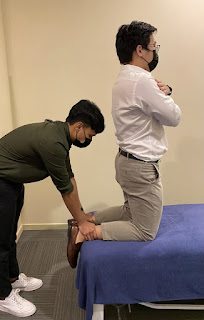
Starting position
Want to reduce your risk getting a running injury by half with no equipment needed? It takes less than ten minutes a week. It also helps you become a stronger and faster runner. What's the catch? Some of you will already be asking.


It almost sounds to good to be true, but this has well documented research to back it up. Researchers reviewed 15 studies (8459 male and female subjects) across different sports with subjects ranging from 18 to 40 years old. Those that did the Nordic hamstring exercises (also know as Icelandic curls) decreased their injury rates by 51 percent.
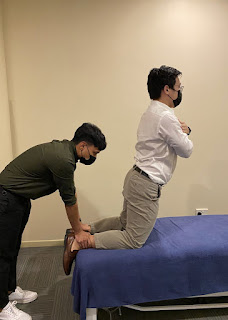
Lean forward and hold
My patients often struggle when I show them how to do it. We get the patient to kneel at the edge of our treatment bed with both ankles secured. The patient then progressively leans forward from the knees while keeping their back straight. When they can't hold the position any longer, they just use the hands to catch themselves as they fall forward.

Please bear in mind that the Nordic hamstring exercise (NHE) is extremely difficult to do. Some of my patients who had their anterior cruciate ligament (ACL) reconstructed can barely manage one rep before their hamstrings start to fatigue/ cramp. It's also quite common to get delayed onset of muscle soreness (DOMs) after attempting the NHE.

To progress, you can slowly increase the number of repetitions over two to three months. You can also lean forward further and hold that position longer before you fall forward.

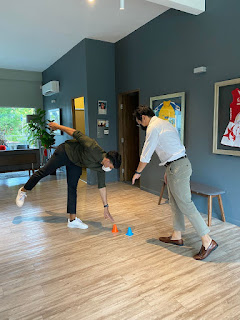
Arabesque
For patients who struggle to do a single repetition, I'll get them to start with another similar exercise to the NHE that lengthens the hamstring at the same time while it's contracting. I get my patients to do the Arabesque first. The patient stands on one straight leg with the other leg behind while attempting to reach forward to touch a bottle or a cone etc. This movement is repeated until fatigue sets in.

When the Arabesque becomes easy, they can progress to doing the NHE.

The above two exercises are also very useful in Australian Rules football, soccer and rugby since the hamstrings are commonly injured in these sports too.

One last tip, if you can't find anyone to hold your ankles while doing the NHE, try putting your feet under a couch with a mat in front to cushion your landing.


Reference

van Dyk N, Behan FP et al (2019). Including The Nordic Hamstring Hamstring Exercise In Injury Prevention Programmes Halves The Rate Of Hamstring Injuries: A Systematic Review And Meta-analysis Of 8459 Athletes. BJSM. DOI: 10.1136/bjsports-2018-100045.

Sunday, July 17, 2016

Fear Is Your Biggest Enemy When You're Injured


Now that's gotta hurt (Picture from Ang Kee Meng)
Are you recovering from an injury or recuperating from a surgery? Fear plays an enormous role when you're recovering from an injury, especially a long term injury.

Trust me I've had 3 knee surgeries on my right knee. For a few years after my 3rd knee operation I was paranoid about the slightest pain in my right knee. I made sure I only ran on grass (less impact or so I thought), read every single published article on articular cartilage injuries (my condition) and did lots of deep water running.

I remember every time if someone on the bus or MRT stood too close to me (let alone bump into my knee) I'll give the person a dirty look and move away.

So I'm pleased to share that I'm not the only paranoid athlete/ person around. Researchers suggest fear can determine whether or not an athlete makes a full recovery. Some athletes even have "post traumatic stress" back to the moment they got injured.

In a group of patients recovering from an anterior cruciate reconstruction (ACL) reconstruction, strength of muscles around the knees, functional range of movement, level of activity and intensity of pain were measured over the course of their recovery. Researchers also measure levels of kinesiophobia, pain related fear of movement,

The most common reason for not having a full recovery was the fear of getting injured again. These athletes did not have higher levels of pain than others in the study, they were just plain scared.

The researchers concluded that their results show that physical impairments may contribute to initial functional deficits whereas psychological factors (or fear) may contribute to longer term functional deficits in patients who are still fearful of re-injury. This fear and/ or lack of confidence may be a barrier to future sports participation.

Addressing your fear, alongside the physical injury is critical for your recovery.

Oh, by the way I forgot to mention that I've also fractured my skull before and had a compression fracture in my lumbar spine as well.

Come see us in either of our clinics if you're struggling to recover from your injuries/ surgery from fear, lack of confidence or other physical reasons.


Reference

Lentz TA, Zeppieri G Jr, George, SZ et al (2015). Comparison Of Physical Impairment, Functional, And Psychosocial Measures Based On Fear Of Reinjury/ Lack of Confidence And Return-To-Sport Status After ACL Reconstruction. AJSM. 43(2): 345-353. DOI: 10.1177/0363546514559707.

Thursday, September 19, 2013

What Do You Do When Your Child Tears His ACL


I was at the supermarket yesterday when I met a patient of mine and his wife. After we exchanged greetings they informed me that their teenage child had just tore his anterior cruciate ligament (ACL) during football training at the Singapore Sports School recently. 

A MRI scan taken confirmed that the ACL was torn. In addition, to complicate matters,the MCL and meniscus was also damaged and there was some bone bruising as well. They then asked for my opinion on what he should do. 

I thought writing about our chance encounter would be really helpful for other parents too and so this is how today's post came about.
My immediate suggestions were to settle the inflammation, regain pain-free full range followed by strengthening the muscles around the knee joint before deciding whether he needs to reconstruct his ligament. All of which are covered in this post in our other blog.
Concurrently, they probably needed to consult a surgeon or two as to whether he needed surgery. In an earlier post, we discussed a published study in which active adults who opted for specialized rehabilitation  after tearing their ACL may not need the operation as their knees were found to be clinically stable and had no real loss in function even five years later. 
However, their teenage son is definitely different from the active adults studied. Evidence suggests that athletes definitely perform better with a reconstructed knee. They definitely needed to discuss at length with their surgeon and their son as well whether he wants to resume competitive sports. I suggested that their son be present at these discussions as he may need to explain his own medical history to his future coaches and subsequently when he reports for national service in the army as well.
One important consideration would be the graft the surgeon chooses to use. Some studies suggest that using the hamstring graft means the hamstring muscle remains weakened even up to five years after the operation despite rehabilitation. There are also cadaver ligaments although a number of studies show that these frozen and sterilized tissues may not be as strong as the bone patella tendon or hamstring option.
One final suggestion was for their child to remain in close touch with his team. He should attend training sessions and games still and help with the coaching staff if necessary. this ensures he feels he's still part of the team and keep his spirits up.
* Picture from richseow - Raffles vs ACJC  'A' Division semi finals match, 2013.

Thursday, August 22, 2013

You May Not Need That ACL Operation


Here's a  follow up post to our current trends in ACL reconstruction management. You may not need an operation as you thought after tearing your ACL despite what your surgeon or your friends tell you, especially if you are still young.

I posted the article in our other blog. Go take a look.

*Picture from flickr.com