Showing posts with label squats. Show all posts

Sunday, March 17, 2024

Knees Out Or Knees In When You Squat?

Out (left) versus in (right)
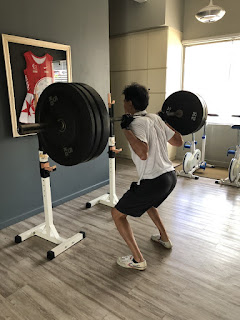
Here is a post that will perhaps change the way you squat. It depends on what area you want to work on. Previously, some physiotherapists and personal trainers hated me for saying that you can let your knees move forward when you squat. Most, if not all, personal trainers teach their clients that it is taboo to let your knees move forward while squatting, They get their patients or clients to stick their bums out instead.

Those same physiotherapists and trainers may be aghast if I suggest squatting with your knees pointing in (gasp!) or pointing out. 

The author recruited 14 males and 18 females for the squatting study (Chiu et al, 2024). Using 3D motion cameras and force platform meausures, normal squats required hip extensor, adductor and lateral rotator net joint movements (NJM). The gluteus maximus muscle exerts hip extensor and lateral rotator moments. The adductor magnus (pictured below) exerts hip extensor and adductor moments. Both muscles combine meet hip demands contributing to hip extensor NJM.
When squatting with hip in lateral rotation (feet pointing outwards), there was smaller hip extensor, lateral rotator and larger hip adductor NJM than normal squats. This loads the adductor magnus.
Medial rotation squats (feet pointing inwards) had smaller hip extensor and adductor NJM and larger hip lateral rotator NJM than normal squats. This loads the gluteus maximus.

Likewise if you stick your bum out when you squat, you are engaging more of your bum (Gluteus Maximus) muscles. If your let your knees move forward when you squat, you are definitely using your thigh (quadricep) muscles. If you want to increase hip adductor (adductor magnus) work, squat with your knees out. It just depends on what muscles you want to engage or work harder. Try it yourself.

There is definitely no real need to restrict forward knee movement when you squat. It's one of the biggest training myths ever. You can add squatting with your knees pointing inwards and outwards to the list of myths as well. 

This information should 'challenge' some old school "perfect squat" gurus.

Reference

Chiu LZF. "Knees Out" Or "Knees In"? Volitional Lateral Versus Medial Hip Rotation During Barbell Squats. J Str Cond Res. 38(3): 435-443. DOI: 10.1519/JSC.0000000000004655.

Monday, February 17, 2020

Who Says Your Knees Cannot Come Forward When You Squat


For almost as long as I have been working as a physiotherapist (> 20 years), I have often heard other physiotherapists, trainers, strength and conditioning coaches tell patients that it's wrong to let their knees come forward when performing a squat. That by doing so, they will damage their knees. In fact, I've had many arguments/ disagreements with my ex colleagues at Sport Singapore (formerly Singapore Sports Council) regarding this.

To which I say that it's one of the biggest training myths ever. Yes, that your knees should not travel forward past the toes during a squat is definitely a myth.

In a study by Fry et al (2003), the authors looked at how joint forces at the knees and hips changed when restricting forward knee movement during a squat. What the authors found was that squatting with restricted forward knee movement showed a 22% decrease in knee forces while increasing hip forces by 1070%!
Picture A- knee travels forward, B restricted knee movement
Hence, you're simply shifting the load from the knees to the hips and lower back when you restrict forward movement of the knee. This is a lot more work for your hips and back to absorb and is potentially more dangerous for your hip and back.

Yes, I do agree it's true that it does stress your knees more when you allow your knees to come forward while squatting. However, this is well within the normal limits of what the knees can handle (Schoenfeld 2010).

You go to any Crossfit gym and/ or watch any  Olympic weight lifters and you will see that in order to reach full depth in the squat, their knees will almost always have to go forward past the toes (see picture below). The Olympic weight lifters will often do that with very high loads too.
Picture from Irving Henson taken at The Pit
If you stick your bum out when you squat, you are engaging more of your bum (Gluteus Maximus) muscles. If your let your knee travel forward when you squat, you are definitely using your thigh (Quadriceps) muscles. It just depends on what muscles you want to engage more. Try it yourself.

Different types of squats will have different types of knee forward movement as well. Front squat, high bar back squat, low bar back squat and box squats just to name a few.

So now you know that there is no real need to restrict forward knee movement when you squat, especially if you want to load your quadriceps more. As long as you are not squatting excessively  and with a super heavy load like the Olympic weight lifters.

References

Fry AC, Smith JC and Schilling BK (2003). Effect Of Knee Position On Hip And Knee Torques During The Barbell Squat. J Strength Cond Res. 17(4): 629-633.

Schoenfeld BJ (2010). Squatting Performance And Kinematics And Their Application To Exercise Performance. J Strength Cond Res. 24(12): 3497-3506. DOI: 10.1519/JSC.0b013e3181bac2d7.

Now surely the knees have to come forward .... picture from Catalyst Athletics

Sunday, April 14, 2019

It May All Be In The Hips

*Very nice hip extension, Prefontaine leading Viren
Last week article was all about reducing your injury risk to stay healthy so you can keep training consistently.  Training consistently allows you to improve. For those of you who participate in races, this week's article will discuss how to improve your athletic performance with another simple exercise.

The biggest muscle we have in the human body is the big and very strong gluteus maximus muscle (there are also two smaller gluteus medius and gluteus minimus muscles). The gluetus maximus muscle extend our hips. This is evident when we're climbing stairs, running up slopes and especially if you're having to sprint for the finish line.

My patients who run tell me they often go to the gym to do strengthening exercises as well to get stronger. Often they are told by their personal trainers to make their quadriceps stronger. Nothing against making the quads stronger, but if you're hoping to improve your sprint performance by doing lots of squats then you should consider another exercise.

Researchers studied whether training the gluteus maximus or the quadriceps stronger was more effective for performance found that the hip thrust exercise (for gluteus maximus) more specific and better gains transferred to running/ sprinting (Gonzalez-Garcia et al, 2019).
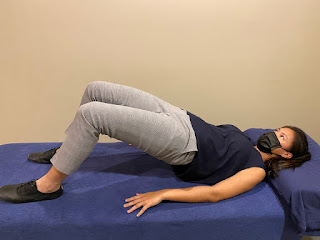
Hip thrust (also called bridging)
What exactly is a hip thrust? The easiest way to do it is lying on a firm surface with your knees bent and lift your buttocks (also known as bridging). You can add resistance by doing it with a elastic band around your waist to make it more difficult. In the hospitals, this exercise is often given to patients who are recuperating from surgery.
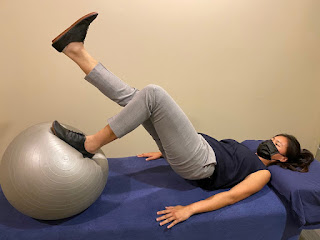
Single leg version on unstable surface
To progress, you can bridge on an unstable surface like a gym ball with both legs followed by single leg (picture above).

If you're in the gym, while facing upwards, you can rest your arms and neck on a bench and bridge with your knees bent. I've also seen gym rats resting a loaded barbell on the hips to make it more difficult.

All the above described exercises are all suitable and good if you want to make your hip extensors (gluteus maximus) stronger. However, they are all done lying down, i.e. in a non weight bearing position. In running, you are definitely upright and not lying down.
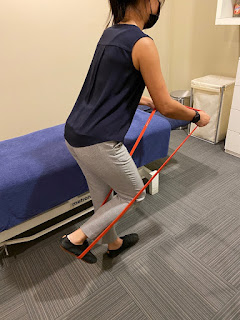
Starting position
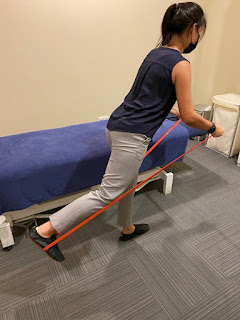
Hence, my preferred way to make the gluteus maximus stronger is in a standing position with an elastic band. Lean forward slightly with your back straight and straighten your right leg against the resistance of the elastic band. Repeat with good form until fatigue and do the same with your left leg.
Extending the R hip
I find that this way of strengthening the gluteus maximus is more specific and mimics the running posture. Strength gains are more easily transferred.


Reference

Gonzalez-Garcia J, Morencos E et al (2019). Effects Of 7-Week Hip Thrust Versus Back Squt Resistance Training On Performance In Adolescent Female Soccer Players. Sports. 7(4): 80. DOI: 10.3390/sports7040080.
*Taken from page 46 and 47 with my iPhone X from one of my favorite books "The Olympians" by Sebastian Coe with Nicholas Mason.

You see Steve Prefontaine leading Lasse Viren in the 1972 Munich Olympics with brilliant form! Excellent hip extension, Viren with his R hip, Prefontaine with his L hip. Both were wearing Adidas at this Olympics.

Prefontaine would later be the poster boy for Nike while Viren would do the same for Asics.