Showing posts with label gluteus maximus. Show all posts

Sunday, February 23, 2025

If You Want Buns Of Steel ....

Ok I admit, that was a heading to get you to read this post. But seriously, I had a patient who was referred to our clinic by a GP across the road.  He hurt his groin while doing Brazilian jiu-jitsu 2 months ago and had not gotten better. He said his previous physiotherapist just got him to do clam shell exercises and it did not help at all. 

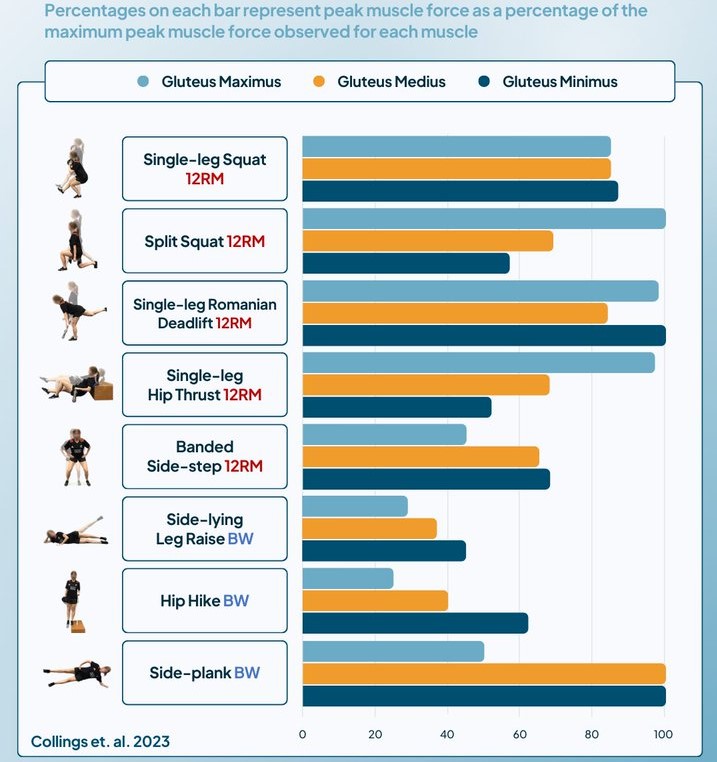
Want to know the best exercise for packing the biggest punch for the gluteal area? Let me share the results of the following study by Collings et al (2023).

Their study compared and ranked gluteal muscle forces in 8 hip focused exercises performed without and with external resistance, i.e. dumbbells or loaded barbell.

This 8 hip focused exercises in the study were single leg (S/L) squat, S/L Romanian deadlift (RDL), split squat, S/L hip thrust, banded side step, hip hike, side plank and side lying leg raise. The exercises were performed with and without weights for 12 reps max (RM)  and measured by electromyography (EMG). 

Analysis of muscle forces were limited to gluteus maximus (pictured above), medius and minimus (below). The results show that varying demands were placed on the individual gluteal muscles. Peak gluteal muscle forces significantly increased when all exercises were performed with weights compared with body weight alone. 

R gluteus medius and minimus
This is the first study to investigate a wide range of hip focused exercises that also includes isometric hip and hip abduction exercises. Clam shell exercises which you already know from my earlier  blog post is not great at activating gluteus medius and was not even included in this study. The S/L RDL and side plank  produced the highest peak gluteus medius and minimus muscle forces. 

Side plank
This is what I found most interesting. I was surprised that this variation of the side plank (pictured above) really targeted the gluteus medius and minimus too. It will be a good choice for physiotherapists to teach their patients this since no equipment is needed. Patients can easily do it at home or during on field/ court training.

Single leg RDL
We already know that the S/L RDL (pictured above) is good for  hamstrings strengthening. Done with weights, the S/L RDL activated high gluteus minimus force (100 percent observed) while gluteus maximus (98 percent) and gluteus medius (84 percent). S/L RDL is the go to exercise if you need to target all 3 gluteal muscles simultaneously along with the hamstrings.

To sum up, for the gluteus maximus, the split squat, S/L RDL and S/L hip thrust are the exercises that you want to do if that is what you want to train. The S/L RDL and side plank  produced the highest peak gluteus medius and minimus muscle forces. Those who are injured may start by doing the lower tier exercises and/ or reduce load (pictured above). You may want to remember this if your goal is to prevent injury, as part of rehabilitation or for performance.

Reference

Collings TJ, Bourne MN, Barrett RS et al (2023). Gluteal Muscle Forces During Hip-Focused Injury Prevention And Rehabilitation Exercises. Med Sci Sp Ex. 55(4): 650-660. DOI: 10.1249/MSS.0000000000003091

Sunday, September 8, 2024

Can You Prevent Running Injuries?

We have been seeing some runners in our clinic recently. Some seasoned runners, but quite a few new, novice runners. My definition is unless the runners have been training, running and/ or racing for at least 5 years, they are still considered novice runners.

As a runner I would love to run long and hard daily, alas if we do that injury definitely beckons. How do we prevent that from happening? Can we actually prevent running injuries?

I came across an article investigating if it was possible to prevent running injuries. In this particular study (Leppanen et al, 2024), there were 325 participants who were fairly new runners (less than 2 years of running experience) and aged between 18-55 years. Interventions were completed before the actual runs. The runners attended group training twice a week with a physiotherapist for 6 months.

They were divided into 3 training groups, 2 intervention and 1 control group. All 3 groups followed a similar training program and all runners were taught about the basics of running technique. The first intervention group (108 runners) did strength and conditioning exercises for the hip and core. The 2nd group (111 runners) did exercises to strengthen the ankle and foot, while a third control group (106 runners) did static stretching.

Each training session lasted about 30 minutes twice a week with the exercises and difficulty level progressing over the course of 6 months. Each exercise had 4 different versions with different levels of difficulty and intensity. After the training session, the participants ran outdoors for 30-75 minutes. The participants reported all running related injuries each study week using a mobile application.

Results show that the group that focused  on hip and core training sustained the least injuries among the 3 groups. They had 39 percent lower prevalence of all overuse injuries and 52 percent lower prevalence of overuse injuries compared to the control group. 

I was surprised that the  ankle and foot exercise group did not prevent running related injuries compared to the stretching group. The incidence of acute injuries was lower in the control group than ankle and foot exercise group perhaps suggesting that stretching may help prevent acute running injuries. However, do take note that there were a low number of acute running injuries in this study so this observation should be approached with caution.

This study shows that beginner or novice runners injury rates can be significantly reduced by training the hip and core muscles. Overuse injuries can be cut by about half by strengthening this area compared to stretching which has always been traditionally thought to prevent injuries. And it's really easy to do with just body weight and/ or resistance bands.

Come see our physiotherapists at Physio Solutions and Sports Solutions to learn about what stregthening exercises would help prevent running injuries for you.

Reference

Leppanen M, Viiala J, Kaikkonen P et al (2024). Hip And Core Exercise Program Prevents Running-related Overuse Injuries In Adult Novice Recreational Runners: A Three-arm Randomised Controlled Trial (Run RCT). BJSM. 58: 722-732. DOI: 10.1136/bjsports-2023-107926.

Sunday, April 14, 2019

It May All Be In The Hips

*Very nice hip extension, Prefontaine leading Viren
Last week article was all about reducing your injury risk to stay healthy so you can keep training consistently.  Training consistently allows you to improve. For those of you who participate in races, this week's article will discuss how to improve your athletic performance with another simple exercise.

The biggest muscle we have in the human body is the big and very strong gluteus maximus muscle (there are also two smaller gluteus medius and gluteus minimus muscles). The gluetus maximus muscle extend our hips. This is evident when we're climbing stairs, running up slopes and especially if you're having to sprint for the finish line.

My patients who run tell me they often go to the gym to do strengthening exercises as well to get stronger. Often they are told by their personal trainers to make their quadriceps stronger. Nothing against making the quads stronger, but if you're hoping to improve your sprint performance by doing lots of squats then you should consider another exercise.

Researchers studied whether training the gluteus maximus or the quadriceps stronger was more effective for performance found that the hip thrust exercise (for gluteus maximus) more specific and better gains transferred to running/ sprinting (Gonzalez-Garcia et al, 2019).
Hip thrust (also called bridging)
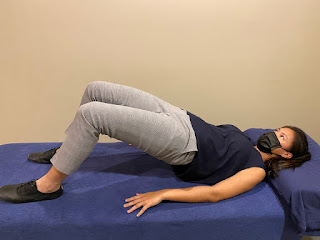
What exactly is a hip thrust? The easiest way to do it is lying on a firm surface with your knees bent and lift your buttocks (also known as bridging). You can add resistance by doing it with a elastic band around your waist to make it more difficult. In the hospitals, this exercise is often given to patients who are recuperating from surgery.
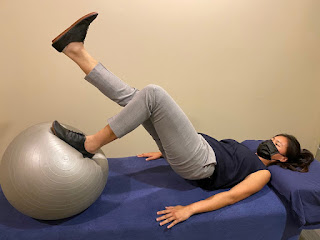
Single leg version on unstable surface
To progress, you can bridge on an unstable surface like a gym ball with both legs followed by single leg (picture above).

If you're in the gym, while facing upwards, you can rest your arms and neck on a bench and bridge with your knees bent. I've also seen gym rats resting a loaded barbell on the hips to make it more difficult.

All the above described exercises are all suitable and good if you want to make your hip extensors (gluteus maximus) stronger. However, they are all done lying down, i.e. in a non weight bearing position. In running, you are definitely upright and not lying down.
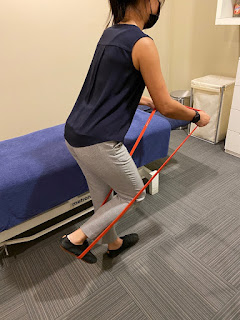
Starting position
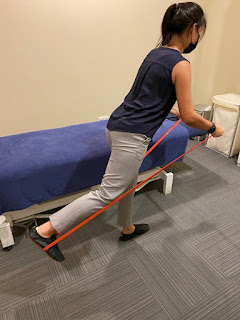
Hence, my preferred way to make the gluteus maximus stronger is in a standing position with an elastic band. Lean forward slightly with your back straight and straighten your right leg against the resistance of the elastic band. Repeat with good form until fatigue and do the same with your left leg.
Extending the R hip
I find that this way of strengthening the gluteus maximus is more specific and mimics the running posture. Strength gains are more easily transferred.


Reference

Gonzalez-Garcia J, Morencos E et al (2019). Effects Of 7-Week Hip Thrust Versus Back Squt Resistance Training On Performance In Adolescent Female Soccer Players. Sports. 7(4): 80. DOI: 10.3390/sports7040080.
*Taken from page 46 and 47 with my iPhone X from one of my favorite books "The Olympians" by Sebastian Coe with Nicholas Mason.

You see Steve Prefontaine leading Lasse Viren in the 1972 Munich Olympics with brilliant form! Excellent hip extension, Viren with his R hip, Prefontaine with his L hip. Both were wearing Adidas at this Olympics.

Prefontaine would later be the poster boy for Nike while Viren would do the same for Asics.

Monday, October 28, 2013

Achilles Pain Related To Your Glute Strength


I've just had 3 patients in a row today all come and see me with pain in their Achilles. Strangely enough, all 3 had weakness in their gluteus medius muscle despite that side being their dominant (and should be stronger) leg. That was also the leg that had Achilles pain. Hence this write up.

It has been published and I've written before on how your gluteus medius (or buttock muscles) can cause knee pain especially in females. Well guess what, I just found a published paper from Australian researchers that found a link between gluteus medius and maximus weakness and Achilles pain (in male runners). Yet more confirmation on how important your gluteus medius and maximus really are.

The Australian researchers in the published paper compared 2 groups of male runners where one group had Achilles pain while the control group did not. Both groups of  runners did short runs at about 6:40 min per mile pace and the group of runners with Achilles pain were found to activate their gluteus muscles later than the group with no Achilles pain.

And not only that, their gluteal activation was also shorter in duration compared to the pain free group. This is of significance as poorer gluteal muscle activation can cause increased hip internal rotation and adduction (movement towards the midline of the body) leading to Achilles problems.

The authors are suggest retraining and strengthening gluteal muscles be included for runners with Achilles injuries.

The causes of your Achilles pain can be multifactorial, one of which can be due to your weakness in your gluteus medius and maximus as described above. Come see us at Physio and Sports Solutions to treat the cause of your Achilles pain.

Worth a look?
Reference

Smith MM, Honeywill C et al (2013). Neuromotor Control in Runners with Achilles Tendinopathy. Med Sci in Sports Ex. doi: 10.1249/MSS .0000000000000133.

*Pictures from Flickr.com