Showing posts with label Adidas. Show all posts

Sunday, May 3, 2026

Sub 2 Hour Marathon

Back in 2017, renowned sports scientist Dr Ross Tucker wrote that a sub 2 hour marathon was unlikely to occur for generations. Then Nike introduced the Breaking 2 project which resulted in Eliud Kipchoge running under 2 hours albeit in a paced setting, not in an official race. 

The 2 hour barrier was finally broken last week at the London marathon when winner Sabastian Sawe and runners-up Yomif Kejelcha achieved the breakthrough, the latter running only his first marathon.

The podium
Sawe beat the previous world record by 65 seconds, finishing in 1:59:30 hrs. He ran an amazing negative split, 60:29 for the first half and the next half in 59:01 min. Kejelcha finished 2nd in 1:59:41 hours. The race was so fast that third place finisher Jacob Kiplimo also broke the previous world record (set in 2023) by 7 seconds. He clocked 2:00:28 hrs.

What lead to the breakthrough? Perhaps due to a "perfect storm" or convergence of many of the following factors. 

Sawe's team said he was running in excess of 200 km a week in the 6 weeks leading up to London, with a maximum of 241 km (150 miles). The volume of his training runs is likely an important factor for him to break 2 hours. Not many elite runners can tolerate that sort of volume, especially when most of it is done at low intensity (or Zone 1). High training volume done at relatively low intensity (Zone 1) is associated in faster marathon performances (Muniz-Pumarez et al, 2024).

Sawe's 5 km splits from 30 km onwards were superb. 30-35 km : 13:54 min, 35-40 km : 13:42 min. His final 2.2 km was 5:51 min. His 24th mile was 4:12 min - the fastest single mile ever run in a marathon. As the finishing line beckoned, he was still accelerating. No way he could have done this if he was not fueling well.

Sawe's nutrition was exceptional. I'm not plugging names here, in fact I've not even tried their products, but Sawe is a Maurten athlete. Elite athletes train their gut take up to 120 grams of carbs while competing without GI distress. The previous recommendation was 60 grams per hour previously. Sawe's reported intake was 115 grams an hour. Maurten's research team was with Sawe in Kenya for 32 days across 6 trips between last year and this April to train his gut to absorb that amount. 

Please note that 120 grams of carbs are NOT recommended for the recreational athlete. That is probably why cycling races and marathons are getting faster since there is no depletion in carbohydrate levels.

Sawe also used sodium bicarbonate (also from Maurten) to buffer his lactic acid build up during the race. He took the sodium bicarbonate early since it peaks in the bloodstream  roughly 60-90 minutes after ingestion so the timing of 2 + hours before the race would put peak buffering capacity at the start.

What about his shoes? Adidas says those were the fastest and lightest super shoes ever made. Actually, Adidas had a great day as 4 of the top 5 men were wearing the same Adizero Adios Pro Evo 3. It weighs 97 grams (for men's size 9), 30 percent lighter than its predecessor with a stack height of 39 mm (below the 40 mm limit by World Athletics). 

The Lightstrike Pro foam used is 50 percent lighter than the previous version, along with the carbon plate. Research suggests that the foam and carbon plate can affect the "spring like" bounce of the body as the foot strikes and leaves the ground. The shoes help to store and release energy and acts like the runner is pushing off a springboard so less energy is needed for the run.

London is considered a relatively fast course (though not as fast as Berlin) and the weather conditions was between 13-17 degrees Celsius, close to ideal.

There you have it, exceptional athlete physiology, high mileage training without injury, efficient biomechanics, super shoes , optimized fueling and favorable conditions. The recipe for success for running marathons.

Reference

Muniz-Pumares D, Hunter B, Meyler S et al (2025). The Training Intensity Distribution Of Marathon Runnersd Across Performance Levels. Sports Med. 55: 1023-1035. DOI: 10.1007/s40279-024-02137-7

Sunday, April 14, 2019

It May All Be In The Hips

*Very nice hip extension, Prefontaine leading Viren
Last week article was all about reducing your injury risk to stay healthy so you can keep training consistently.  Training consistently allows you to improve. For those of you who participate in races, this week's article will discuss how to improve your athletic performance with another simple exercise.

The biggest muscle we have in the human body is the big and very strong gluteus maximus muscle (there are also two smaller gluteus medius and gluteus minimus muscles). The gluetus maximus muscle extend our hips. This is evident when we're climbing stairs, running up slopes and especially if you're having to sprint for the finish line.

My patients who run tell me they often go to the gym to do strengthening exercises as well to get stronger. Often they are told by their personal trainers to make their quadriceps stronger. Nothing against making the quads stronger, but if you're hoping to improve your sprint performance by doing lots of squats then you should consider another exercise.

Researchers studied whether training the gluteus maximus or the quadriceps stronger was more effective for performance found that the hip thrust exercise (for gluteus maximus) more specific and better gains transferred to running/ sprinting (Gonzalez-Garcia et al, 2019).
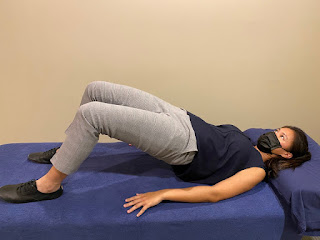
Hip thrust (also called bridging)
What exactly is a hip thrust? The easiest way to do it is lying on a firm surface with your knees bent and lift your buttocks (also known as bridging). You can add resistance by doing it with a elastic band around your waist to make it more difficult. In the hospitals, this exercise is often given to patients who are recuperating from surgery.
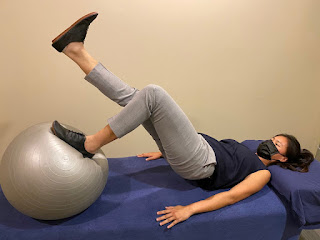
Single leg version on unstable surface
To progress, you can bridge on an unstable surface like a gym ball with both legs followed by single leg (picture above).

If you're in the gym, while facing upwards, you can rest your arms and neck on a bench and bridge with your knees bent. I've also seen gym rats resting a loaded barbell on the hips to make it more difficult.

All the above described exercises are all suitable and good if you want to make your hip extensors (gluteus maximus) stronger. However, they are all done lying down, i.e. in a non weight bearing position. In running, you are definitely upright and not lying down.
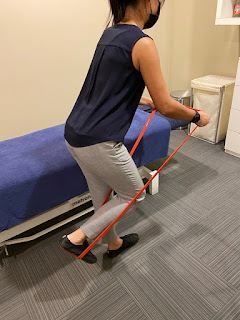
Starting position
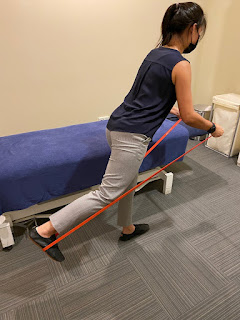
Hence, my preferred way to make the gluteus maximus stronger is in a standing position with an elastic band. Lean forward slightly with your back straight and straighten your right leg against the resistance of the elastic band. Repeat with good form until fatigue and do the same with your left leg.
Extending the R hip
I find that this way of strengthening the gluteus maximus is more specific and mimics the running posture. Strength gains are more easily transferred.


Reference

Gonzalez-Garcia J, Morencos E et al (2019). Effects Of 7-Week Hip Thrust Versus Back Squt Resistance Training On Performance In Adolescent Female Soccer Players. Sports. 7(4): 80. DOI: 10.3390/sports7040080.
*Taken from page 46 and 47 with my iPhone X from one of my favorite books "The Olympians" by Sebastian Coe with Nicholas Mason.

You see Steve Prefontaine leading Lasse Viren in the 1972 Munich Olympics with brilliant form! Excellent hip extension, Viren with his R hip, Prefontaine with his L hip. Both were wearing Adidas at this Olympics.

Prefontaine would later be the poster boy for Nike while Viren would do the same for Asics.

Friday, October 2, 2015

Don't Try Anything New On Race Day

Elid Kipchorge and his shoes
I was away on holiday this past week after teaching the Kinesio Taping Level 1-2 course over the week end and did not have regular internet access at where I was.

Having just returned, am catching up on all my mail and news and I came across the results from the recently concluded 2015 Berlin marathon.

Eliud Kipchorge ran and won in a personal best time of 2:04:01 hours in a pair of prototype shoes that malfunctioned!!

According to reports, Kipchorge started having problems with his prototype Nike Air Streak 6 barely just a kilometre into the race. He bravely ran on even after the insoles popped out at the 20 kilometre mark forcing him to run the remaining 22 kilometres with flapping insoles.

Look in your own running shoes and you will find a insole (or sock liner) which is usually easily removed and can be replaced by your own custom orthotic if needed.  They are normally fairly secure and I've never seen them come off during a run (or a race for that matter). Racing flats usually have flatter and thinner inserts that are often glued down and not easily removed.

He ended up with blisters on his left foot and a cut on his big toe with lots of blood.

Remembering he was a sponsored athlete, he added with good PR skills "We have talked with technicians and even the highest authority of the (Nike) company. They are resourceful people. Remember, in life, challenges must be present and I urge my fans to run to Nike stores and grab this version immediately when it's out".

Ethiopian running legend Haile Gebrselassie joked tongue-in-cheek that Nike shoes would never be better than his preferred brand of Adidas. Maybe that's why Gabrselassie joked about it, as Kipchorge was previously sponsored by Adidas.

As you've often heard from me, don't try anything new on race day. I've learnt the hard way before too. Now that's a different post.

Talking about the Nike Air Streaks, I owned a pair of the first version way back in 1997. You can see it below.
The original Air Streak