Showing posts with label foam roller. Show all posts

Sunday, March 7, 2021

No Need To Stretch Or Foam Roll Your ITB?

You are a runner and you haven't been able to run more than 2 km before a sharp pain in your outer knee reduces your run to a hobble. Resting, icing and changing your running shoes made no difference. The sports doctor you saw just diagnosed you with the dreaded Iliotibial Band Syndrome (ITBS). He tells you that you need to stretch your Iliotibial band (ITB) and use a foam roller.

Sounds familiar? Well, this latest published paper on the ITB by Paul Giesler (2020) challenges common treatment approaches of stretching and massaging the ITB. Basically, he says that you do not want to stretch or foam roll your ITB.

Attachments of ITB at L knee
I've written about the ITB before in a few different posts. Except for Daniel Liberman and Carolyn Eng's study, most other articles seem to suggest that the ITB causes pain via a 'friction syndrome'. This is thought to be due to the ITB rubbing to and fro over Gerdy's tubercle on the outer shin bone while running due to hip weakness. 

Treatment is normally targeted at stretching the ITB (to reduce friction). Doctors will often suggest a steroid injection to reduce 'inflammation' (in the bursa) on the outer knee.  Giesler (2020) however,  suggested that ITB pathology is more likely to involve compression of sensitive structures beneath the ITB rather than friction.

also know as Iliotibial tract (ITT)
Since the ITB is a really broad, strong and complex structure with many attachments (picture above) along the hip, thigh and around the knee, it can provide stability for both the hip and knee. Like I wrote before, the ITB is actually thought to function like our Achilles tendon. To store and release energy like a spring. Therefore you cannot and would not want to stretch a spring. A coiled spring can release energy much better than a spring that is stretched out.

From Carolyn Eng's running simulation 
Hence the need to treat the cause of the problem rather than just treating the pain over the outer knee. Hip strength and control thus thought to be key in causing ITBS, especially weakness in hip increased hip adduction (dropping of the hip inwards) during loading. 

Runner on L has increased hip adduction
In runners/ patients with excessive hip adduction while running, progressive rehab and addressing potential causes should be adapted for individual runners, especially while running downhill and during longer runs. I've written on this topic specifically, you can read that article here.

So treatment should be to calm the symptoms (knee pain) and treat the cause. We don't get you to stretch your ITB or use the foam roller in our clinics, come see us if you want to run pain free.

The Paul Geisler (2020) article is free, click on the link under references if you want to read it.

References

Bramah C, Preece SJ Nimh G et al (2018). Is There A Pathological Gait Associated With Common Soft Tissue Running Injuries? AJSM. 46(12): 3023-3031. DOI: 10.1177/0363546518793657

Eng CM, Arnold AS, Liberman DE et al (2015). The Capacity Of The Human Iliotibal Band To Store Elastic Energy During Running. J Biomech. pii: S0021-9290 (15) 00354-1. DOI:10.1016/j.jbiomech.2015.06.017.

Geisler PR (2020). Iliotibial Band Pathology: Synthesizing The Available Evidence For Clinical Progress. J Ath Trg. DOI: 10.4085/JAT0548-19

Saturday, March 24, 2018

Storm Before Floss Band Course

Storm outside our clinic
There was a big storm before the Floss band course today and maybe that's why the turn out was less than normal. But it certainly didn't dampen our spirits. We had a chiropractor, physiotherapy students, a Singapore Cycling Association coach, another strength and conditioning coach from CrossFit Fire City and personal trainers.
Flossing Ben's knee
As usual, I took the time and effort to explain Tensegrity, what and how our fascia functions and the Pain Gate Theory (by Ronald Melzack and Patrick Wall, 1965) so that the participants understand how the Floss band works. And they can in turn explain to their patients, athletes and friends what the Floss band does.
Can't touch my head
A big thank you to Amy, Danny, Ekina and Jane for coming to get the clinic ready for the course. That allowed me to eat after I saw patients in the clinic from this morning. And for packing up after, so I can see another patient.

A big thank you to everyone who came despite the heavy storm before. Hope everyone learnt useful strategies that you can use use in your own area or work, play and training.

Please contact them at Sanctband Singapore for the next Floss band course and if you need to get the Floss bands.

A big thank you to everyone who came despite the heavy storm before. Hope everyone learnt useful strategies that you can use use in your own area or work, play and training.

Saturday, September 23, 2017

FFTT - Floss Band, Foam Roller, Trigger Ball And Taping

Underwrap? To explain fascia?
It's been a few months since we had our last floss band course. I was told by Jane we had eight previous courses so far.

After the last course Jane mentioned to me that many people have asked about the benefits and especially differences between using the Floss band, foam roller, trigger ball and taping.

She told me my new task was to effectively address how FFTT - floss band, foam roller, trigger ball and taping can be effective (or not depending on how you use them) in treating myofascial pain, addressing adhesion/ knots in fascia and improving range of motion.

Talking about fascia
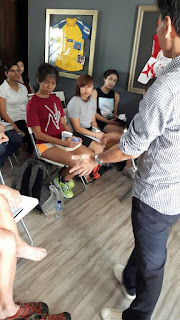
We spent lots of time on the anatomy of fascia. After explaining how to effectively move fascia, we went on to the practical part of the course. Demonstrations using the floss band, foam roller, trigger ball were shown.
Marc helping with the foam roller demo
For the taping bit, I just showed the class pictures. You've got to come to our Kinesio Taping course if you want to learn the taping techniques.

Let me also mentioned that other than Kinesio TapingFunctional Fascial Taping (or FFT) using rigid sports tape too can influence fascia.

Functional fascial taping for the knee
Ron Alexander who used to treat the Australian Ballet dancers developed the technique while working with the ballet dancers.  If you've attended the course, you will know how much you need to "gather" or pull the tape. In Kinesio Taping, the ability of the Kinesio tape to recoil does the work for you.

Once again, chapeau to Jane, Danny and Ekina for coming to get the place ready and for helping me to pack up too. I wouldn't have gotten ready in time to teach without their help. Please contact them at Sanctband Singapore if you are keen to find out more.

Thank you also all the physiotherapy students, physiotherapists, Terrance Yap from Atlas Chiropractic, the teachers from Nanyang Junior College and the rest who attended the course today. Hope you found it useful.
Getting Tang from NYJC to march
The physiotherapy students and their discussion
Gek Han deep in thought
Gurmit comfy on the floor

Sunday, April 7, 2013

Trigger Ball Workshop

Participants at a Trigger Ball Workshop learnt many techniques to find their trigger points and release them with the use of a trigger ball. The trigger ball is a simple tool to use for the release of tight muscles which are a result of sport or sitting for long periods at work.

Gino shared the common trigger points and the ways to use the ball to reduce the tension in muscles. This ball that resembles the durian makes a great travel buddy. You can use it on the go, anywhere, as soon as you start to feel muscle tension in your body.

Do email us at admin@sportssolutions.com.sg if you'd like to find out more about the courses and workshops that we offer.
You have to be on the ball!

Releasing the low back

Demonstrating the 'leopard crawl'

Enjoying this one...not!