Showing posts with label Minimalist shoes. Show all posts

Sunday, May 21, 2023

Do Orthotics Reduce Kneecap Loads In People With Knee Pain?

Many of our patients wear insoles (or orthotics) as they have been told that it 'corrects' their flat feet while helping to reduce excessive forces on their patellofemoral (kneecap) joint. This then helps to prevent kneecap pain.

Customed made orthotic
Well, if you have been told (by your health professional) that you need insoles/ orthotics for the same reasons, now you can tell them that this latest published systematic review/ meta analyses from the BJSM suggests otherwise. This is a very important study since kneecap pain is very commonly seen in in our clinics (and many others) affecting both the young adolescents and older adults. 

The authors identified 33 eligible studies and did 3 different comparisons during walking and running combined. Using insoles/ orthotics with medial (arch) support versus no insoles, minimalist shoes versus conventional footwear and lastly rocker versus non-rocker footwear.

Arch supports
Analyses by the authors showed that insoles/ orthotics that support your medial arches DID NOT alter kneecap loads during walking or running. This questions results from previous research that suggests the pain reducing effects of insoles/ orthotics. The reduction in pain may have been due to other influences and not the reduction in kneecap loads.

Results also show that mimimalist type footwear reduced peak kneecap loads when compared to conventional footwear during walking and running combined. This systematic review demonstrated an average 9.5 percent reduction in kneecap load in minimalist type footwear compared to conventional footwear over a run of just 1 km. This translates to 1,462 kg for an 80 kg person. This is clinically relevant considering the cumulative load reduction that can occur over numerous loading cycles during running.

I've written about this known fact many times over the years. Using results from Daniel Liberman's study (2010), runners who land correctly in their running technique will have benefits as impact is a lot less (even less than landing on your heels with cushioned shoes on).  If you land wrongly (with minimalist type shoes) the impact is 7 times greater thus greatly increasing the chance of injury. See picture below.

Because kneecap loads are reduced, they are transferred to the ankle and foot bones leading to fractures in the foot bones especially when you do too much too soon. Hence, correct technique and patience is crucial using minimalist type footwear. This is why many podiatrists say minimalist type footwear is not good (for you) since they cause foot  and metatarsal fractures, but bear in mind podiatrists also cannot sell you orthortics to place in your minimalist type footwear. 

You have also never seen Kipchoge or any elite marathoners wear these minimalist type shoes in a race. The body's muscles will not be able handle absorbing the load (while wearing minimalist type shoes) while running at the high intensities at which these races are contested.  They are good for training definitely, but not for racing, especially if you are not patient enough to get used to them. 

Evidence regarding the effect of rocker-soled shoes (see below) during walking and running were uncertain due to limited studies.

Take home message from the researchers is that minimalist type footwear reduces kneecap loads compared to conventional footwear in people with or without kneecap pain during running. 

Insoles/ orthotics that support the arches do not alter kneecap load during walking or running. Now you know for sure.


References

Liberman DE, Venkadesan M et al (2010). Foot Strike Patterns and Collision Forces in Habitually Barefoot Versus Shod Runners. Nature. Jan 463(7280): 531-535.

Kayll SA, Hinman RS, Bryant AL et al (2023). D Biomechanical Foot-based Interventions Reduce Patellofemoral Joint Loads In Adults With And Without Patellofemoral Pain Or Osteoarthritis? A Systematic Review And Meta-analysis. BJSM. DOI: 10.1136/bjsports-2022-106542

MBT rocker-sole shoes
*Thanks to Hui Meng for getting me the article

Sunday, November 7, 2021

My Basic Guidelines For Running

Screenshot from the talk
Thank you to those of you who took time to attend the talk on running we had 3 days ago. From the 'live' questions and those I received via email, it seems like many Singaporeans did take up running last year during the circuit breaker/ lockdown. Good to know that many have continued running since then.

Many of these runners are not aspiring to complete a marathon (not yet anyway). However, they all seem to want to run faster. Well, as runners, we all want to run faster and longer for some reason. 

Over the years, I've put together a set of guidelines for runners, my patients or anyone who wants to keep running for health, fitness or performance.

Some runners swear by their heart rate monitors (HRM). Those who know me know that I do not like training with a heart rate monitor (HRM) even though I was sponsored by Polar Heart Rate Monitors when I was still competing. I just used their HRM as watches. (FYI - Polar was the market leader for HRM before Garmin came along and disrupted that market). 

I am not against anyone training with HRM's. My take is that our bodies do not work in physiological zones where exceeding aerobic zones is a crime. When feeling good, your easy runs can be a little faster, But if you're tired or not recovering quickly, then I'd say your easy run can be at a snail's pace. Better still take a rest day. No doing planks, core exercises etc, just total rest. 

The next few suggestions are specially for those who run ultras. Please don't feel obligated to follow anybody's training, especially if they're pro or semi-pro. This means trying to clock 100 km a week, running twice a day etc. All of these tips/ suggestions on training have too many confounding factors and variables so do not even venture there. Plus in sunny and super humid Singapore, it takes a lot more to recover from all that mileage.

Don't keep chasing mileage and vertical (climbs) totals. They are variables for stress, but they are not the actual stress experienced by your body. A 20 km run is just a 20 km run. Or it may act like a 30 km run if you have been up at night with a sick child or rushing a dateline at work. Our bodies know the distance we've covered, but stress from other non physical factors mentioned above is interpreted as stress by the body too. More stress is not always better. Our bodies can adapt to lower or higher volume as long as the stress is appropriate for you.

I have patients who deliberately fast before training to improve performance. Perhaps it MAY improve energy efficiency in some (very few) athletes, but I rather they eat and find their 'strong' to train harder instead of messing with their sensitive metabolic pathways.

Those of you who listened to my talk will know that I'm not recommending minimalist nor maximalist shoes for everyone. Wear shoes that are comfortable for you and not anyone else. Different shoes work for different people.

Do stay active and engaged in activities and groups you find meaningful and care about you, as they help increase both quality and quantity of life. Social interaction is critical for mental and physical health.

Sunday, November 15, 2020

Towel Scrunching Exercises For Your Feet?


Have you ever been asked to do foot strengthening exercises? A patient who saw me this week was asked to do foot strengthening exercises by another health professional who saw him recently. This included some towel scrunching exercises for his "collapsed arches" so as to strengthen the muscles supporting his arches

My patient was quickly bored and I told him just walking in minimalist footwear would be just as effective as doing strengthening exercises for the foot.

We know from published evidence that weakness in our intrinsic foot muscles can lead to a variety of load related injuries. And supportive footwear can contribute to intrinsic foot muscle weakness since these muscles tend to switch off (since they aren't absorbing forces and controlling foot movement) while walking and running.

Researches randomly assigned runners into three different groups. One group wore minimialist shoes (Vivo Barefoot), another group did foot strengthening exercises and the third was a control group. All groups maintained their running mileage throughout the study.

The minimialist footwear group increased their walking step count weekly while the foot exercise group did progressive resistance exercises at least 5 days per week.

Foot muscle strength and size were measured via ultrasound at the start of the study, week 4 and at the end of  the study (week 8). Researchers found all foot muscle sizes and strength had increased significantly in both the minimalist footwear and foot strengthening exercise group. There were no changes in the control group.

The researchers concluded that walking in minimialist shoes is just as effective as doing strengthening exercises for your feet. It is definitely way more convenient changing footwear rather than doing specific foot exercises. This may result in better compliance with patients.

So definitely don't throw away your Vibrams or barefoot styleminimialist type shoes. They are definitely still useful. Vibram ended up with a bad reputation after they were sued. 

However, I feel minimalist type shoes were unfairly criticized as the evidence for barefoot or minimalist type shoes are actually sound provided your running technique is correct. 

*Much less impact if technique is correct-see below

If you walk with barefoot style/ minimalist type shoes instead or running (to strengthen your intrinsic foot muscles) there will be a much lower risk of injury.

Definitely still useful. And much less boring than doing towel scrunches.


Reference

Ridge S, Olsen M et al (2019). Walking In Minimalist Shoes Is Effective For Strengthening Foot Muscles. 51(1): 104-113. DOI: 10.1249/MSS.0000000000001751.

Liberman DE, Venkadesan M et al (2010). Foot Strike Patterns And Collision Forces In Habitually Barefoot Versus Shod Runners. Nature. Jan 463(7280): 531-535.

*Using results of Daniel Liberman's study, runners who land correctly in their running technique will have benefits as impact is a LOT less (even less than heel striking with cushioned running shoes). If you land wrongly (with barefoot style shoes), the impact is 7 times greater thus greatly increasing the chance of injury. See picture above.

Sunday, November 27, 2016

Are There Any Benefits In Running With Zero Drop Shoes?

My wife's zero drop running shoes
Although you don't see it as much now, the minimalist type running shoes were the rage all few seasons ago. These minimalist type (and not the barefoot type) usually have a relatively low heel to toe drop. Meaning the height in the midsole and the outsole at the back of the shoe is almost level and/or no difference in height.

One proposed benefit of zero drop running shoes is that it may reduce injury. Shoes with a large drop encourage severe heel striking which can contribute to knee injuries. With zero drop shoes, it may also allow your feet to land as if you were not wearing shoes which helps to distribute impact forces.

Shoes with a high drop may also tilt you forward too much and contribute to alignment and compensatory discrepancies.

If you visit the running section of most running stores now, most midsoles of current running shoes are almost back to before when they were much thicker. But many manufacturers have retained the zero drop while offering plenty of cushioning like the Hokas and Altras.

A recent study however found that a shoe's heel to toe drop may not have have anything to do with running injuries.

The researchers studied 533 non elite runners wearing running shoes with 0, 6 or 10 millimetres (mm) drop for six months. The running shoes were 2l mm in the heel and forefoot, 21 mm in heel and 15 mm in forefoot and 24 mm in heel and 14 mm in forefoot respectively. The shoes were otherwise similar.

25 percent of the runners reported being injured during the six month study period. An injury was defined as leg or lower back pain that resulted from running and prevented planned running for at least one day.

The main finding of the study was that injury rates among the three groups were similar, regardless whether their shoes had a heel to toe drop of 0, 6 or 10 mm.

However, among the runners who ran more frequently, those in the 0 or 6 mm drop shoes had a higher injury rate than the frequent runners with a 10 mm drop.

The researchers suggested that that this may be due to the runners transitioning to fast from their regular running shoes to zero drop shoes leading to increased injury rates as 78 percent of the runners recruited in the study hadn't run in zero drop shoes before.

I remember when I was racing cross country races as a kid we used to train in heavier cushioning shoes and then switched to racing flats for the race. It was very common to have sore calves after the first few races of the season as I've not done enough running in the racing shoes (which had lower drop than the training shoes). Yes, racing flats back then were very similar to the zero drop shoes now.

It was more apparent (sore calves) switching to racing spikes for the track training and track meets when cross country season ended and I raced in track events.

As I always tell my patients, their running technique is much more important than their running shoes. Be sure to rotate your running shoes to minimise injuries too.

Reference

Malisoux L, Chambon N et al (2016). Influence Of The Heel-to-Toe Drop Of Standard Cushioned Running Shoes On Injury Risk In Leisure-time Runners. A Randomized Controlled Trial With 6-month Follow-up. AJSM. 44(11): 2933-2940. DOI: 10.1177/0363546516654690.


Now, this is what I'll call a racing flat

Friday, September 16, 2016

Earth Runners Huraches/ Running Sandals Review

My Earth runners huraches
More than a year ago Mike Dally, founder of Earth Runners contacted me and asked if I was keen to review a pair of his earth sandals. I wrote back and said that I would be most happy to try a pair and mentioned that I live in Singapore.

Mike simply wrote back and asked for my size and mailing address. I requested for the Alpha X-11 mm which was a bit thicker and were more moldable. Mike added he was sending me the conductive leather laces.

The sandals were "zero drop" (same thickness between heel and the forefoot). There was a strap between the big and second toe and buckle on the outside the secure the sandal.

What was interesting was that I noticed there was a copper grounding insert flushed with the Vibram outsole. I later read that they were there to offer electrical conductivity  (or earthing). This is to offer the primal experience of walking/ running grounded to the earth. You can read more about the concept of earthing here. The copper inserts did not bother me at all while walking or running.
Copper inserts
I've waited a long time to write this as I wanted to wear the sandals in a bit before commenting. Mike Dally told me to take my time as most of the reviewers feedback was the longer they'd worn the sandals the more comfy they feel.

I first wore them mostly at home for up to a couple of hours at a time. I found that the leather straps (even though they were very soft) tend to cut into my first web space between my big and second toe. Because of this, I felt slightly more discomfort over the base of the second toe. Otherwise I had no issues at all with walking. The buckle at the side tightened without any difficulty at all.

I've began to wear them more recently as my older boy has been wanting to ride his bicycle. He can ride well but is afraid to stop as his feet can't touch the ground yet.

Lending a helping hand
So almost every single morning he's been asking to ride so I just wear my earth sandals with normal ankle socks and run alongside him steadying him when the need arises.


How does the sandal feel while running? If you've run in minimalist shoes, then you'll understand when I say they have a fair ground feel. They were nice to run in after you've broken them in and gotten used to them. They offer more than ample protection for the running that I do. If you have black toenails like me, then they will be very much appreciated since there's nothing for you to jam your toes against.

For the fashion conscious, hey look real cool with its raw genuine hurache appearance and you can wear them pretty much everywhere else.

Thanks Mike for a great pair of running sandals.

Wednesday, May 20, 2015

Huraches/ Running Sandals From Earth Runners


Here's what arrived in the mail for me today? Yes, A pair of running sandals from Earth Runners.

Otherwise known as huraches. Used to have a pair from Nike years ago, although those were really running shoes called Nike Air Huraches and not sandals like the pair I got today. The Tarahumara Indians will probably wear something similar to this.

Used to have a pair like this

Well, let me do a few runs in them and I'll tell you how they feel, stay tuned.

Another look at my Earth Runners

Sunday, November 30, 2014

What Happens On Your First Run In Minimalist Running Shoes

Nike Free 3.0 (left) and 4.0 (right)
Runners hate getting injured since they usually can't run while nursing an injury. To minimise injury, you can vary the impact forces by running on different surfaces, running at different speeds and running on different terrain. I wrote previously that rotating your running shoes can help prevent injury as it loads bones and soft tissue differently.

Vibrams have been taken to task for advertising that wearing their shoes can help you change your running gait and thus prevent injuries.

Now I have good news for runners wanting to try minimalist running shoes. Another study has shown that switching from conventional running shoes to Nike Frees does not change your running gait, which is great for those of you thinking of transitioning to minimalist running shoes provided your running technique is correct.

Researchers had runners who were used to running in conventional running shoes do three 10 minute runs. First 10 minutes in their normal shoes, then in Nike Free 3.0, and in their normal shoes again.

The researchers expected the runners would change their gait while running in the Nike Frees as they were unfamiliar with the shoes. (This is thought to increase injury risk as you need to get used to a different shoe).

The researchers were surprised to report that in trained runners, there was no change in lower limb variability while wearing minimalist shoes for the first time. It was similar when the runners switched back to their regular shoes.

My own personal take on this? As written previously, the Nike Free's are probably on the conservative end of minimalist running shoes (as compared to say Vibrams) and provide cushioning close to traditional running shoes. It may be different for minimalist shoes that are more minimalist.

Now while I'm writing on Nike Free's, remember I received 3 pairs of Nike Free's earlier this year? Well, I guess it's not too late for me to write a little on how the shoes feel since I've logged some decent miles in them.

Since late May this year I've been working a couple of half days at Physio Solutions. I usually try to run home after I'm done seeing patients there.

Well, I worked there 3 half days this week, which means I ran home 3x this week!! When I first started running home, I ran mostly in my 3.0's. Now I prefer the 4.0, mainly because the 3.0 seems to run a bit on the short length wise. Probably half a size smaller. My suspicions were confirmed when I put my 3.0's and 4.0's together. Though both were listed as size 7, the 3.0's were a tiny bit smaller.

Slight difference in length even though both same size
Width wise the 3.0's were pretty snug. Again I found it easier to put on and take off the 4.0's compared to the 3.0's. The 3.0's had a more "sock-like" feel compared to the 4.0's. Both have very soft midsoles. I sometimes try to cough deliberately when I'm running to pass someone as quite a few people who don't hear me have been startled when I run pass them.

As for my 5.0's,I've not run in them yet, just worn them for walking around.

Reference

Frank NS et al (2013). Lower Limb Kinematic Variability Associated With Minimal Footwear During Running. Footwear Sci. 5(3): 171-177.  DOI: 10.1080/1942480.2013.797505.

*Thanks to Andrew Kwong again for my 3 pair's of Nike Free's, to Andrea Goh for bringing them and Ernest Rodrigues and Duane Wee for previous Nike Free's.

My previous 5.0 all worn
The "pull-tab" makes it easier to wear

Sunday, May 18, 2014

Today's Straits Times Article 180514

Have a look at page 17 of today's Sunday Times under the Home section and you'll see Sports Solutions quoted in the article. The journalist asked about our views on the Vibram Five Fingers lawsuit, the health benefits and also the general vibe of the running community regarding this case.

I was quoted as saying the evidence for barefoot or minimalist style is actually very sound provided the wearer's running technique is correct.

Using results of Daniel Liberman's study, runners who land correctly in their running technique will have benefits as impact is a lot less (even less than landing on your heels with  shoes on).  If you land wrongly (with minimalist shoes) the impact is 7 times greater thus greatly increasing the chance of injury. See picture below.

From Liberman's article
Unfortunately most of us (runners) are very impatient for results and do not master the correct running/ landing technique while just using minimalist shoes thinking that will be sufficient.
 
Also read why if you run in more cushioned/ expensive shoes, the more likely you seem to get injured to further support why running in minimalist shoes with correct technique is superior to running with cushioned/ expensive shoes. 

Reference 

Liberman DE, Venkadesan M et al (2010). Foot Strike Patterns and Collision Forces in Habitually Barefoot Versus Shod Runners. Nature. Jan 463(7280): 531-535.

Email me if you want the article.

My own minimalist running shoe in the picture below. My brother bought it for me from Shanghai for $RMB30 (or S$6) , much cheaper than Vibrams ($149-$209 here in Singapore).

Like I've always said and written, it's not what shoes you wear, its your technique that's more important.

Friday, February 21, 2014

Running Injuries Linked To Your Footstrike

Photo by Jordan Shakeshaft from flickr
I wrote earlier that the minimalist/ barefoot inspired type running shoes sales were declining, however researchers seem to be very keen on finding how they affect running still. To put it simply, researchers are very interested to find out if barefoot running, minimalist shoes or how you land (forefoot, mid or rear) can reduce injuries.

A group of South African researchers specifically studied how barefoot running (or forefoot striking) affects five common running injuries.

Bear in mind that many researchers and runners alike tend to assume "barefoot running" and running with forefoot/ midfoot strike as similar although some studies have shown differences.

Well, here are the main points on the five common running injuries. Regarding shin splints/ tibial stress fractures injuries are decreased by barefoot running although runners have to be extra careful with transition time from their previous more cushioned shoes.

Increased incidences of metatarsal (or your foot) stress fractures with barefoot running. I've seen some of our patients with metatarsal fractures after switching to Vibram Five Fingers.

As I've written earlier before, good news if you have knee pain as it may be reduced by barefoot running, but not so good news if you have Achilles tendon injuries as it may be increased with barefoot running.

For those of you with plantar fasciitis, barefoot running can reduce this if you gradually and correctly transition from your cushioned running shoes.

Well, as you can see, nothing is foolproof yet with barefoot running. What the researchers were sure was that bad training practices like training too much too soon, running too fast and hard are the major causes of running injuries. And my favourite, they mentioned that good (i.e. correct) running technique may be more important than shoe selection.

Reference
Tam N, Wilson JLA, Noakes TD and Tucker R. (2013). Barefoot Running: An Evaluation Of Current Hypothesis, Future Research And Clinical Applications. BJSM. doi:10.1136/bjsports-2013-092404.

Tuesday, June 18, 2013

Minimalist Running Shoe Fad Over? Or Not Quite...

Minimalist running shoes from Runnersworld.com

Headlines for the running community that you runners may want to know. Despite running shoes sales growing 8 % for the first quarter of 2013, sales of minimalist shoes declined more than 10 % during the same period.

This is in contrast to past few years' quarterly reports where the minimalist shoe category had the highest growth while sales in the motion control and stability segment stagnated or fell.

What drove sales of running shoes this past quarter surprisingly was motion control and stability shoes which grew > 25 % and 10 % respectively. A real reversal of sorts it seems.

An running shoe industry observer even commented that the "minimalist shoe fad is pretty much over."

So, do we take the report as the headlines suggest? That there are decreasing number of runners buying and wearing minimalist running shoes and perhaps even reverting back to the more chunky counterparts?

Well, my personal take on this is, hold your horses. A line from the running report said that "Lightweight, which remains the largest sub category, grew in the low teens." This minimalist (or barefoot) trend has definitely influenced and even resulted in running shoes becoming lighter across the board. Other design elements like low or zero drop midsoles, wide toeboxes etc have been transferred to other shoe categories. The whole running shoe market has shifted toward lighter, simpler shoes to give you, the runner a much wider choice than before.

If you recall, it wasn't that long ago when you went to a running shoe store and your options were pretty much limited to relatively heavy and chunky (> 12mm drop) shoes from brands that was classified as neutral, stability or motion control. Those days are long gone (although many medical professionals here in Singapore who have not kept in touch still insist on those categories) and the market has shifted and studies have shown that the previous model of fitting shoes were not effective.

Probably the most important issue now is how to choose your running shoes given the wide variety you now have.

By the way, I just got a minimalist/ barefoot running inspired shoe for my wife. She loves her new running shoes. A clue that "the fad" is not quite dead yet perhaps?
A pair of Merrell's for my wife

Those of you who work in the Singapore running shoe retail stores may have the latest trends probably, some comments here would be appreciated.

 * Footnote - Nike Free running shoes were not included in the minimalist shoe category as SportsOneSource (the company doing the statistics, SportsOneSource) felt that a lot of people buying Nike Free shoes are not real runners.

* Some numbers for those of you keen on statistics, most of the core running brands all had strong sales increases. Brooks and Mizuno improved about 40 %, Asics about 25 %, Saucony in the low teens and Nike in the high teens.  Under Armour running (not common here in Singapore) doubled for the year so far.

 To buck the trend, both Adidas and Reebok declined sharply in their share of running shoe sales.

Tuesday, August 3, 2010

Do Your Running Shoes Prevent Injuries?


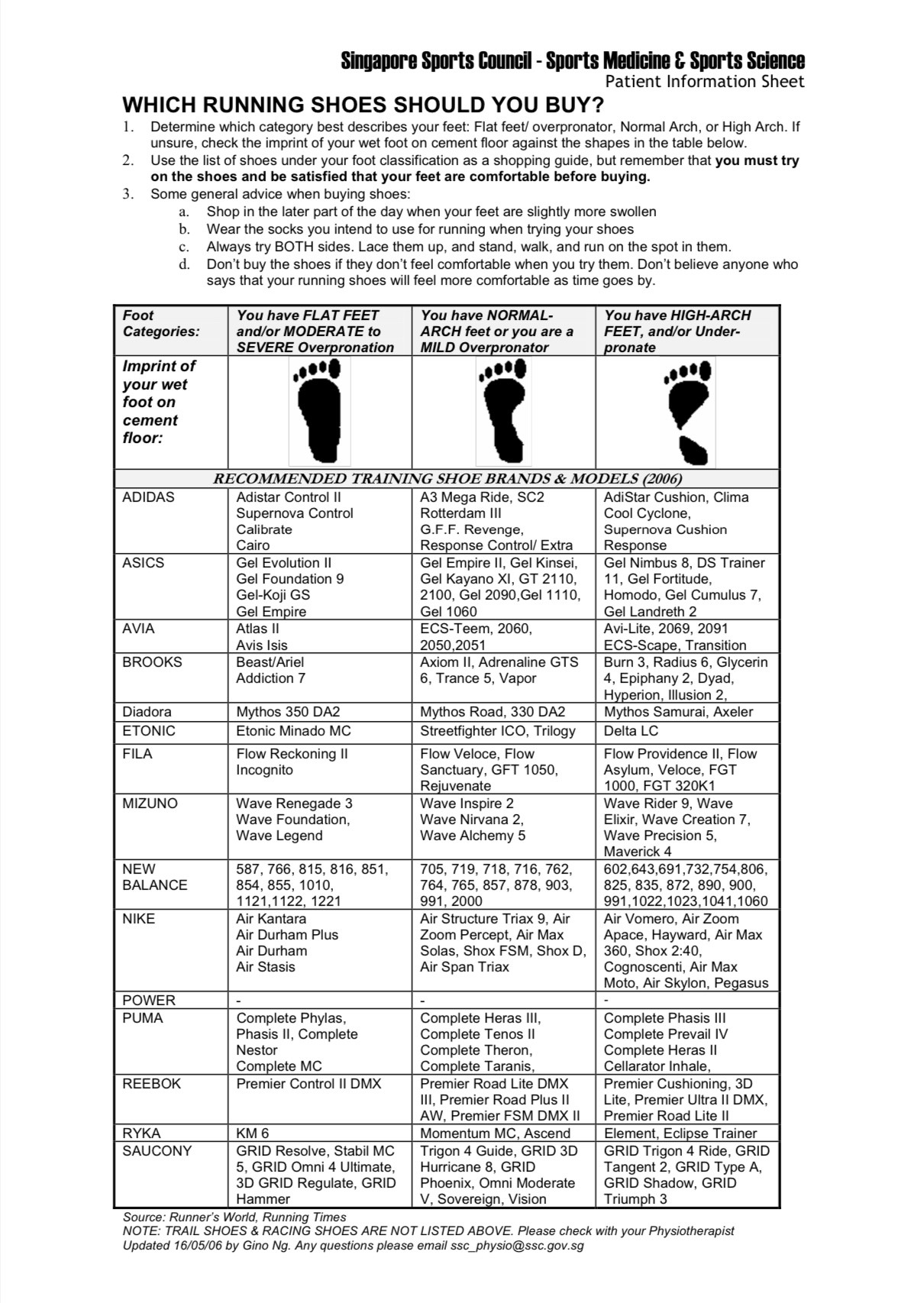
How do you choose your running shoes? I've been asked that question many times over. I've even compiled a shoe list regularly over the years since the 90's and yes many other physios, health professionals etc have conveniently/ blantantly taken out my name and passed the list off as their own (picture below).


One of my often copied shoe lis
For years, podiatrists, coaches and shoe salesmen etc have looked at your foot type (to see if you have a normal, low or high arches) and then recommended that you have stability, motion control and cushioned shoes respectively. The rationale being that if you had high arches, you did not pronate enough and needed softer, well cushioned shoes while if you had low arches, you tend to overpronate and needed sturdy motion control shoes to control that overpronation. Runners with normal arches needed neutral shoes and were prescribed stability shoes. This method was deeply rooted in athletic circles and widely accepted.

The above mentioned method was exactly what the US military did in terms in handing out shoes to their recruits as injuries were rampant during basic military training. Military authorities hoped that injury rates will drop by ensuring their recruits were fitted with the correct shoes according to their foot type.In order to determine whether fitting correct shoes help in lowering injury rates, military researchers found no scientific literature in support of what they were doing and decided to do their own research.

And you know what, they found almost no correlation at all between wearing proper running shoes and avoiding injuries (this is published in the American Journal of Sports Medicine recently). Injury rates were actually highest amongst soldiers who had received shoes fitted according to their foot types. Wearing the so called "correct" shoes for their type of feet had actually increased the recruits' chances of getting injured.

If you have been following our blog, you would have read that Sports Solutions first wrote about this last year when researchers in another published article in the British Journal of Sports Medicine concluded that sports medicine specialists should stop recommending running shoes based on a person's foot type as there was no evidence supporting it. Please have a look at one of our our more popular post last year

And just in case you decided that published studies on military recruits were of a lower quality, another study done on experienced runners was published more recently in support of the military subjects paper. In this study, 81 runners were classified according to their foot postures (a more detailed measure of foot type than just arch shape). Runners in each category were then randomly assigned one of 3 footwear conditions, neutral (Nike Pegasus), stability (Nike Structure Triax) and motion control (Nike Nucleus).

All the women embarked on a 13 week half marathon training program. How did they fare? Nearly a third of the women had to miss some training days because of pain, with a majority of the injured runners wearing (yes you guessed correctly) shoes specifically designed for their foot postures. What's more, also of note was that motion control shoes were the shoes across the board that "caused" the most injuries.

Now in theory, overpronators should benefit from motion control shoes to limit their overpronation. However, these runners who overpronated actually complained of pain and missed training after wearing them as did a number of runners with normal feet and every single underpronating (or high arched) runner randomly assigned to a pair of motion control shoes.

This is despite that fact that motion control shoes do limit over pronation as numerous biomechanical studies of runners running on treadmills have repeatedly proved that runners who wear motion control shoes have significantly reduced pronation.

There you go, not quite what you may expect I imagine. Please email this to your friends who are planning to invest in new running shoes.

I have all 3 articles, email me if you want a copy.

References

Knapik JJ, Trone DW, Swedler DI et al (2010). Injury Reduction Effectiveness Of Assigning Running Shoes Based On Plantar Shape In Marine Corps Basic Training. AJSM published online before print June 24, 2010.

Richards CE, Magnin, PJ and Callister R (2009). Is Your Prescription Of Distance Running Shoes Evidenced Based. BJSM. 43(3) : 159-162.

Ryan MB, Valiant GA, McDonald K et al (2011). The Effect Of Footwear Stability Levels On Pain Outcomes In Women Runners: A Randomised Control Trial. BJSM. 45:715-721. DOI:10.1136/bjsm.2009.069849.