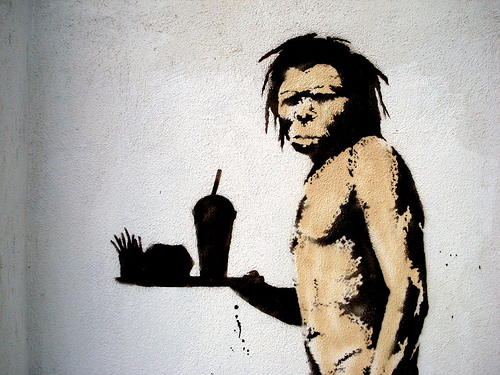
Showing posts with label Daniel Lieberman. Show all posts

Sunday, May 21, 2023

Do Orthotics Reduce Kneecap Loads In People With Knee Pain?

Many of our patients wear insoles (or orthotics) as they have been told that it 'corrects' their flat feet while helping to reduce excessive forces on their patellofemoral (kneecap) joint. This then helps to prevent kneecap pain.

Customed made orthotic
Well, if you have been told (by your health professional) that you need insoles/ orthotics for the same reasons, now you can tell them that this latest published systematic review/ meta analyses from the BJSM suggests otherwise. This is a very important study since kneecap pain is very commonly seen in in our clinics (and many others) affecting both the young adolescents and older adults. 

The authors identified 33 eligible studies and did 3 different comparisons during walking and running combined. Using insoles/ orthotics with medial (arch) support versus no insoles, minimalist shoes versus conventional footwear and lastly rocker versus non-rocker footwear.

Arch supports
Analyses by the authors showed that insoles/ orthotics that support your medial arches DID NOT alter kneecap loads during walking or running. This questions results from previous research that suggests the pain reducing effects of insoles/ orthotics. The reduction in pain may have been due to other influences and not the reduction in kneecap loads.

Results also show that mimimalist type footwear reduced peak kneecap loads when compared to conventional footwear during walking and running combined. This systematic review demonstrated an average 9.5 percent reduction in kneecap load in minimalist type footwear compared to conventional footwear over a run of just 1 km. This translates to 1,462 kg for an 80 kg person. This is clinically relevant considering the cumulative load reduction that can occur over numerous loading cycles during running.

I've written about this known fact many times over the years. Using results from Daniel Liberman's study (2010), runners who land correctly in their running technique will have benefits as impact is a lot less (even less than landing on your heels with cushioned shoes on).  If you land wrongly (with minimalist type shoes) the impact is 7 times greater thus greatly increasing the chance of injury. See picture below.

Because kneecap loads are reduced, they are transferred to the ankle and foot bones leading to fractures in the foot bones especially when you do too much too soon. Hence, correct technique and patience is crucial using minimalist type footwear. This is why many podiatrists say minimalist type footwear is not good (for you) since they cause foot  and metatarsal fractures, but bear in mind podiatrists also cannot sell you orthortics to place in your minimalist type footwear. 

You have also never seen Kipchoge or any elite marathoners wear these minimalist type shoes in a race. The body's muscles will not be able handle absorbing the load (while wearing minimalist type shoes) while running at the high intensities at which these races are contested.  They are good for training definitely, but not for racing, especially if you are not patient enough to get used to them. 

Evidence regarding the effect of rocker-soled shoes (see below) during walking and running were uncertain due to limited studies.

Take home message from the researchers is that minimalist type footwear reduces kneecap loads compared to conventional footwear in people with or without kneecap pain during running. 

Insoles/ orthotics that support the arches do not alter kneecap load during walking or running. Now you know for sure.


References

Liberman DE, Venkadesan M et al (2010). Foot Strike Patterns and Collision Forces in Habitually Barefoot Versus Shod Runners. Nature. Jan 463(7280): 531-535.

Kayll SA, Hinman RS, Bryant AL et al (2023). D Biomechanical Foot-based Interventions Reduce Patellofemoral Joint Loads In Adults With And Without Patellofemoral Pain Or Osteoarthritis? A Systematic Review And Meta-analysis. BJSM. DOI: 10.1136/bjsports-2022-106542

MBT rocker-sole shoes
*Thanks to Hui Meng for getting me the article

Sunday, September 27, 2020

Toe Spring And Plantar Fasciitis

Ever wonder why so many people other than runners are getting plantar fasciitis? It may be because of the amount of 'toe spring' in your shoes.

You may have already noticed this in your running (or other) shoes, most of them seem to have 'toe spring'. Toe spring is how much the front of the shoe is curved upwards. This curve allows your foot to roll off the front of your foot more easily compared to wearing flatter soled shoes.

Hence, the toe spring allow your foot muscles to work less hard when you are walking or running. The more toe spring in the shoe, the less work your feet have to do.

However, this may lead to weaker foot muscles according to research (Sichting et al, 2020).Weaker intrinsic foot muscles may increase your chances of sustaining injuries like plantar fasciitis.

In the research which includes famed Harvard evolutionary biologist / barefoot running researcher, Daniel Lieberman, had subjects walk on a specially designed treadmill that had force plates and infrared cameras to measure how much power was put into each step.

The subjects walked barefoot in four different pairs of custom made sandals. The sandals had varying angles of toe spring from 10 to 40 degrees. These ranges of curvatures were designed to be similar to modern footwear.

Sandals were chosen as they allowed the researchers to see the exact motion of the subjects' feet as they walked. The different degrees of toe spring can be filmed to see how they affected their gait with special attention paid to the metatarsophalangeal (MTP) joints at the base of their toes. This is where the toe bones join to the foot bones.

The results showed that the more the shoes curved up front, the less propulsive force was generated with their MTP joints. This means that your intrinsic foot muscles are working less to maintain stability when you move making walking and running easier. However, it also decondition your foot muscles over time, making them weaker and not able to protect other structures in your foot.

Weaker intrinsic foot muscles make one more susceptible to conditions like plantar fasciitis as people rely on their plantar fascia to do what the intrinsic muscles normally do. This may also explain why people get injured if they transition too quickly minimalist type barefoot style running shoes.

Many of my patients who do not run with plantar fasciitis have been told to wear more 'supportive' and comfortable shoes while outside or even at home. This may be worse as their intrinsic foot muscles continue to weaken.

This is why shoes with more toe spring are popular because they are more comfortable and prevent your feet from tiring. This is great in a race and it may be why most racing shoes have a lot of toe spring (see picture below).

More research needs to be done with toe spring and foot injuries as other elements of footwear like stiffer soles and amount of cushioning can impact how our intrinsic foot muscles work.

So what should a runner do? Some physiotherapists and podiatrists often suggest doing intrinsic foot exercises like towel scrunching or pulling your toes toward your heel.

I suggest going barefoot more often. Either at the beach, or when you're at the playground with your kids. In Singapore we are generally barefoot while we're at home. That's better than wearing shoes with lots of toe spring at home. 

While training, look for running shoes with little or no toe spring when you train. 

For my patients who have plantar fasciitis, I tell them to wear flat slippers like Havaianas to minimize the effect of toe spring and for their intrinsic foot muscles to get stronger. 

That is totally different from what some other physiotherapists or podiatrists may suggest. Of course, I also treat plantar fasciitis differently from them.

Reference

Sichting F, Holowka NB, Hansen OB and Lieberman DE (2020). Effect Of The Upward Curvature Of Toe Springs On Walking Humans. Sci Reports 10, 14643. DOI: 10.1038/s441598-020-71247-9.

Asics Metaracer Tokyo - a racing shoe with lots of toe spring

Sunday, September 13, 2015

Carbs With Your Paleolithic Diet?

Picture by Lord Jim from Flickr
I've previously written on the Paleolithic or caveman diet before, which typically consists of hunted meats and fish and food that can be gathered like eggs, insects, fruits, seeds plants and herbs etc.

As a result you're supposed to get healthier, low fat protein, healthier fats and much less dairy and grain (or carbohydrates) than what we normally eat today.

A recent published article however suggests that the Paleo diet did in fact consist of lots of starchy carbohydrates.

The researchers put together information from genetics, archaeology, physiology and nutrition to come up with a theory that our Paleolithic ancestors did actually eat starchy plants like potatoes and possibly even cooking them over fires.

They also suggested that eating carbs help made our brains larger. Without carbs, we may be very different today. We may also not be runners like we can be now.

The authors wrote that carbohydrates are essential for long distance running which is how our ancestors chased down and captured prey. We get energy from glycogen stored n our bodies during vigorous exercise. Our glycogen stores normally lasts about 20 miles (or 32 km) and if you don't eat or drink, you'll hit the wall.

Even evolutionary biologist Daniel Liberman, who has written so much about humans and barefoot running said "The idea that people shouldn't eat carbohydrates is just silly, we've been eating carbohydrates for a long time."

Lieberman however isn't convinced that carbs helped Paleo hunters run better. His research suggested that Paleo hunters who chased down their prey didn't have to run that fast as they actually walked and ran. At those speeds (to keep up with a wounded prey usually) they may not need a lot of carbohydrates. Their bodies probably used more fat instead.

I've written before that relying on fat may help running performance. This is especially true if you have trained your body to use fat as fuel (which our bodies have plenty). It allows us to run further without hitting the wall.

Some have proposed that this may be better for ultra marathon distances (since you tend to run slower). However as speed increases, carbohydrates tend to be vital, especially if you want to run long and fast, suggested Lieberman.

Do take note that the carbs our Paleo ancestors ate were complex carbohydrates and not the overly processed and refined carbohydrates we get on supermarket shelves today.

The authors suggested that we need to be careful when trying to replicate ancestral diets as we still do not know exactly what Paleo man ate.

Looks like you can and should eat complex carbs, especially if you wanna race long and fast.

Reference

Hardy K, Brand-Miller J et al (2015). The Importance Of Dietary Carbohydrate In Human Evolution. The Quarterly Review Of Biology. 90(3): 251-268. DOI. 10.1086/682587.

Cavemen and dinosaurs? by Orln Zebest from Flickr

Monday, August 31, 2015

Latest Research On The ITB (Iliotibial Band)


Picture taken with my Canon Ixus 
Mention the ITB (or iliotibial band) and images of pain quickly crop up. IT band syndrome is a painful overuse injury usually at the lateral (or outer) portion of the knee in many runners and cyclists.

Latest research on the IT band from Daniel Lieberman's Harvard lab by his former student Carolyn Eng shows that the IT band may not function as what was formerly believed.
Another view
The ITB runs along the outer part of the thigh, originating from your Tensor Fascia Lata and Gluteus Maximus muscles just above your hip to attach just below the knee. It is made up of fascia, an elastic connective tissue found throughout our body. Fascia is a sheath of connective tissue that wraps our muscle, nerves and blood vessels. It also connects our muscles to bones.

The researchers used human cadavers to investigate how the IT band moves and stretches during walking and running. A computer model was then built to calculate the forces and strains involved and then compared to the equivalent structure in chimpanzees (published in another journal).

Previously, the IT band's primary function was believed to stabilize the hip during walking. Carolyn Eng's research suggested that the IT band actually acts like a spring, storing energy when you swing your leg back and releasing it as the leg swings forward.

This energy storage capacity is highly developed in humans, enabling it to store 15 to 20 times more energy than a comparable structure in chimpanzees.

Lieberman suggested that if we consider evolution and how humans are adapted not just for walking but running as well, then the IT band is looked at at a totally different perspective. The IT band looked like another elastic structure, similar to the Achilles tendon, and this may be important for saving energy during walking and especially running.

The researchers estimate the IT band stores about seven joules of energy during fast running compared to about the standard estimate of about 50 joules in the Achilles tendon.

The researchers hope that with this improved standing of how the IT band works, they can compare how much forces the IT band transmits in runners with and without IT band pain. This will then establish a scientific basis for treating IT band injuries.

References

Eng CM, Arnold AS, Liberman DE et al (2015). The Capacity Of The Human Iliotibal Band To Store Elastic Energy During Running. J Biomech. pii: S0021-9290 (15) 00354-1. DOI:10.1016/j.jbiomech.2015.06.017.

Eng CM, Arnold AS et al (2015). The Human Iliotibila Band Is Specialized For Elastic Energy Storage Compared With The Chimp Fascia Lata. J Exp Biol. 218(15): 2382-2393. DOI: 10.1242/jeb.117952.

Here's Carolyn Eng's (Harvard University) computer simulation of a human leg running from here.

Sunday, May 18, 2014

Today's Straits Times Article 180514

Have a look at page 17 of today's Sunday Times under the Home section and you'll see Sports Solutions quoted in the article. The journalist asked about our views on the Vibram Five Fingers lawsuit, the health benefits and also the general vibe of the running community regarding this case.

I was quoted as saying the evidence for barefoot or minimalist style is actually very sound provided the wearer's running technique is correct.

Using results of Daniel Liberman's study, runners who land correctly in their running technique will have benefits as impact is a lot less (even less than landing on your heels with  shoes on).  If you land wrongly (with minimalist shoes) the impact is 7 times greater thus greatly increasing the chance of injury. See picture below.

From Liberman's article
Unfortunately most of us (runners) are very impatient for results and do not master the correct running/ landing technique while just using minimalist shoes thinking that will be sufficient.
 
Also read why if you run in more cushioned/ expensive shoes, the more likely you seem to get injured to further support why running in minimalist shoes with correct technique is superior to running with cushioned/ expensive shoes. 

Reference 

Liberman DE, Venkadesan M et al (2010). Foot Strike Patterns and Collision Forces in Habitually Barefoot Versus Shod Runners. Nature. Jan 463(7280): 531-535.

Email me if you want the article.

My own minimalist running shoe in the picture below. My brother bought it for me from Shanghai for $RMB30 (or S$6) , much cheaper than Vibrams ($149-$209 here in Singapore).

Like I've always said and written, it's not what shoes you wear, its your technique that's more important.

Monday, September 9, 2013

Want To Run As Fast As The Kenyans?


Want to run as fast as the Kenyans? You may need to lose some more weight. A new study suggests that Kenyan runners are fast because of their extreme thinness (and not just due to living / training from young at altitude).

For a long time it was thought that the success of Kenyan runners were due to their walking/ running long distances on their way to school while growing up. In comparison, our kids now get a ride in fancy cars from their parents or the school bus to school and play computer games after. And, of course struggle to keep up in major marathons and get their behinds kicked.

Renown scientists Yiannis Pitsiladis and Daniel Lieberman were among the group of researchers who tested the early training theory and to their (and mine) surprise found that there was not sufficient evidence supporting that. These mostly thirteen year old Kenyan kids were really active and they covered around 7.5km to and fro in their daily trips to school and back. They also did not eat any junk food. The kids who ran and walked the most to school did not actually have the highest Vo2 max scores.

Rather, what actually stood out in their research was that the kids had a really low BMI (body mass index), i.e. they were really thin. Being fit and skinny means you'll have a high Vo2 max. These "untrained" kids were found to have the potential to run a 2:18 marathon for the boys and 2:39 hrs for the girls! And these are just the groups' averages.

So bad news for the rest of the world as Kenyan runners will probably continue to dominate distance running for a while yet.

Reference

Gibson AR, Ojiambo R, Konstabel K, Lieberman DE et al (2013). Aerobic Capacity, Activity Levels and Daily Energy Expenditure in Male and Female Adolescents of the Kenyan Nandi Sub-Group. PLoS One. 8(6) : e66552. doi: 10.1371/journal.pone.0066552.

*Picture from Flick.com