Showing posts with label Pain free running. Show all posts

Sunday, November 27, 2016

Are There Any Benefits In Running With Zero Drop Shoes?

My wife's zero drop running shoes
Although you don't see it as much now, the minimalist type running shoes were the rage all few seasons ago. These minimalist type (and not the barefoot type) usually have a relatively low heel to toe drop. Meaning the height in the midsole and the outsole at the back of the shoe is almost level and/or no difference in height.

One proposed benefit of zero drop running shoes is that it may reduce injury. Shoes with a large drop encourage severe heel striking which can contribute to knee injuries. With zero drop shoes, it may also allow your feet to land as if you were not wearing shoes which helps to distribute impact forces.

Shoes with a high drop may also tilt you forward too much and contribute to alignment and compensatory discrepancies.

If you visit the running section of most running stores now, most midsoles of current running shoes are almost back to before when they were much thicker. But many manufacturers have retained the zero drop while offering plenty of cushioning like the Hokas and Altras.

A recent study however found that a shoe's heel to toe drop may not have have anything to do with running injuries.

The researchers studied 533 non elite runners wearing running shoes with 0, 6 or 10 millimetres (mm) drop for six months. The running shoes were 2l mm in the heel and forefoot, 21 mm in heel and 15 mm in forefoot and 24 mm in heel and 14 mm in forefoot respectively. The shoes were otherwise similar.

25 percent of the runners reported being injured during the six month study period. An injury was defined as leg or lower back pain that resulted from running and prevented planned running for at least one day.

The main finding of the study was that injury rates among the three groups were similar, regardless whether their shoes had a heel to toe drop of 0, 6 or 10 mm.

However, among the runners who ran more frequently, those in the 0 or 6 mm drop shoes had a higher injury rate than the frequent runners with a 10 mm drop.

The researchers suggested that that this may be due to the runners transitioning to fast from their regular running shoes to zero drop shoes leading to increased injury rates as 78 percent of the runners recruited in the study hadn't run in zero drop shoes before.

I remember when I was racing cross country races as a kid we used to train in heavier cushioning shoes and then switched to racing flats for the race. It was very common to have sore calves after the first few races of the season as I've not done enough running in the racing shoes (which had lower drop than the training shoes). Yes, racing flats back then were very similar to the zero drop shoes now.

It was more apparent (sore calves) switching to racing spikes for the track training and track meets when cross country season ended and I raced in track events.

As I always tell my patients, their running technique is much more important than their running shoes. Be sure to rotate your running shoes to minimise injuries too.

Reference

Malisoux L, Chambon N et al (2016). Influence Of The Heel-to-Toe Drop Of Standard Cushioned Running Shoes On Injury Risk In Leisure-time Runners. A Randomized Controlled Trial With 6-month Follow-up. AJSM. 44(11): 2933-2940. DOI: 10.1177/0363546516654690.


Now, this is what I'll call a racing flat

Thursday, April 21, 2016

Your Running Style Definitely Changes When You're Tired

Picture by richseow from Flickr
"I'm a fore/ mid foot runner, I don't land on my heels etc". I often get responses like this from my patients who are runners when I ask them if they have changed their running style recently.

To which I will reply, "How about when you're tired?"

I remember when I was still racing triathlons the official race photographer will email pictures of the race and I'll be quite amazed by the transformation. Often the smooth stride at the start of the run is often reduced to a not so pretty shuffle near the end of the race - (exception is when I'm sprinting or trying to out sprint another competitor at the end).

Is that the same for you as well? Well, I looked through pictures of my school boy track races I used to run, my stride looked pretty good all the way, but that's for track races (which are much shorter) and many moons ago (I was much younger then).

Most research so far has focused on fresh (and not fatigued) runners usually on a treadmill. Not much use then when your running style tend to fall to pieces when you get tired.

Well, I'm not the only person wondering if you running stride changes when you're tired. A small group of 14 habitual forefoot runners who typically ran about 30 miles (48 km) a week were studied. They ran to exhaustion (average of 15 minutes) while researchers took detailed measurements of their stride at both the start and end of the run.

There were significant changes even after only 15 minutes. Eight out of the 14 runners studied were landing farther back toward their heels by the end of the run. The ankles and knees were more flexed during the gait cycle suggesting that this may give a little more shock absorption when the ankle and calf muscles get too tired to provide sufficient shock absorption.

This shows that our running stride gradually changes as we fatigue, regardless of whether you start off heel striking, mid foot or forefoot striking.

Hence the authors suggest this can be a problem running in minimalist/ barefoot inspired type running shoes as your muscles fatigue during a long race and your land on your heels without sufficient cushioning. I've previously written that will reduce overall impact forces

You can of course gradually increase your mileage in your minimalist/ barefoot inspired type running shoes to increase your strength and build up fatigue resistance as I've previously written that your own muscles and tendons and a good running technique will reduce overall impact forces.


Reference

Jewell C, Boyer KA and Hamil J (2016). Do Footfall Patterns In Forefoot Runners Change Over An Exhaustive Run? J Sports Sciences. 22: 1-7. DOI: 10.1080/02640414.2016.1156726.

Sunday, December 15, 2013

Rotate Your Running Shoes To Minimise Injury

Picture by Tomas Kalina from Flickr.com
I started running when I was twelve. I ran mostly cross country and track races (as there were definitely a lot less road races then compared to now). Since those early running days, I began rotating all my running shoes.

My mum would nag at me for having so many pairs of running shoes and wanted to throw away the older pairs. I would simply tell her I'd throw them out but secretly kept them in another place or brought them to school to keep in my locker.

After getting good enough results to be sponsored, my shoe rotating "habit" got worse I guess.

Back then, I simply felt that using different shoes each time I ran would stress different parts of my foot and legs and hopefully less chance of me getting injured.

Turns out I was right. A recently published study suggests that runners who rotate more than one pair of running shoes are significantly less likely to get injured compared to those who wear the same pair of shoes each time they ran.

The researchers studied 264 runners over 22 weeks. Information on training volume, injury rate, cross training, shoe usage and other variables were obtained. 116 runners in the study used a single pair of running shoes, with 91% of their running done in that same shoe. The other 148 runners used multiple pairs of running shoes. They had a main pair which they ran in (an average of 58% of their runs) while also using another 3.6 pairs (on average) for their other runs during the study period.

The researchers found that those who rotated their running shoes had 39% lower risk of getting injured during the study period compared to those who ran mainly in one pair of running shoes. The researchers suggested that different shoes distributed impact forces from running differently, lessening repetitive strain on the legs during running.

Depending on the shoe's midsole height and firmness, a person's stride length and ground reaction time also changes, affecting running gait although these factors (midsole densities, structure and geometry) need further research. Also in support of reducing injury due to varying loads, the researchers found that the runners who also cross trained had lower incidences of injury.

Well, all you shoe geeks can rejoice now that you have an excellent reason to convince your significant other, wife, husband or mum that you need another pair of running shoes.

Reference

Malisoux L, Ramesh J et al (2015). Can Parallel Use Of Different Running Shoes Decrease Running-related Injury Risk? Scand J Med Sci Sports. 25(1): 110-115. DOI: 1111/sms.12154.

*Picture by Ian Dennoir of shop window @ Carnaby Street Soho London from Flickr.com

I like!

Wednesday, October 28, 2009

The Human Body Is Built For Distance


Sorry I haven't written in a while, our 2nd clinic Sports Solutions has been keeping me busy... and stressed so far. Anyway, the topic for this particular post was actually "given" by one of my patients and a very frequent participant in our weekly running club sessions (on Thursdays).

I first read about this topic last year when I was made aware of a book "Born to Run" by Christopher McDougall, based on the Tarahumara Indians of Mexico, a tribe unknown to the rest of the world but are capable of running extraordinary distances in nothing but thin-soled sandals. This was what led me to write about 2 of our more popular topics on March 14 this year "  Do High Tech Running Shoes Work "and "Pain Free Running" on March 17.

The article -which is the title of this week's post was published in the New York Times on 261009 and this patient sent me a link to this article. Go ahead and have a read, we humans are really made to run.

Ask our participants at our running club, many of them have been told by their doctors and surgeons not to run, but are now running again. Give us a ring to let us know if you are coming (63331211 or 62236078). Here's too more running.


*Photo by Luis Esocobar, The New York Times

Tuesday, March 17, 2009

Pain Free Running


Do you want to run pain free? please read on if you do.

As you have read from the previous post, the thick heels from your high tech running shoes will encourage you to land with a heavier heel strike. Landing on your heels causes you to pronate (or roll your foot inwards) which then puts stress on your shins (leading to shin splints), knees, hips and your back. This "unnatural" heel strike is partly to blame for causing all sorts of running injuries. The evidence is now considerable and definitely stacking up in the article from the previous post.

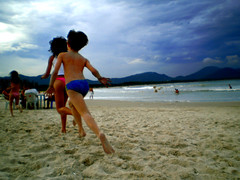
Is landing our our heels unnatural you will definitely ask. Well, I'm going to say yes. Next time you happen to be in the company of little children look at how they walk or better still, see how they run. Parents who have kids and are reading this will tell you their little ones are always "falling forwards" as if they are tipping over slightly whether walking or running. And believe me they have a nice smooth style and they are fast. They also have no foot pain (or knee, hip and back pain for that matter) even though they love running around barefooted. Somehow as we grow older, we all stand up taller and walk with our stride out longer and landing on our heels.

We've had patients who have been told never to run again but are able to run pain free and even take part in races after seeing us at Physio and Sports Solutions. How do we do it? We do it by teaching you how to run with good technique so you can run pain free. Similar to how little kids run. Come and join us at our running club (please see the Physio Solutions or the Sports Solutions site for details) or come see us in the clinic.