Showing posts with label Paleolithic or caveman diet. Show all posts

Sunday, September 13, 2015

Carbs With Your Paleolithic Diet?

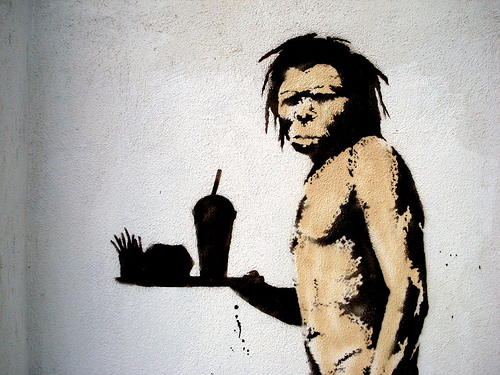
Picture by Lord Jim from Flickr
I've previously written on the Paleolithic or caveman diet before, which typically consists of hunted meats and fish and food that can be gathered like eggs, insects, fruits, seeds plants and herbs etc.

As a result you're supposed to get healthier, low fat protein, healthier fats and much less dairy and grain (or carbohydrates) than what we normally eat today.

A recent published article however suggests that the Paleo diet did in fact consist of lots of starchy carbohydrates.

The researchers put together information from genetics, archaeology, physiology and nutrition to come up with a theory that our Paleolithic ancestors did actually eat starchy plants like potatoes and possibly even cooking them over fires.

They also suggested that eating carbs help made our brains larger. Without carbs, we may be very different today. We may also not be runners like we can be now.

The authors wrote that carbohydrates are essential for long distance running which is how our ancestors chased down and captured prey. We get energy from glycogen stored n our bodies during vigorous exercise. Our glycogen stores normally lasts about 20 miles (or 32 km) and if you don't eat or drink, you'll hit the wall.

Even evolutionary biologist Daniel Liberman, who has written so much about humans and barefoot running said "The idea that people shouldn't eat carbohydrates is just silly, we've been eating carbohydrates for a long time."

Lieberman however isn't convinced that carbs helped Paleo hunters run better. His research suggested that Paleo hunters who chased down their prey didn't have to run that fast as they actually walked and ran. At those speeds (to keep up with a wounded prey usually) they may not need a lot of carbohydrates. Their bodies probably used more fat instead.

I've written before that relying on fat may help running performance. This is especially true if you have trained your body to use fat as fuel (which our bodies have plenty). It allows us to run further without hitting the wall.

Some have proposed that this may be better for ultra marathon distances (since you tend to run slower). However as speed increases, carbohydrates tend to be vital, especially if you want to run long and fast, suggested Lieberman.

Do take note that the carbs our Paleo ancestors ate were complex carbohydrates and not the overly processed and refined carbohydrates we get on supermarket shelves today.

The authors suggested that we need to be careful when trying to replicate ancestral diets as we still do not know exactly what Paleo man ate.

Looks like you can and should eat complex carbs, especially if you wanna race long and fast.

Reference

Hardy K, Brand-Miller J et al (2015). The Importance Of Dietary Carbohydrate In Human Evolution. The Quarterly Review Of Biology. 90(3): 251-268. DOI. 10.1086/682587.

Cavemen and dinosaurs? by Orln Zebest from Flickr

Thursday, March 5, 2015

Eating Like The Caveman? ST 050315


Our Sports Solutions blog has a much bigger head start on the Straits Times this time round with their article on "Eat Like A Caveman" in today's Straits Times in the Mind Your Body section on pages 8-9.

I first wrote about this caveman diet (or Paleolithic diet) way back in 2009 and a more detailed follow up article after that. Clink on the links to have a read.

Like I said, more reason to read our blogs.

Monday, September 21, 2009

Eating Like A Caveman Part II


I first read about the Paleolithic diet back in 2005. In his book "The Paleo Diet for Athletes, the author Loren Cordain states that the Paleo diet will make you fitter and healthier. The author also calculated that Paleo man got 55% of their calories from meat (more protein than what is currently recommended) but the Paleo diet also contains much more fiber, calcium, vitamins, iron, folate and essential fatty acids, but much less sugar, salt and saturated fats than we now get from our current diet. The meat from Paleo man's era were also not burgers or anything like the Atkin's diet.

To the author, grains were the original fast food back then as it is fairly cheap, easily obtained and overly processed (humans first began cultivating grains about 10,000 years ago). Moreover, grains have a lot less nutrients than fresh fruits and vegetables. Since most of our current available grains were only available in the last 10,000 years, our Paleo ancestors ate no bread, pasta, pancakes, kuay tiao, bee hoon or rice as these "modern" grains were not available then. Cordain believes that we live healthiest when we consume a diet similar to what early (or Paleo) man ate as even now our digestive systems are not adapted to process grains properly.

I was rather skeptical upon reading this as I had been brought up on a diet of pasta, bread and rice especially (since I am from Singapore where it's fried rice paradise).

Well, this is what Joel Friel, renown triathlon, multisport and cycling coach who has written "The Training Bible" series of books on cycling, triathlon etc had to say. He first tried the diet to actually proof Cordain wrong. In Friel's first two weeks, he felt terrible but by the third week, he felt strong enough to increase his training by 50% and another 50% on the fourth week and since then he's been a true believer.

Friel explained in great detail on how to get the best carbohydrates before, during and after training or races. He is especially particular about the post exercise or post race period breaking it into 3 separate stages where you eat/ drink fruits and fruit juices to potatoes and sweet potatoes and finally to the last stage where you mix carbs and protein.

According to Cordain, the Paleo diet will likely increase your protein and fat consumption while lowering your carbohydrate intake slightly. But since your carbs are mostly coming from fruits and vegetables, you will have a lot more micronutrients. Protein is from lean meats with low saturated fat levels and from fish (with high levels of healthy omega-3 fats) and fats from canola, walnut and olive oil (which is healthy monosaturated fat).

I feel like having a big greasy burger for lunch after this with my favorite fries especially since I'm no longer racing. But after writing all that, I think maybe I should have steam vegetables instead.....

Reference

Loren Codain (2005). The Paleo Diet for Athletes: A Nutritional Formula for Peak Athletic Performance. Published by Rodale Inc

*Picture from Flickr.com

Sunday, September 13, 2009

Should I Be Eating Like A Caveman?


Or should I stick to the more popular but unhealthy western diet like burgers, pizzas, and french fries etc?

Most of us know that too much of the typical western diet leads to numerous chronic diseases. But would a Paleolithic hunter-gatherer diet do better? A what diet you say? A Paleolithic diet (also known as Stone Age diet) is one that is similar to what our pre agricultural hunter-gatherer ancestors (or caveman) ate before. The Paleolithic era is one that is nearly 2.5 million years ago.

The Paleolithic diet consists of foods that can be hunted and fished, such as meat and seafood, and that can be gathered, such as eggs, insects, fruit, nuts, seeds, vegetables, mushrooms, herbs and spices. This diet included more low fat proteins, healthy fats and much less carbohydrates than most of us eat today.

A group of researchers decided to find out, feeding 9 healthy, non-obese volunteers a Paleo diet for 10 days (no grains, dairy & legumes). The protocol was designed to ensure the volunteers did NOT lose weight, which would have influenced results.

The results? Compared to their prior diets, the volunteers experienced significant reductions in blood pressure and plasma insulin. Moreover, there were large, significant reductions in total cholesterol, LDL, and triglycerides. All this in just 10 days. Impressive or what?

Stay tune as I will discuss in my next post on how the Paleo diet can help in your training and racing.

Reference

Frasetto L et al, (2009). Metabolic and Physiologic Improvements from Consuming a Paleolithic, Hunter-gatherer Type Diet. European Journal Of Clinical Nutrition. 63: 947-955

*Picture taken from Flickr.com