Showing posts with label Tim Noakes. Show all posts

Sunday, July 28, 2019

How To Beat Muscle Cramps? Sunday Times Article

Sunday Times article 280719
Today's Sunday Times article on training for the Straits Times run says avoid muscle cramps by consuming more sodium? Nah, not totally true. Not at all actually. I've written about this exact same topic way back in 2015.

In that post, I wrote about how renown sports scientist Tim Noakes found no significant differences in sodium and magnesium levels in 72 ultra marathoners among those who cramped and those who did not cramp (Schwellnus et al, 2004). They found that sweating too much had no real effect on muscle cramps.

Try to think of when you last had a muscle cramp? After running 30 km in your marathon or after 3 km in a 10 km race?

Muscular fatigue (or when your muscles get too tired) is what really causes muscle cramps. The muscle cramps so you can avoid injury before you can push yourself further. That the Sunday Times article definitely got correct.  

Muscle cramping occurs mostly during races than during training. If you started your race too fast or you pushed too hard, that may cause your muscle to fatigue and then cramp. Other studies have shown that tough, hilly courses and poor pacing are predictive of muscle cramps.

I also wrote that sports drinks cannot replace your sodium levels during exercise. Your electrolyte levels actually rise when you sweat a lot. Yes, you read correctly. I'll explain this below.

Assume you have five cups of water and five teaspoons of salt/ electrolytes in your body. Say you sweat 2 cups of water and a teaspoon of salt/ electrolytes when you exercise, the concentration of salt/ electrolytes is now higher. It will remain higher as you become more dehydrated.

Apply this concept to our running physiology. Our sodium (salt) concentration is about 140 mM (or 3.2 grams of salt in every litre of blood). Our sweat has a sodium concentration between 20-50 mM. Even for a "salty sweater" (those who lose more salt than others when they sweat), they lose about 1.1 grams of salt max in every litre of sweat.

Hence, the theory that muscle cramping is caused by low electrolytes/ salt as a result of sweating is not true. You will definitely lose more water than sodium when you sweat. You can read more of that here.

You read it here first. Now you definitely know.

References


Dugas J (2006). Sodium Ingestion And Hyponatraemia: Sports Drinks Do Not Prevent A Fall In Serum Sodium Concentration During Exercise. BJSM> 40:377. DOI: 10.1136/bjsm.2005.022400.

Schwellnus MP, Nichol J, Laubscher T and Noakes T (2004). Serum Electrolyte Concentrations And Hydration Status Are Not Associated With Exercise Associated Muscle Cramping (EAMC) In Distance Runners. BJSM. 38: 488-492. DOI: 10.1136/bjsm.2003.007021.

*The Sunday Times article is on page A27 under the Sports section. Go take a look.

Sunday, December 18, 2016

Which Calf Is Bigger?


Notice any difference in the picture above? If you look closely, you'll notice that the left calf is slightly bigger than the right. Upon palpation my patient's left calf does feel more "meaty" compared to his right.

This is surprising as my patient says that his right leg is his dominant leg. Usually the dominant leg is bigger and stronger than the non dominant leg.

Now, this patient, who is an ultra marathoner came in to see me yesterday after a 35 km training run in the morning. He said that his right calf muscle often cramps after about 35 km.

Even after an easy run, his right calf and hamstrings often feel more tired and fatigued compared to his left. He also felt that it required more effort to bend his left knee compared to his right.

My patient also does not have any numbness, pins and needles down his right leg or other neurological signs. After checking his back as well, I explained to my patient that the reason for his muscle cramping in his right calf muscle is simply due to muscular fatigue.

Since his left calf is bigger, it will also be stronger than his right calf. This means that after running a certain distance his right calf will work harder than the left calf and will fatigue faster too.

I explained that muscle cramping is not due to sodium (or salt) loss, dehydration, electrolyte or fluid loss. I've explained this in a bit more detail before in another post, have a read here please if you're keen.

We then discussed how he could do some isolated (right) leg training to make his right calf stronger to avoid cramping eventually.

Here in his case, size does matter.

Reference

Schwellnus MP, Nichol J, Laubscher T and Noakes T. (2004). Serum Electrolytes Concentrations And Hydration Status Are Not Associated With Exercise Associated Muscle Cramping (EAMC) In Distance Runners. BJSM. 38: 488-492. DOI: 10.1136/bjsm.2003.007021.

Saturday, January 16, 2016

Carbohydrates Still The Best Energy Source For Racing

Picture by Erik Stattin from Flick.
Stick to your carbohydrate diet if you want to race well? Or train your body to burn more fat to be more effective in sustaining your effort. Much has been debated over how much carbohydrates and fat we need in our diet to enhance running (or endurance) performance.

Since our bodies can only hold limited amounts of muscle glycogen (or carbohydrates), we usually "hit the wall" after about 20 miles of running. Our bodies store large amounts of fat and if we can utilize the fat stores, we can potentially rely less on carbs.

And fat-adapted running diet is getting popular, especially in the long/ ultra distance running community in an attempt to teach their bodies to use fat (instead of carbs) for fuel.

Prominent exercise physiologist Tim Noakes has suggested that training your body to burn more fat is a more effective way to sustain effort (especially in a long race). Noakes may be right about utilizing fat for ultra distances and we await more research from him.

But carbs may be better if you are running high intensity intervals or racing hard and fast, so says a recently published research.

The researchers studied a group of male competitive runners in four randomized trials running on a treadmill at a speed of 95 per cent of their best half marathon time to exhaustion.

The runners consumed a pre run meal before each trial with different nutritional values. Runners in the first two trials were fed carbs in the form of a jelly. Runners in the next two trials fasted overnight and were given a jelly that looked and tasted the same to the carb group but contained no calories.

Runners in trials two and four were given nicotinic acid which prevented the use of fat stores during testing. This is to test whether blocking the use of fat as a fuel hampered run performance.

Results showed that majority of the time, (83-91 per cent) carbohydrates were the source of primary fuel. The nicotinic acid did not affect the runner's performance or the body's ability to use carbohydrates as fuel. The runners did use a small amount of fat as fuel, but the main source was still carbohydrates.

Your friends or other runners may want to experiment with utilizing more fat to fuel their runs, but this study shows that at least for races up to half marathon, carbohydrates are still best for getting you to the finish line or clocking your personal best timing.


Reference

Lackey JJ, Burke LM et al (2015). Altering Fatty Acid Availability Does Not Impair Prolonged, Continous Running to Fatigue: Evidence For Carbohydrate Dependence. J App Physiol. DOI:10.1152/japplphysiol.00855.2015.

**Note from a runner

A friend who's been on a low carb,  high fat Paleo diet shared that adding carbs back to his diet can be discouraging. For every ounce of carbohydrate he ate after training his body to be used to low carbs, his body stored three ounces of water. His weight shot up quickly.

Sunday, September 13, 2015

Carbs With Your Paleolithic Diet?

Picture by Lord Jim from Flickr
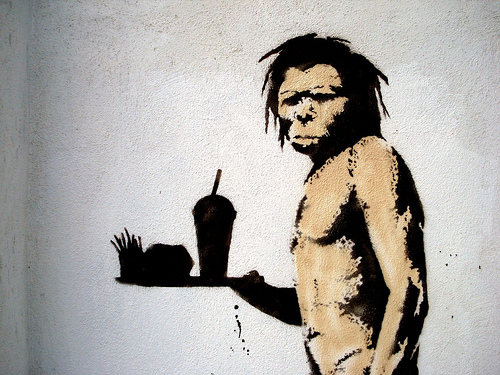
I've previously written on the Paleolithic or caveman diet before, which typically consists of hunted meats and fish and food that can be gathered like eggs, insects, fruits, seeds plants and herbs etc.

As a result you're supposed to get healthier, low fat protein, healthier fats and much less dairy and grain (or carbohydrates) than what we normally eat today.

A recent published article however suggests that the Paleo diet did in fact consist of lots of starchy carbohydrates.

The researchers put together information from genetics, archaeology, physiology and nutrition to come up with a theory that our Paleolithic ancestors did actually eat starchy plants like potatoes and possibly even cooking them over fires.

They also suggested that eating carbs help made our brains larger. Without carbs, we may be very different today. We may also not be runners like we can be now.

The authors wrote that carbohydrates are essential for long distance running which is how our ancestors chased down and captured prey. We get energy from glycogen stored n our bodies during vigorous exercise. Our glycogen stores normally lasts about 20 miles (or 32 km) and if you don't eat or drink, you'll hit the wall.

Even evolutionary biologist Daniel Liberman, who has written so much about humans and barefoot running said "The idea that people shouldn't eat carbohydrates is just silly, we've been eating carbohydrates for a long time."

Lieberman however isn't convinced that carbs helped Paleo hunters run better. His research suggested that Paleo hunters who chased down their prey didn't have to run that fast as they actually walked and ran. At those speeds (to keep up with a wounded prey usually) they may not need a lot of carbohydrates. Their bodies probably used more fat instead.

I've written before that relying on fat may help running performance. This is especially true if you have trained your body to use fat as fuel (which our bodies have plenty). It allows us to run further without hitting the wall.

Some have proposed that this may be better for ultra marathon distances (since you tend to run slower). However as speed increases, carbohydrates tend to be vital, especially if you want to run long and fast, suggested Lieberman.

Do take note that the carbs our Paleo ancestors ate were complex carbohydrates and not the overly processed and refined carbohydrates we get on supermarket shelves today.

The authors suggested that we need to be careful when trying to replicate ancestral diets as we still do not know exactly what Paleo man ate.

Looks like you can and should eat complex carbs, especially if you wanna race long and fast.

Reference

Hardy K, Brand-Miller J et al (2015). The Importance Of Dietary Carbohydrate In Human Evolution. The Quarterly Review Of Biology. 90(3): 251-268. DOI. 10.1086/682587.

Cavemen and dinosaurs? by Orln Zebest from Flickr

Sunday, August 2, 2015

What Causes Muscle Cramps?

Picture by Jon Candy from Flickr
A patient came in to see me yesterday and complained  that if not for a muscle cramp near the end of her recent race, she would have won her age group and also gotten a personal best timing.

After putting it up on Facebook, she had many, many unsolicited comments : Eat bananas, take salt tablets, drink Gatorade, have some pretzels. Knowing that I used to race, she wanted to know my thoughts and get some advice on how not to cramp during a race.

While her friends and even strangers who posted on her Facebook page meant well, none of their advice will help her as even expert exercise physiologists can't say for sure what causes exercise induced cramps.

The most common and popular theory on cramps is that they are caused by sodium (or salt) loss and dehydration. Fluid and electrolyte loss. This has been the focus of much Gatorade (or other companies) sponsored research. More on that in another post definitely.

Tim Noakes, possibly the most renown sports scientist on this topic found no significant differences in sodium and magnesium levels of 72 ultra marathoners between those who cramped and those who didn't cramp. There was no differences in body weight, plasma (or blood) volume between the two groups, showing that dehydration had no real effect on cramps.

Dehydration could however hasten muscle fatigue. And this is what Noakes and most exercise scientists believe is the likely cause of cramps.

In the above ultra marathoner study, 100 percent of the runners cramped in the last half of the race or right after the race. Think about it, when was the last time you had a muscle cramp? At mile 20 (or 32 km) in a marathon or after 3 km in a 5 km race?

This explains why cramping is most likely to occur during races than training. You tend to start off too fast or you pushed yourself too hard. Other studies have found that tough, hilly course and poor pacing (starting too fast) are predictive of muscle cramps.

So, anything you can do to prevent muscle fatigue should then help to prevent cramps. The obvious though undesirable strategy is to simply slow down. Not exactly what you would want to hear or read!

Since guarding against muscle fatigue is key, you can't take any short cuts in training. Train more, do longer distances. You simply have to adapt to the distance you want to race. There is no substitute for strength work that is running specific. Gotta love hills and speed work.

Plyometrics (or explosive exercises) may improve the endurance of the receptors in your muscles that are thought to cause muscle cramps.

Knowing your own capabilities is key as you can choose a pace right from the onset of the race. Cramps are more likely to happen to athletes who start too fast.

"That's it"? My patient said. Yes, that's it.

Reference

Schwellnus MP, Nichol J, Laubscher R and Noakes T. (2004). Serum Electrolyte Concentrations And Hydration Status Are Not Associated With Exercise Associated Muscle Cramping (EAMC) In Distance Runners. BJSM. 38: 488-492. DOI: 10.1136/bjsm.2003.007021.

Sunday, June 29, 2014

Can Running (And Other Endurance Sports) Lead To Worse Dental Health?

Picture by Jason Lee from Flickr
While out with my son earlier today, I met a patient asking why I hadn't written recently. I told her that since Luis Suarez and his teeth attracted attention for all the wrong reasons recently at the World Cup, I'll be writing a post on teeth as well. She then asked me what does running have to do with teeth?

Well here you go Audrey, a post on how running (or endurance exercise) can affect your teeth.

A group of German researchers studied a group of triathletes and non athletes and found that the triathletes had significantly higher rates of tooth erosion. What's more, among the athletes, those who trained harder had more cavities than those who trained less.

The researchers found that 46% of the athletes consumed sports drinks while training, while 51% drank water. 74% used gels or bars during training. Both groups revealed no significant difference in cavities, but those who trained the most amongst the triathletes had the most cavities. There was also a highly significant difference in the triathlete group for tooth erosion.

Like me, you must be starting to scratch your head and wonder why. Well, due to the triathletes high carbohydrate consumption of which includes gels, bars and sports drinks during training, their mouth's pH levels are below 5.5 (and  hence acidic), leading to dental erosion and cavities. In addition, during hard training, the athletes breathe through their mouth, making the mouth dry and produces less saliva (more acidic), which normally protects the teeth.

Note that both groups had similar saliva profile at rest. Only when the athletes begin exercising then they had less saliva. Degree of acidity increased with the length of time spent exercising.

The researchers concluded that endurance training has a detrimental effect on oral health.

This view has been raised before by Needleman and colleagues who found poor dental and even overall health in many Olympic athletes at the London 2012 Olympics (Needleman et al, 2013). Prof Tim Noakes suggested that this may happen due to their high carbohydrate diet and the frequent ingestion of sports drinks.

So make sure you brush your teeth following your bike or run session, especially if you've consumed gels, bars or sports drinks during or after your run.

References

Needleman I, Ashley P et al (2013). Oral Health And Impact On Performance Of Athletes Participating On The London 2012 Olympic Games: A Cross-sectional Study. BJSM. 47:1054-1136.doi: 10.1136/bjsports-2013-092891.

Frese C, Frese F et al (2014). Effect Of Endurance training On Dental Erosion, Caries, And Saliva. Scan J Med Sci Sports. doi: 10.1111/sms.12266.

Always clean your teeth after you run
Picture by doc18 from Flickr


Sunday, June 8, 2014

Is Carbohydrate Loading Still Relevant For Endurance Sports?

Picture by Weena from Flickr
Runners accept that carbo loading to be a norm prior to a race. Exercise physiologists have long told us that our muscles primarily use muscle glycogen (what the carbohydrate we eat turns into) during high intensity exercise. Hence we are advised to eat large amounts of carbohydrate before and during exercise.

However, 3 famous exercise scientists have come forward and suggested this is not totally logical. Since most if not all elite (and recreational) athletes spend most of their time training at submaximal levels (and not at high intensities) is it necessary to always eat a high carbohydrate diet?

The authors suggest that there is a lack of evidence surrounding low carb diets and its relationship to performance in the endurance exercise. Out of only 11 published studies done previously, 9 of them actually suggests that the subjects perform better or at least the same on a low carb diet compared to a high carb diet.

As a matter of fact only one study out of the 11 used subjects that were used to a low carb diet. Why is this important? Well just like a runner who have just changed shoes from a "regular cushioned" pair to a thinner soled pair will need time to adapt, a low carb eater will need time to adapt if he/ she has been used to a typical high carb diet (used by most runners).

As humans store limited amounts muscle glycogen in the body, this glycogen is mostly depleted after 20 miles of running. Hence runners often "hit the wall" after 20 miles into the marathon. Our bodies however store large amounts of fat in the body, if we can utilize the fat stores we have, we would be able to run two marathons back to back.

One of the authors (Phinney) in the current paper published a previous study in which cyclists after being on a low carb diet for three weeks used significantly more fat than they had on a typical high carb diet. Moreover, they also showed a four fold reduction in the use of muscle glycogen. This is remarkable as it was thought to very difficult (or even impossible) to produce energy purely from utilizing body fat (and not using muscle glycogen) at such high intensities of exercise.

Based on the Paleo outlook, the authors suggested that the subjects were able to have instant access to their fat reserves at all times since they live and train on low blood sugar levels (based on their low carb diet). This metabolism is similar to our ancestors in the prehistoric (or caveman era) where they were predatory hunters.

Since there is much variation among athletes, there are many unanswered questions regarding low carb diets especially since there are so many more studies done on high carb diets.

We await more research on the effectiveness on low carb diets since there may be long term health consequences of regularly eating a high carbohydrate diet since there are increasing numbers of recreational athletes who are insulin resistant (IR 4-6) and those eating too much refined sugar from high carbohydrate diets may be at risk of developing Type II Diabetes Mellitus.

Reference

Nokes T, Volek JS and Phinney SD. (2014). Low-carbohydrate Diets For Athletes: What Evidence? BJSM. doi: 10. 1136/bjsports-2014-093824.

Phinney SD et al (1983). The Human Metabolic Response To Chronic Ketosis Without Caloric Restriction: Preservation Of Submaximal exercise Capability With Reduced Carbohydrate Oxidation. Metabolism. Aug 32(8): 768-776.

Low carb diet
Picture from Flickr