Showing posts with label Muscle recovery. Show all posts

Sunday, July 14, 2024

Hot Water (Not Cold) Immersions More Effective For Recovery

Picture from Racold.com
With the Paris Olympics around the corner, many of my patients have been asking me about recovery, ice immersions and the Singapore women's swimming Olympic selection fiasco (no, I am not discussing that).  

A patient I saw yesterday mentioned that an ice immersion recovery center just opened near his home and he was hoping it will help his sore muscles.

Picture from Business Insider by Alexandre Simoes 
I told him that evidence shows that ice baths/ immersions does not help  recovery. In fact cold water immersion after hard exercise suppressed signaling pathways associated with recovery. This suppression lasted several days. In addition, ice bathing reduced the body's muscles uptake of dietary proteins, which is important for growth and cell maintenance. Grgic (2022) showed that cold water immersion reduced exercise related strength gains while (Pinero et al, 2024) showed that ice bathing immediately after weight training inhibited muscle growth.

On the contrary, hot water immersion (below) improved recovery following exercise induced muscle damage (Sautillet et al, 2024).

Picture from Newsmeter
Following exercise induced muscle damage, Sautillet and colleagues (2024) put 30 active males through one of the following recovery interventions : cold water immersion (11 degrees Celcius), hot water immersion (41 deg Celsius) and control group of warm-bath (36 deg Celcius).

Quadriceps maximum strength and explosive strength were measured pre, 24 and 48 hours post exercise. Pressure pain threshold (PPT), or was also measured to quantify the recovery from muscle soreness

Here are the results. 48 hours post exercise, quadriceps maximal strength returned to baseline values after both cold and hot water immersions. However, explosive strength levels and PPT (muscle tenderness) returned to baseline levels post 48 hours only after hot water immersion.

In addition, surface electromyography (electrodes) signals from the vastus lateralis (outer quadriceps) was significantly increased following cold water immersion. Meaning more muscle fatigue. Or as patients like to say, their muscles are 'very tight'.

The authors concluded that a single session of hot water immersion (rather than cold water immersion) improved the rate of explosive strength following exercise induced damage. When explosive power is a key performance requirement, hot water immersion should be preferred over cold.

*Note that the cold bath temperature used in this study (Santillet et al, 2024) was 11 degrees Celcius. Wim Hof (the Dutch iceman), others on Tik Tok, other social media and purveyors of commercial health and wellness have different protocols.

For those who are keen the temperature of the hot bath was 41 degrees Celsius for a duration of 15-30 minutes.

References

Grgic J. (2023). Effects Of post-exercise Cold-water Immersion On Resistance Training-Induced Gains In Muscular Strength: A Meta-analysis. Eur J Sp Sci. 23(3): 372-308. DOI: 10.1080/17461391.2022.2033851.

Pinero A, Burke R, Augustin F et al (2024). Throwing Cold Water On Muscle Growth: A Systematic Review With Meta-analysis Of The Effects Of Postexercise Cold Water Immersion On Resistance Training-induced Hypertrophy. Eur J Sp Sci. 24: 177-189. DOI: 10.1002/ejsc.12074

Sautillet B, Bourdillon N, Millet GP et al (2024). Hot Bt Not Cold Water Immersion Mitigates The Decline In Rate Of Force Development Following Exercise-Induced Muscle Damage. Med Sci Sp Ex. DOI: 10.1249/MSS.0000000000003513

Sunday, September 11, 2016

Can Antihistamines Decrease Muscle Soreness?

I still shave/ wax my legs. Not as often as before, but I still try to keep them hair free.

Ever since my racing days, I've been making sure my legs are free of hair. Why is that so you should be asking?

In the event of a bike crash and the resulting abrasions, the wounds are easier to clean if there is no hair on the skin.  From time to time I need to take Clarityn (which is a relatively mild antihistamine) for my hives that result from the ingrown hair.
Easier to clean the wounds with no hair
I sometimes use Clarityn for mild allergies as well. Piriton (or chlorphenamine) is stronger, but it makes me very drowsy.

So I was surprised to read that taking a single dose of antihistamines can help lessen delayed onset of muscle soreness (or DOMs) after a hard workout.

After a hard workout, blood flow to your muscles remain elevated for a while. Histamines (part of your body's immune response) play a role in triggering this post exercise blood flow, which may be linked to inflammation and subsequent repair of muscle.

The researchers' aim was to investigate if blocking histamines with antihistamine medication would reduce post exercise blood flow, reduce inflammation and increase muscle damage and DOMs.

The subjects had to run downhill on a 10 percent grade for 45 minutes after taking the antihistamine medication (control group didn't take). Blood flow, inflammatory markers, pain sensitivity, perceived soreness and strength were measured for three days.

Results showed that blood flow to the legs was reduced by 29 percent an hour after exercise in the antihistamine group. There were however no differences in markers of inflammation.

Creatine kinase (used to determine muscle damage) levels were very different. This seems to supports the idea that blocking histamine receptors resulted in increased muscle damage.

The control group (didn't take medication) was 19.3 percent weaker the day after the hard workout compared to the group that took the antihistamines (7.8 percent weaker).

Before you rush to the nearest pharmacy to buy some Clarityn, do bear in mind that the results were a little more complex after you examine them closely.

This is very similar to what I wrote a few weeks earlier about the balance between recovery and adaptation.

The researchers themselves do not know exactly why this is so. It is possible that the antihistamine medication make you feel less pain and soreness (even if there was more damage in your muscles).

This makes antihistamines a double edged sword. They may make you more prone to muscle soreness even though you may not feel it.

If, however you want an edge to reduce next day soreness and strength loss when you have back to back races or games then taking antihistamines may help.

If you interfere with the recovery process to make yourself better soon (or recover faster), do you then risk delaying the repair or adaptation process? It is a short term versus long term trade off.

Reference

Ely MR, Romero SA et al (2016). A Single Dose Of Histamine-receptor Antagonists Prior To Downhill Alters Markers Of Muscle Damage Andd Delayed Onset Muscle Soreness. J Appl Physiol.
DOI: 10.1152/japplphysiol.00518.2016.

Friday, September 2, 2016

Michael Phelps Does Cupping For Recovery. Should You?


You've seen the tell tale signs all over his back and shoulders during the Rio Olympics. Strange, dark purplish circular marks were seen on Michael Phelp's body.

These are the marks after cupping is done. Cupping (thought to be an ancient Chinese recovery technique) is supposed to help recovery and increase mobility.

Glass cups are put on the skin to create suction (using either heat or air), pulling the skin slightly up and away from the underlying muscles. The suction usually lasts only a few minutes, it then causes the capillaries just beneath the skin's surface to rupture. This causes the obvious eye-catching bruises that you see.

The Chinese practitioners believe this can balance the flow of Qi (energy) and blood to wherever it is stagnant or deficient due to soft tissue imbalances from over training or traumatic injuries.

You can expect to feel some mild discomfort (from the tugging of the skin) but it's mostly relaxing once you get used to it. Your skin may feel a little sensitive afterwards. The cupping can be repeated again after the marks from the previous session have dissipated, which usually take a few days.

There's no doubt many athletes, coaches and trainers believe in cupping for recovery even if there isn't any clear and convincing evidence that it is better than myofascial release, massage, taping or using your pressure ball/ foam roller. 

Even my dad believes in cupping. I remember helping my dad do cupping on his back at home as a teenager. I had to put glass cups after using a lighter to set fire to a piece of cotton ball that he'd soaked with some Chinese herbs. I definitely had no knowledge of what it was back then.

If you're looking for scientific proof for cupping, a meta-analysis of 135 controlled trials suggest that more research is needed although there appears to be no negative effects.

The athletes may be feeling better because of a placebo effect. Still, a placebo effect can be beneficial at the Olympic level as Michael Phelps will attest.

My dad? He comes to our clinic for treatment when needed now.

References

H Cao, X Li and J Liu (2012). An Updated Review Of The Efficacy Of Cupping Therapy. PLos One. 7(2): e31793. DOI: 10.1371/journal.pone.0031793.

Rozenfeld E and Kalichman L (2016). New Is The Well-forgotten Old: The Use Of Dry Cupping In Musculoskeletal Medicine. J Bodywork Mvt Therapies. 20(1): 173-178. DOI: 10.1016/j.jbmt2015.11.009.

Sunday, August 21, 2016

Do Compression Garments Help While Exercising? Or Only With Recovery?

Picture I retook with my iPhone 6 from Alex Hassentein/ Getty Images
Allyson Felix just missed another gold medal in Rio earlier in the week, finishing second in the 400 meters after losing to a dive by Shaunae Miller of the Bahamas.

Last night, she just won her 6th gold medal at the Olympics in the Women's 4 x 400 m relay, the most ever by a woman in track and field.

Five of her gold medals have come in relays. Her individual gold came in the 200 meters in 2012.

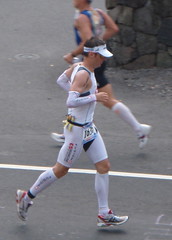
Why am I writing about Allyson Felix? Other than being one of my favorite runners, she is also one of many athletes in the Rio Olympics wearing compression sleeves (see picture above) while competing.

You too would have seen many athletes wearing them while training or racing. I've written about compression garments before way back in 2009.

Newly published studies suggest they definitely do help muscles recover significantly after exhausting exercise. The compression garments can aid the the movement of blood through muscles after exercising, when blood flow would otherwise be slow.  This increase in circulation may help reduce inflammation and muscle aches.

To provide such benefits, the compression garments must be quite tight, which some people may find uncomfortable. They must be also be worn for several hours after exercising/ racing, even if they become unpleasantly damp and stinky.

However, they do have certain downsides that may cause some of us not to wear them. Most recent studies indicate that compression garments do not boost blood flow through muscles during exercise, most probably because the movement of blood when we are exercising is already at its peak.

Even though many athletes report that exercise feels easier when they wear compression garments, these athletes performed similarly whether they wear the compression garments or not.

The authors concluded that compression garments has small effects on short duration sprints, running at VO2 max, as well as time trial performances (Born et al, 2013).

Like I wrote before  I've never raced with compression garments, I've only worn them after hard training so I can recover and train again the next day.

Maybe Allyson Felix didn't have to wear her calf compression sleeves after all ......

References

Born DP, Sperlich B et al (2013). Bringing Light Into The Dark: Effects Of Compression Clothing On Performance And Recovery. Int J Sp Physiol Perf. 8(1): 4-18. DOI: 10.1123/jisppp.8.4

Engel FA, Holmberg H and Sperlich B (2016). Is There Evidence That Runners Can Benefit From wearing Compression Clothing? DOI: 10.1007/s40279-016-0546-5.


*Here's another look at Allyson Felix's compression sleeves - took the picture with my iPhone 6 from the original by Cameron Spencer/ Getty Images.

Sunday, April 5, 2009

Sock It


I've had a few discussions with my patients and some athletes regarding compression garments/ socks this past week so I thought I'll do a write up on the topic. I first used them back in 2005 and those of you who know that I used to race and asked me how I recovered quickly to train consistently, well here's one the secrets (since I don't race anymore). Some of our national athletes (and gold medalists at the games) that I treated from badminton, table tennis and sailing also started using them prior to and during the 2006 Asian Games in Doha. There is a growing body of evidence in recent times on the benefits of compression garments for athletes, especially in "energy return" and clearance of lactate from tired muscles.

Compression socks were first created to help diabetic patients improve circulation, now they are used by cylists, runners and of course triathletes looking to help with the recovery process and run faster of course. A recent study done by German scientists on "below the knee" compression stockings (or socks) adds further evidence for these benefits. Two tests were performed, the second within 10 days of recovery of the first test. The first test involved some runners wearing the compression socks for a treadmill test while other runners did not. The opposite for the second test. Runners were randomly assigned as to the order which they performed the test. Results were as follows. With the compression socks the runners ran longer (36:44 vs 35:03 min), had a higher workload (422 vs 399 kJ) while maximum aerobic capacity was not significantly different (although it was slightly higher in runners wearing the socks). More importantly, researchers found that running performance at anaerobic threshold was significantly higher (meaning you can run in your fastest optimal speed before onset of accumulating lactic acid longer).

Before all of you rush out to get some of your own, here's the deal. The garments may work but in our super hot and humid climate in sunny Singapore, please take note that some of its effects may be negated. I've never raced in any of the garments, I've only put them on after training so I can recover and train again the next day. The socks may be most practical to race with compared to long sleeved tops and bottoms.

Paula Radcliffe wears the compression socks while racing and of course set the women's marathon best time wearing them as well (but she faltered at the Beijing Olympics - not because of the socks though). Those of you familiar with cycling, Samuel Sanchez who won the Olympic cycling road race wears them before and after his races (especially so if he has a flight to catch after). Allen Iverson of the Philadelphia 76ers wears a compression garment on his dominant arm while playing hoops. So does Boston Celtics star Ray Allen, in fact he wears it over both arms. Martina Hingis wore one over her right arm while playing tennis.

One last note, I once answered the door dressed in full long sleeve top and bottom after a hard training session. The postman delivering the parcel gave me a strange look......so be warned.

Reference

Kemmler W et al (2009). Effect Of Compression Stockings On Running Performance In Men Runners.  J Strength Cond Research 23(1): 101-105. DOI: 10.1519/JSC.0b013e18eaef3.