Showing posts with label Compression socks. Show all posts

Sunday, April 7, 2024

Tight Or Just Tired?

Who says my hamstrings are tight?
I always hear my patients telling me that their muscles are feeling 'tight' or tense. Does this mean that their muscles are 'short' or have poor range of motion? Or is it that the area that they complain about is tight and does not feel relaxed or 'loose'. Perhaps there is a vague sense of discomfort, not pain, just an unpleasant feeling, but too mild to be painful.

I always explain that when I put both my hands on their e.g. trapezius muscles that they feel the same, one side is not 'tighter' than the other. 

If I get a dollar each time my patients tell me how tight they feel when they come and see me I will have many extra dollars for sure.

A patient ran a very hard 21 km road race recently and complained of 'tightness' in his hamstrings for the past 5 days came to see me in our clinic this week. He said his hamstrings felt very hard, achy and 'tight' of course. They even threaten to cramp when he tried running or doing some strengthening exercises. 

However, he can easily put his palms on the floor in a forward bend. (Note: there are other patients whose hamstrings do not feel 'tight' but they can barely get their hands past their knees while bending forward).

He tried stretching but other then feeling a little better for less than a minute the 'tightness' came back quickly. Upon assessment he definitely had some delayed onset of muscle soreness (DOMs). I told him his 'tightness' was actually fatigue from his training and racing.

I suggested resting and focusing on his recovery. Definitely decrease his intensity and mileage. My personal experience after a hard race would be doing any of the 2 aerobic exercses outlined below at reduced intensity and low volume.

These low intensity exercises will increase blood flow to the affected muscles and often reduce pain. Pedaling at low resistance on a stationary bike is ideal as you don't have to worry about traffic (if you ride on the roads). An easy swim or just walking in waist or chest high water works well too. Wearing compression garments will help reduce DOMs as well. These above mentioned strategies do have some support in the research.

After he recovers fully, I suggested testing for strength imbalances and deficits as weaker muscles do tend to fatigue more rapidly. Specific strength training will address that.

In most other cases of patients feeling 'tight', the reason is obvious. If the stay in the same position/ posture for too long, their muscles need a rest or change of position to reduce the lack of blood flow or metabolic stress that is causing the noxious stimuli. Think of the last time when you spent hours in a car, plane or behind your computer, after you move/ stretch, the symptoms of stiffness/ tightness will be alleviated.

Remember this, when you feel stiff and 'tight', it is just a feeling and not necessarily a physical shortening that needs you to structurally change it. Like other things that you feel, you may feel it more sometimes compared to others. Like other forms of sensitivity, those feelings will change if you improve your overall fitness, strength and health.


Reference

Stanton TR, Moseley GL, Wong AYL et al (2017). Feeling Stiffness In The Back: A Protective Perceptual Inference In Chronic Back Pain. Sci Rep. 791): 968. DOI: 10.1038/s41598-017-09429-1

Sunday, August 21, 2016

Do Compression Garments Help While Exercising? Or Only With Recovery?

Picture I retook with my iPhone 6 from Alex Hassentein/ Getty Images
Allyson Felix just missed another gold medal in Rio earlier in the week, finishing second in the 400 meters after losing to a dive by Shaunae Miller of the Bahamas.

Last night, she just won her 6th gold medal at the Olympics in the Women's 4 x 400 m relay, the most ever by a woman in track and field.

Five of her gold medals have come in relays. Her individual gold came in the 200 meters in 2012.

Why am I writing about Allyson Felix? Other than being one of my favorite runners, she is also one of many athletes in the Rio Olympics wearing compression sleeves (see picture above) while competing.

You too would have seen many athletes wearing them while training or racing. I've written about compression garments before way back in 2009.

Newly published studies suggest they definitely do help muscles recover significantly after exhausting exercise. The compression garments can aid the the movement of blood through muscles after exercising, when blood flow would otherwise be slow.  This increase in circulation may help reduce inflammation and muscle aches.

To provide such benefits, the compression garments must be quite tight, which some people may find uncomfortable. They must be also be worn for several hours after exercising/ racing, even if they become unpleasantly damp and stinky.

However, they do have certain downsides that may cause some of us not to wear them. Most recent studies indicate that compression garments do not boost blood flow through muscles during exercise, most probably because the movement of blood when we are exercising is already at its peak.

Even though many athletes report that exercise feels easier when they wear compression garments, these athletes performed similarly whether they wear the compression garments or not.

The authors concluded that compression garments has small effects on short duration sprints, running at VO2 max, as well as time trial performances (Born et al, 2013).

Like I wrote before  I've never raced with compression garments, I've only worn them after hard training so I can recover and train again the next day.

Maybe Allyson Felix didn't have to wear her calf compression sleeves after all ......

References

Born DP, Sperlich B et al (2013). Bringing Light Into The Dark: Effects Of Compression Clothing On Performance And Recovery. Int J Sp Physiol Perf. 8(1): 4-18. DOI: 10.1123/jisppp.8.4

Engel FA, Holmberg H and Sperlich B (2016). Is There Evidence That Runners Can Benefit From wearing Compression Clothing? DOI: 10.1007/s40279-016-0546-5.


*Here's another look at Allyson Felix's compression sleeves - took the picture with my iPhone 6 from the original by Cameron Spencer/ Getty Images.

Sunday, April 5, 2009

Sock It


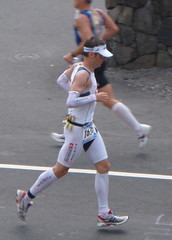
I've had a few discussions with my patients and some athletes regarding compression garments/ socks this past week so I thought I'll do a write up on the topic. I first used them back in 2005 and those of you who know that I used to race and asked me how I recovered quickly to train consistently, well here's one the secrets (since I don't race anymore). Some of our national athletes (and gold medalists at the games) that I treated from badminton, table tennis and sailing also started using them prior to and during the 2006 Asian Games in Doha. There is a growing body of evidence in recent times on the benefits of compression garments for athletes, especially in "energy return" and clearance of lactate from tired muscles.

Compression socks were first created to help diabetic patients improve circulation, now they are used by cylists, runners and of course triathletes looking to help with the recovery process and run faster of course. A recent study done by German scientists on "below the knee" compression stockings (or socks) adds further evidence for these benefits. Two tests were performed, the second within 10 days of recovery of the first test. The first test involved some runners wearing the compression socks for a treadmill test while other runners did not. The opposite for the second test. Runners were randomly assigned as to the order which they performed the test. Results were as follows. With the compression socks the runners ran longer (36:44 vs 35:03 min), had a higher workload (422 vs 399 kJ) while maximum aerobic capacity was not significantly different (although it was slightly higher in runners wearing the socks). More importantly, researchers found that running performance at anaerobic threshold was significantly higher (meaning you can run in your fastest optimal speed before onset of accumulating lactic acid longer).

Before all of you rush out to get some of your own, here's the deal. The garments may work but in our super hot and humid climate in sunny Singapore, please take note that some of its effects may be negated. I've never raced in any of the garments, I've only put them on after training so I can recover and train again the next day. The socks may be most practical to race with compared to long sleeved tops and bottoms.

Paula Radcliffe wears the compression socks while racing and of course set the women's marathon best time wearing them as well (but she faltered at the Beijing Olympics - not because of the socks though). Those of you familiar with cycling, Samuel Sanchez who won the Olympic cycling road race wears them before and after his races (especially so if he has a flight to catch after). Allen Iverson of the Philadelphia 76ers wears a compression garment on his dominant arm while playing hoops. So does Boston Celtics star Ray Allen, in fact he wears it over both arms. Martina Hingis wore one over her right arm while playing tennis.

One last note, I once answered the door dressed in full long sleeve top and bottom after a hard training session. The postman delivering the parcel gave me a strange look......so be warned.

Reference

Kemmler W et al (2009). Effect Of Compression Stockings On Running Performance In Men Runners.  J Strength Cond Research 23(1): 101-105. DOI: 10.1519/JSC.0b013e18eaef3.