Yes you did. Yesterday's Straits Times (130609 page c32) had a report called Water way to fitness. Please see the link here).
Our post -Aqua Based Rehabilitation (Deep Water Running) was published on 30th April this year (Check it out here).
We have classes weekly, please contact us if you are keen on learning it.
Sunday, June 14, 2009


Tuesday, June 9, 2009
You Spin Me Right Round Baby Right Round
 No, this write up is not about the 80's song by Dead or Alive made famous again in the show "The Wedding Singer". Rather, I am talking about riding your bike and spinning your pedals round.
It's well documented that part of Lance Armstrong's key to success is an unusually fast cadence while cycling- about 110 rpm (revolutions per minute). The rationale behind is this- spinning faster requires less muscle effort, so you fatigue less and recover faster, especially while climbing. It works for Lance, but will this style work for the rest of us? Well, what works best is finding what is most the most efficient cadence for yourself.
First and foremost, you have to have an efficient riding position before you learn how to pedal in smooth circles. For me, I use a goniometer (measuring tool) to ensure the cyclist has a saddle height that leaves his/ her knees bent between 25-35 degrees when the pedal is farthest away from the saddle. In addition I also drop a plumb line with pedals horizontal at the front of the knee cap to bisect the pedal axle. This is to achieve an optimal position for power transfer. For the actual pedal stroke it is better to "lift and pull back" with each pedal stroke and not push the pedals down. This can be achieved with strong core and hip flexor muscles. Please also see this.
Bear in mind that riding smaller gears and spinning faster than what you are used to will feel uncomfortable at first. It takes a while before it becomes natural. Try the following drills.
On your next ride, shift to a low gear and experiment with different cadences, 85, 95, 110 rpm, spinning a few minutes at each. If you ride 20 rpms faster than what you are normally used to, riding at your usual cadence will feel easy. You ideal maximum cadence is when you are spinning fastest with you form intact - no bouncing up and down in the saddle.
Single leg pedaling will teach you how to apply power through the whole pedal stroke (and not just on the down stroke). It's better to do this on a relatively traffic free road if you do not have a trainer at home. Do 30 secs on each leg, building to 2 mins, with equal rest time.
But don't let this technique become your cardinal rule. Sometimes you still need to shift to a heavier gear and go - especially if you want to accelerate instantly. Like when you buddy attacks and you want to follow, or when you are doing the attacking.
* Picture of Lance taken by Aized on Stage 6 in Adelaide, Tour Down Under 2009
Wednesday, June 3, 2009
Hyponatremia at Sundown Marathon
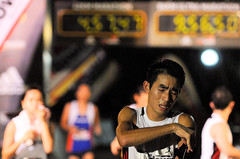
What's that again you say? Hyponatremia means having low levels of sodium (or salt) in your bloodstream (<135 meq per litre).
At least 3 runners were known to be affected judging from the data my friend collected as part of his research from runners who participated in the 84km Sundown marathon last Sunday.
How serious is this? Well, there was one death from hyponatremia in the 2002 Boston marathon. Thankfully, there were no fatalities from this race. Most runners are aware of the dangers of dehydration, but not many are aware of the dangers of over hydration.
Usually, athletes who participate in marathon distances and above, half ironman distances triathlons and above are most at risk.
Sodium (or salt) is a very important electrolyte that is involved in muscle contraction and has a role in moving water through your cell walls and distributing it throughout your body. When you sweat, you lose salt and water, and if you sweat a lot, you can deplete your body's sodium stores. If you drink too much water and do not have enough enough sodium (or salt) in the body, the water cannot move from the gut to the blood stream so the water remains in your tummy.
A common complaint among athletes is that they have drank a lot yet still feel thirsty. They feel bloated, their tummy is swollen and they have a upset stomach. More severe symptoms can include cramps, giddiness, disorientation, vomiting, diarrhoea, convulsions, swelling in the brain and even death in severe cases. Trust me on this, I had most of the previous mentioned symptoms and even spent 2 days in the ICU in a Hong Kong hospital when I had hyponatremia while taking part in a 100km run in November 2000.
Some interesting numbers for your consideration. Sweat contains 2.25-3.4 grams of salt per litre. In a long race, you can easily sweat 1 litre an hour, so in a 12 hour race that can add up to 27-41 grams of salt. A general rule of thumb is that you should consume 1 gram of sodium per hour in a long event. You should also increase your salt intake in the days leading up to the event (try 10-25 grams of salt per day pre race). Now, those of you who know me know why I always sprinkle extra salt on my french fries and why I'm not afraid of eating chips. Well, now that I'm not training like before, I'd better not go crazy with my salt intake.
To get just one gram from sports drinks alone, you will need to drink 2.8 litres of Gatorade. Do you think you can drink that much for the duration of your race? Not many of us can. Even if you drink sports drinks (instead of water), it is quite likely you will sweat out more salt than you can drink, especially on a hot day. You will probably need to replace your salt specifically.
Hope this helps with your next long training session or race.
References
Almond CSD et al, (2005). Hyponatremia among runners in the Boston Marathon. New Engl J Med. 352: 1550-1556.
Noakes, T (2002). Hyponatremia in distance runners: fluid and sodium balance during exercise. Curr Sports Med Rep. 1: 197-207.
Wednesday, May 27, 2009
Am I Watching The Match?

Some of my patients asked if I was gonna be watching the UEFA Champions League final tonight? Of course I will be. Have been spoilt for choice over what to watch recently, there's cycling (Giro'd Italia), French Open tennis all live in the evenings, and there's NBA in the mornings (although I haven't been able to watch much because of work of course). And of course tonight's dream final between Barcelona and Manchester United. Two of the most supported teams trying to win the most prestigious club competition at the Stadio Olimpico in Rome.
With all the attention on soccer the past few days, I happened also to come across an interesting British paper attempting to find key characteristics that distinguish between successful and less successful soccer players and teams (professional footballers from 1973-74 vs 2003-04).
The results are as follows, a significant increase in average height in present day players but no significant changes in body weight, body mass index or BMI and reciprocal ponderal index (RPI). RPI is the cube root of body weight divided by height to determine obesity.
Goalkeepers, central defenders and strikers were taller, heavier and older than players in wider positions. Midfielders and wider players were also found to have lower BMI and RPI than central players. Players from the more successful teams (top 6 in table) were also taller, more muscular and younger. This trend was even more obvious in the most recent season studied (2003-04).
Let's see if we can find any interesting matchups to see where the game will be won in tonight's game. With injuries and suspension affecting the Barcelona defense, 22-year-old Gerard Pique (1.91m, 85kg) will most likely be tasked with keeping 24-year-old Cristian Ronaldo (1.85m, 75kg) quiet. More incentive for Pique is the fact that he will be facing the team he used to play for and he will be out to prove Manchester United was wrong in letting him go.
At the other end it will be Lionel Messi (21 years, 1.70m, 67kg) versus Patrice Evra (28 years, 1.75m, 75kg). Evra will have his hands and legs full to keep Messi in check as Messi can turn the game in a flash if given too much freedom with his superb movement, tricks, pace and vision.
In central midfield Xavi Hernandez (29 years, 1.68m, 66kg) will have a key "head to head" confrontation with Michael Carrick (27 years, 1.83m, 70kg). The tall, athletic Carrick against a diminutive, dynamic Xavi will showcase a clash in styles. Carrick will have additional defensive duties as Darren Fletcher is suspended besides trying split the Barca defence with pinpoint passes or penetrating runs. Xavi's role mirrors that of Carrick as he is just as crucial in attack as defence for Barcelona.
Let the match begin.
Reference
Journal of Sports Science 2009 27(5): 419-426
Photo taken from www.soccernet.com
Sunday, May 24, 2009
What Time is It?

It's French Open Time. For all you tennis fans out there, the French Open kicks off tonight. It looks like an intriging two weeks up ahead as the French Open is billed as the most challenging among all the grand slams. Why most challenging, you may ask? Well, it's a time when the ubiquitous power games on both the men's ATP and women's WTA tour take a back seat to strategy, guile and court craft. The rallies are long, matches longer and only the mentally tough can win the utimate prize. Hosted in Paris at the Stade de Roland Garros, one of the most romantic cities in the world, the French Open runs from 24th May to 7th June this year.
I'd still say the big favorite for the French Open remains Rafael Nadal. How can you pick against arguably the greatest clay court player in the history of tennis who'll be gunning for a record setting 5th consecutive title (to overtake Bjorn Borg).
I'd still say the big favorite for the French Open remains Rafael Nadal. How can you pick against arguably the greatest clay court player in the history of tennis who'll be gunning for a record setting 5th consecutive title (to overtake Bjorn Borg).
Well, there's Roger, some will no doubt say. Roger Federer accomplished what no other player this year has, he played spectacularly to beat Nadal in straight sets last Sunday to win the ATP Masters Madrid Open (see photo above). For Federer to beat Nadal is rare enough as he'd lost their previous five finals (previously all matches head to head is 13-6, in Nadal's favor, 9-1 on clay, including 11-4 in finals). But to do so on clay is an enormous achievement for Federer.
However, before you start to think that the tide has turned and that Federer has regained his status as the man to beat, it must be pointed out that the last time Nadal lost a final on clay, it was also to Federer, in Hamburg 2007, and only a few weeks later, he went on to beat Federer in the final of the French Open. Moreover, at this Madrid Open which is a new clay court event on the calender this year, it obviously has a faster surface than Paris (which suits Federer's game more) and cannot be compared with the French Open.
Nadal came into last Sunday’s final less than 24 hours after spending a record- breaking 4 hours 3 minutes on court in the semis against Novak Djokovic. The match is believed to be the longest best-of-three sets singles match on the ATP World Tour in the Open Era (since 1968). Not to take anything away from Federer, who played an excellent clay match against his fiercest rival. He was able to take advantage of Nadal’s heavy legs and prolific unforced errors. He kept a cool head, which has not always been the case for the Swiss maestro recently. He truly earned the win and will now head into the French Open next week with buckets of confidence.
Nadal mostly staggered through that match. His legendary focus on big points was absent. He went 0/4 on break points against Federer in the match and saved neither of the two break points Federer had against him. Nadal's backhand was often short and tired looking and he could not find his range on the forehand wing. Federer, who obviously noticed that Nadal was struggling with his movement, used the drop shot to great effect. His tactics were simply exceptional throughout the match. Besides these two great players, other challengers in the men's field will include Novak Djokovic, David Ferrer and maybe Andy Murray.
For the ladies, the draw looks wide open with a few likely ones challenging for the honors. Svetlana Kuznetsova, Jelena Jankovic, Elena Dementieva and Ana Ivanovic are the usual suspects though the latter and who is a former World No 1 and defending champion hasn't been playing well recently. After losing in the 3rd round at the Australian Open, Ana has managed only 2 quarterfinal appearances to date so far and pulled out of the Madrid Open last week with a knee injury. The Williams sisters Venus and Serena haven't done so well in Paris recently, but you can never count them out especially in grand slam events. My guess for the win? Dinara Safina, yes Marat's little sister, who is having a super stellar season so far. The current World No. 1 was runners-up at this year's Australian Open (and also last year's French Open). She's the one in ominous form recently and has won back to back clay court titles in Rome and Madrid.


Who will I be rooting for? Rafa of course. I had the honor of taking a picture with him at the Beijing Olympics last year and he was really humble and obliging. But, here's the clincher, Rafa has never lost in Paris, going 28-0 in Paris since first winning there in 2005. He has never even been pushed to a 5th set there so far. In fact, he didn't lose a single set in last's year's run to the title. This year will will be tougher though given he has a tough draw. But in Paris, he's still the man to beat.
Tuesday, May 19, 2009
Eating on the Fly

On the just concluded queen stage 10 (longest stage of 262km) of the ongoing Giro d' Italia (a 21 day cycling stage race otherwise known as the Tour of Italy), the riders in the picture on the left are seen getting their feed bag to get some much needed nourishment so they can do well on this particular stage. 262km in a day? How many of us have ridden that far in a week recently, let alone in a day?
Unless you've been living on another planet, most of you will be aware of the tremendous importance of carbohydrates (CHO) for sporting performance. Much of the published emphasis has been on replenishing CHO stores after training or competition.
There is however, emerging evidence that CHO feeding during exercise offers significant benefits. There is no way the riders can get away with not eating during that stage where they ride 262km. In fact, they have to eat a lot before, during and after the stage. For the rest of us mortals who ride or train much less, eating on the go (while training or exercising) may be just as critical.
Consider the following study where investigators attempt to find out what the impact of eating during a 75 minute training ride at 80% VO2 max on CHO stores in the body and also protein oxidation. In the first trial, the cyclists took 125 grams of glucose while riding, while in the second trial, no glucose was ingested. Sweat and urine metabolites were also analyzed to see how much protein was being oxidized during exercise ( to track to see if your muscle tissue is being broken down to fuel your exercise).
Results showed that feeding on the glucose reduced liver glycogen stores by 12% and muscle glycogen usage by a whopping 16%. The impact on protein utilization was more significant, glucose feeding resulted in a two-thirds drop in protein oxidation.
Hence, it is clear that by ingesting CHO during training, it offers significant benefits to endurance athletes (more so since the athletes studied were not low in CHO stores before the study). Not only does it spare muscle glycogen stores, it also reduces the loss of muscle tissue via protein oxidation. This may be especially useful for endurance athletes who struggle to maintain muscle mass during periods of high volume training or competition.
So more reason to eat on the go for your next long run or ride.
Reference
Int Journal Sport Nutr Exercise Metab Aug 2005; 15(4) : 350-365
Tuesday, May 12, 2009
Shin Splints Or Stress Fracture?

I've seen quite a few of my patients recently with shin pain so I thought I'd write about it. This condition can usually be caused by any activity that involves running, jumping or even extended periods of walking. Patients usually present with pain at the beginning of exercise. During the initial phase, the pain may disappear during the warmup or after 15-20 minutes of exercise, but returns for several hours after exercise. In the more severe cases, pain is usually present during training and aggravated during daily activities like walking, squatting or climbing stairs. There is often pain at rest as well. The pain is often described as a dull, aching discomfort of varying degrees of intensity.
Left untreated, it can progress to a stress fracture in your tibia (or shin bone). Which is exactly what happened to one of my patients.
The picture shown above is the x-ray of my patient's stress fracture. The arrow depicts the callus formation of thickening of the bone indicating a stress reaction in the bone. Usually a bone scan is needed to detect a stress fracture as an x-ray only picks up the callus formation (about a month later) as the bone is healing.
The term "shin splints" refers to pain along your tibia and this is usually caused by too much pulling of your muscles along their attachments along the bone. Research has shown that it is usually the tibialis posterior and soleus muscles that causes this condition. With repeated pulling (or stress), this causes the shin bone to be irritated and pain results. That is why this condition is also known as medial tibial stress syndrome. Milder cases are treated fairly easily. Most physiotherapists will ask their patients to rest, ice the painful area, change footwear and modify your training routine to prevent shin splints from recurring. The cause of your pain should be addressed rather than just treating the shin pain alone.
Most of the time shin splints occur from overuse. It is commonly seen in athletes who suddenly increase their duration or exercise intensity of training. Overpronation is often listed as one of the common causes of shin splints. Now if you've been following our blog article Pain Free Running or running with the Physio or Sports Solutions team, then you will be happy to know that you can run pain free and even avoid getting shin splints. Our athletes with shin splints or stress fractures often do their rehabilitation in the pool as well to maintain their fitness.
I have had stress fractures in both legs before, early in my racing days, when I was just competing in track and field events. This was before I started competing in triathlons of course. I know exactly how frustrating it can be not being able to run. Will be most willing to help if you need any advice on this.
Please read this for more on shin splints.
Please read this for more on shin splints.
Reference
Thacker SB, Gilchrist J, Stroup DF and Kimsey CD (2002): The prevention of shin splints in sports: a systematic review of literature. Medicine and Science in Sports and Exercise 34: 32-40.
Subscribe to:
Posts (Atom)