Showing posts with label Hyponatremia. Show all posts

Sunday, February 13, 2022

The Big Hand Syndrome

Since my accident last year, my wife and I have been going for longer walks (since I could not run then). We enjoy the time together since it gives us a chance to share our thoughts, talk things out and simply hang out.

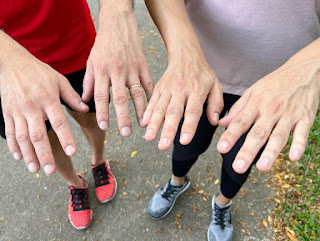
What we have noticed is that our hands are often swollen at the end of these hour long walks. It never happens when we go for a run, only after a walk.

Looking through some endurance related forum boards revealed that this is fairly common among ultra runners too. Ultra runners complain that their hands look like a "blown up rubber glove" or having fingers that feel "tight and hard to bend".

I've tried looking for research regarding the causes of hand swelling during walking/ moderate exercise, but not much can be found. It has been suggested by one published report that one out of four people will experience swollen fingers/ hand while walking. Women seem to be more commonly affected than men. 

There have also been suggestions that arm motion, heat-related issues or metabolic changes may play a part but nothing seems conclusive. 

One study (reference below) referred to the post-walking hand swelling as the "big hand syndrome".

It is suggested that hand swelling may be a result of the way our bodies and blood vessels respond to blood flow during exercise. Since exercise increases blood flow to our heart, lungs and our lower limb muscles (while walking) blood flow to our hands is reduced. This makes our hands cooler while the blood vessels react by opening wider, leading to swelling in the hands. 

As you contiune on your walk, your muscles try to dissipate the heat generated by pushing blood to the vessels closest to the surface of your body. This response makes you pespire and can also contribute to hand swelling.

In hot, sunny and extremly humid Singapore, skin blood flow and circulation may be compromised and regulation of body temperature will be more difficult, even during light exercise. Vasodilation (opening of blood vessels) occurs to cool our bodies by pespiring.

Depending on how much water we drink and our bodies' ability to cool itself, this may create a fluid imbalance, leading to excess fluid in the skin and underlying tissues.

Some papers also suggest fingers/ hand swelling can be a early sign of hyponatremia, but I don't think so. It would be very unlikely that one can get hyponatremia from walking for an hour or two. 

Trust me on this, I've had hyponatremia before and the more serious and obvious signs and symptoms include vomiting, cramps, giddiness, disorientation, diarrhoea and convulsions. I had most of those symptoms and that landed me in the hospital intensive care unit (ICU) for a few days after a ultra running race in Hong Kong back in 2000. Now you know what I mean when I say I'm a cat with 9 lives. I've definitely used up a few of those 9 lives. 

Unfortunately, there is no fool proof way to reduce or prevent exercise related hand swelling. What we found helped was opening and closing your fingers frequently when walking and/ or making exaggerated arm swings or circular actions with your elbow. 

Taking off your rings (like my wife in the picture above) and loosening your watch strap if you wear one will make it less uncomfortable.

All smart endurance athletes know it is important to pay attention to their bodies and it's natural to wonder if suasage-like fingers are symptoms of something sinister. Fortunately, hand swelling is just a slightly annoying, but not harmful, response to exercise. 


Reference

Ravaglia FF, Leite MG Leite, Bracellos TF et al (2011) Post Ambulatory Hand Swelling (Big Hand Syndrome): Prevalence, Demographics And Association With Dog Walking. ISRN Rheumatol. DOI: 10.5402/2011/65995

Thursday, August 15, 2019

You Definitely Do Not Need Extra Sodium Supplementation, Not Even In Hot Conditions


A few weeks ago I wrote about why it is not necessary to consume sodium to prevent muscle cramps. That post was popular as many runners shared it.

Well, here's further proof and confirmation that you do not have to consume sodium, even in a long ultra marathon.

Researchers found that majority of ultra runners (66 percent) in a race feel that sodium supplements should be made available at aid stations to prevent hyponatremia  and muscle cramping.

Previous research shows that consuming extra sodium does not prevent cramps, dehydration or nausea. Findings actually show that excessive sodium consumption can lead to the extra sodium left as residue on your skin and clothes. This is commonly seen as a white deposit left on your skin especially after a long training session or race.

After you consume too much sodium, it may lead to drinking too much water causing hyponatremia. Trust me here, as I'm guilty of this actually. I spent 2 days in the intensive care unit of a Hong Kong hospital when I had hyponatremia during a 100 km race in November 2000.

The researchers also found that a typical race diet (sports drinks, gels and bars) will usually provide enough sodium for your needs. Moreover sodium itself is not a source of fuel that can help sustain your efforts.

The researchers concluded that that study showed that no sodium supplements are required for ultra marathons in hot conditions lasting 15 to 30 hours (Hoffman et al 2015).


References

Hoffman MD et al (2015). Sodium intake During An Ultramarathon Does Not Prevent Muscle Cramping, Dehydration, Hyponatremia, Or Nausea. Sp Med Open. 1(1): 39.


Hoffman MD  and White MD (2019). Belief In The Need For Sosium Supplementation During Ultramarathons Remains Strong: Findings From The Ultrarunners Longitudinal Tracking (ULTRA) Study. Appl Physiol Metab. DOI: 10.1139/apnm-2019-0238.

Saturday, September 16, 2017

Today's Straits Times Article On Hydration

Straits Times article 160917 page C13 under Sport section
Every morning when I pick up the newspapers, I'll usually turn to the sports section first. Today, I happened to look at the article on the training plan for those planning to run the Singapore marathon at the end of the year. "Right hydration integral to a successful race". I thought the article was well written. Fairly straight forward and simple to understand. Also mentioned that over drinking water can lead to hyponatremia.

Wrote about sports drinks. Though you need to know that sports drinks cannot replace or even maintain your sodium levels during exercise or racing.

Just wanted to point out that the two percent loss of body weight (through sweating) during endurance exercise/ racing affecting your performance may not be totally accurate.

I wrote about it before earlier in the year that latest published research suggest that current hydration guidelines may well be wrong.

Two published studies on cyclists and elite male marathoners (including Haile Gabreselassie during 13 major city marathons) showed that weight loss up to three percent did not slow the runners down nor decreased the cyclist's power output.

In fact Gabreselassie lost 9.8 percent of his body weight during the 2009 Dubai marathon and still won the race in 2:05:29 hours! All drinking by the elite runners were ad libitm (or at their own time and pleasure).

Yes I do agree that the quoted study was done on elite runners. How does that apply to us in super humid and sunny Singapore?

My own thoughts are that the sports drink companies definitely recommend us to drink to much. I wrote before that I definitely drink less than my fellow team mates and competitors. From the time I started running cross country as a twelve year old kid to when I was racing triathlons. Even now during my weekly group bike ride. Most of the other cyclists carry two or more water bottles while I survive the three hour ride on one.

In fact I often had a side stitch after drinking while running cross country as a kid. That also deterred me from drinking too much then.

Of course this does not mean you try not to drink at all in your next long run/ ride and especially your next race. What I'm suggesting is that you at least give it a try in your next few long bike or run sessions.  Everyone is different. Try to get through those long sessions drinking as little as you can. You might be pleasantly surprised that you may not need as much fluid as you think.


References

Beis LY, Wright-Whyte M, et al (2012). Drinking Behaviours Of Elite Male Runners During Marathon Competition. Clin J Sport Med. 22(3): 254-261. DOI: 10.1097/JSM.0b013e31824a55d7.

Wall BA, Watson G et al (2015). Current Hydration Guidelines Are Erroneus: Dehydration Does Not Impair Performance In The Heat. BJSM. 49(16): 1077-1083. http://dx.doi.org/10.1136bjsports-2013-092417.

Friday, March 3, 2017

Current Hydration Guidelines May Well Be Wrong

Picture by richseow from Flickr
We've been told in the past by articles, journals and research scientists that if you lose more than 2 percent of your body weight (through sweating) during endurance exercise/ racing your performance will be affected.

Moreover, advertisements from Sports drinks companies keep harping on the fact the you need to drink up or else you get dehydrated.

However, some recent studies (as well as anecdotal evidence from the world's top distance runners) suggest that it may be possible to lose more than 2 percent of your body weight (from sweating) with little or no loss in your performance.

Research scientists from New Zealand's High Performance department have suggested that previous published dehydration studies were conducted in "relatively windless environments (i.e. wind speed less than 12.9km/h) with participants being aware their hydration status." They stated that such conditions do not simulate real race conditions.

In their own (albeit) small study of 10 cyclists, they found that weight loss of up to 3 percent did not slow down the cyclists nor their power output decrease in a 25 km time trial.

Another study on elite male marathoners examined their drinking behavior during 13 major city marathons. Haile Gebreselassie was found to have lost 9.8 percent (and that's a lot) of his body weight during the 2009 Dubai Marathon and still won in 2:05:29 hrs. All drinking by the elite runners were ad libitum (or at their own time and pleasure).

Granted the above study was done on elite runners. Does that even apply to mere mortals like us? Especially in hot and super humid Singapore.

Here are my own thoughts. From the time I started running cross country as a twelve year old kid, I've noticed that I tend to drink less than my team mates and other competitors. And definitely less than what the Sports drinks companies recommend. In fact I often had a side stitch after drinking. That also deterred me from drinking too much then.

So despite what you've heard or read before, at least give it a try in your next few long bike or run sessions. Try to get through those long sessions drinking as little as you can. You'll be pleasantly surprised that you may not need as much fluid as you think.

References

Beis LY, Wright-Whyte M, et al (2012). Drinking Behaviours Of Elite Male Runners During Marathon Competition. Clin J Sport Med. 22(3): 254-261. DOI: 10.1097/JSM.0b013e31824a55d7.

Wall BA, Watson G et al (2015). Current Hydration Guidelines Are Erroneus: Dehydration Does Not Impair Performance In The Heat. BJSM. 49(16): 1077-1083. http://dx.doi.org/10.1136bjsports-2013-092417.

Monday, November 1, 2010

Drinking Too Much Water Leads To Hyponatremia ST 011110

Today's topic in the ST Sweet 16 Marathon Training Plan (on page B13 under the Sports section) talks about the perils of hyponatremia or drinking too much. Drinking too much water that is. You mean you can drink too much water? That is probably what most readers will be asking. Yes, you can.

A common reply from athletes (taking part in endurance events) will be that they have drank a lot of water yet still feel thirsty. Their tummy feels bloated and swollen and they have a upset stomach. More severe symptoms can include cramps, giddiness, disorientation, vomiting, convulsions, diarrhoea, swelling in the brain and death in severe cases. Now, you can trust me on this, I had most of the above mentioned symptoms & even spent 2 days in the ICU of a Hong Kong hospital when I drank too much water and had hyponatremia during a 100km running race in November 2000.

Tuesday, April 6, 2010

Rinse And Spit


Here's an interesting bit of information that may surprise you if you taking part in the OSIM triathlon this weekend. Sure did surprise me. 2 different studies support this.

In the first study, runners were asked to run as hard as they can on a treadmill. Before one run, they rinsed their mouth with a sports drink of 6 % glucose but didn't swallow. Before their second run, they rinsed their mouth with an identical placebo drink with no calories and also didn't swallow the drink. Results? The runners ran faster and felt better when the rinsed their mouths with the sports drink.

In the second study, cyclists made made to do an all out 60mins time trial while a) consuming a placebo drink with no sugars or electrolytes, b) a common sports drink, c) rinsing their mouth with the sports drink but not swallowing any. Here's the funny result. The cyclists performed best while rinsing their mouths with the sports drink but not swallowing. Go figure.

So if you are feeling bloated on the bike or during the run and can't get any fluids down, just rinse and spit out your sports drink. You can still do well.

All the best to our patients taking part this weekend.

References

Rollo I, Williams C et al (2008). The Influence Of Carbohydrate Mouth Rinse On Self-selected Speeds During A 30-minute Treadmill Run. Int J Sp Nutr Ex Metab. 18(6): 585-600.

Potter A, Bouckert J et al (2008) Mouth Rinse of a Carbohydrate Solution Improves 1hour Cycle Time Trial Performance. Scandinavian J of Med and Science in Sports. Nov 3 Epub.

*Picture from Flickr.com

Wednesday, June 3, 2009

Hyponatremia at Sundown Marathon


What's that again you say? Hyponatremia means having low levels of sodium (or salt) in your bloodstream (<135 meq per litre).

At least 3 runners were known to be affected judging from the data my friend collected as part of his research from runners who participated in the 84km Sundown marathon last Sunday.

How serious is this? Well, there was one death from hyponatremia in the 2002 Boston marathon. Thankfully, there were no fatalities from this race. Most runners are aware of the dangers of dehydration, but not many are aware of the dangers of over hydration.

Usually, athletes who participate in marathon distances and above, half ironman distances triathlons and above are most at risk.

Sodium (or salt) is a very important electrolyte that is involved in muscle contraction and has a role in moving water through your cell walls and distributing it throughout your body. When you sweat, you lose salt and water, and if you sweat a lot, you can deplete your body's sodium stores. If you drink too much water and do not have enough enough sodium (or salt) in the body, the water cannot move from the gut to the blood stream so the water remains in your tummy.

A common complaint among athletes is that they have drank a lot yet still feel thirsty. They feel bloated, their tummy is swollen and they have a upset stomach. More severe symptoms can include cramps, giddiness, disorientation, vomiting, diarrhoea, convulsions, swelling in the brain and even death in severe cases. Trust me on this, I had most of the previous mentioned symptoms and even spent 2 days in the ICU in a Hong Kong hospital when I had hyponatremia while taking part in a 100km run in November 2000.

Some interesting numbers for your consideration. Sweat contains 2.25-3.4 grams of salt per litre. In a long race, you can easily sweat 1 litre an hour, so in a 12 hour race that can add up to 27-41 grams of salt. A general rule of thumb is that you should consume 1 gram of sodium per hour in a long event. You should also increase your salt intake in the days leading up to the event (try 10-25 grams of salt per day pre race). Now, those of you who know me know why I always sprinkle extra salt on my french fries and why I'm not afraid of eating chips. Well, now that I'm not training like before, I'd better not go crazy with my salt intake.

To get just one gram from sports drinks alone, you will need to drink 2.8 litres of Gatorade. Do you think you can drink that much for the duration of your race? Not many of us can. Even if you drink sports drinks (instead of water), it is quite likely you will sweat out more salt than you can drink, especially on a hot day. You will probably need to replace your salt specifically.

Hope this helps with your next long training session or race.

References

 Almond CSD et al, (2005). Hyponatremia among runners in the Boston Marathon. New Engl J Med. 352: 1550-1556.

Noakes, T (2002). Hyponatremia in distance runners: fluid and sodium balance during exercise. Curr Sports Med Rep. 1: 197-207.