![]() |
| Picture by Balint Botz from Radiopaedia |
Sunday, April 13, 2025
X-ray Based Diagnosis Leads To Potientially Unnecessary Surgery
Sunday, July 7, 2024
Can Ozempic And Wegovy Help Knee Osteoarthritis Pain?
![]() |
| Picture from Second Nature |
According to results from the STEP-9 trial (by Novo Nordisk) reported at the World Congress on Osteoarthritis (OARSI 2024), Wegovy, containing peptide receptor agonist (GLP-1) semaglutide not only induced weight loss but improved knee pain in people with knee osteoarthritis (OA).
STEP-9 was a multi national, multi center phase 3 clinical trial that enrolled subjects that had a BMI of >30, a clinical diagnosis of knee osteoarthritis with moderate radiographic changes and were experiencing knee pain.There were 407 subjects in STEP-9, randomly allocated 2:1 to receive once a week a subcutaneous injection of either semaglutide 2.4 mg or a placebo for a total of 68 weeks. Mean age of the subjects were 56 years and 81.6 percent were women. 60.9 percent were White, 11.8 percent Native American, 7.6 percent Black and 19.7 percent were of other ethnic origin.
Another finding was that the use of pain medication went down in the semaglutide group compared to the placebo group. This was maintained throughout the study.
Of course the are suggestions that the weight loss itself helped with the knee pain since weight loss fell by a significantly greater amount in the people treated with semaglutide versus those given a placebo. Weight loss was 13.7 percent versus 3.2 percent from baseline after 68 weeks.
The authors questioned if there is a specific action of GLP-1 receptor agonist on the knee joint itself and not through weight loss only. Especially since results from previous LOSEIT trial using liraglutide (also used to treat Type II diabetes) showed that subjects lost 2.8 kg versus a gain of 1.2 kg in the placebo group over a year did not have any change in the Knee injury and Osteoarthritis Outcome scores. The patients in that study had to undergo weight loss first before they were given the liraglutide.
Obesity is a worsening problem world wide in developed countries and Singapore has increasing numbers in people with diabetes. This is certainly going to add to the boom in weight loss drugs.
Morgan Stanley projects that the market for weight loss drugs will reach $54 billion by 2030, a 400 percent increase from today. Especially since so many celebrities have gushed about how much weight they have lost since taking them. Eli Lilly and Novo Nordisk (who owns Wegovy and Ozempic) together have at least 12 more obesity medications under development.
We are living through a cultural shift in which obesity is viewed as a disease rather than the result of lifestyle choices.
Should my patient try Wegovy instead especially since he does have knee pain from osteoarthritis? Wegovy has a higher dose of 2.4 mg semaglutide versus 2 mg for Ozempic.
Will Wegovy or Ozempic be the new default recommended treatment for osteoarthritis pain instead of surgery, gel injections and physiotherapy?
Reference
https://www.medscape.com/viewcollection/37518
*Please note that the STEP-9 study was funded by Nova Nordisk and the principal investigator Henning Bliddal acknowledged that research grants were given by Novo Nordisk to his institution as well as consulting fees and honoraria. He also received congress and travel support from Contura
Saturday, August 19, 2017
Can Sports Injuries Lead to Osteoarthritis In Your Joints?
![]() |
| Picture by Liji Jinaraj from Flickr |
Actually it's not just the athletes, every single weekend warrior or physically active patient that I see will ask when they can get back to their usual activity or exercise.
I'm guilty of doing the same. That's exactly what I asked my doctor after my bicycle accident.
There is now evidence to show that if you rush to get back to playing, whether as part of a team or elite sport or simply just your usual weekly recreational tennis game or jogging you may not allow the injured joint to heal fully.
OA is a degenerative joint disease. It happens when the protective articular cartilage lining the surfaces of bones wear out. This causes pain, stiffness, swelling and often disability that diminishes one's quality of life.
Post traumatic OA don't just happen to older patients. It can affect adolescents or young adults too.
Researchers suggest that acute joint damage can lead to a deterioration of the surface of the bone itself and structures that cushion and stabilize bones of a joint like the knee (Anderson et al, 2012).
That same study found that OA can develop in more than 40 percent of people who seriously injure their ligaments, the meniscus in the knee or articular surface of a joint.
They also found that people with a history of knee trauma are three to six times more likely to develop knee OA.
In order to better manage post traumatic OA, a group of Athletic Trainers (ATC) has suggested a more aggressive approach to both preventing and managing post traumatic OA. Especially in younger patients who get injured playing sports.
They suggested that having less deficits (between both legs) in muscle strength, endurance, balance movement quality and stability will reduce a person's risk of getting injured. After the initial injury, it should be properly managed to prevent additional injuries to the same joint or other joints to minimize OA developing. Ideally a structured rehab program should be maintained for six to nine months.
So don't be too impatient to return to your usual physical activity especially after a joint injury. You may have to modify the activities you do in order not to place unnecessary repetitive stress on the injured joint. Remember our articular cartilage likes and needs weight bearing forces for nutrition. Inactivity will cause the articular cartilage to deteriorate.
References
Anderson DD, Chubinskaya S, Guilak F et al (2012). Post-traumatic Osteoarthritis: Improved Understanding And Opportunities For Early Intervention. J Ortho Res. 29(6): 802-809. DOI: 10.1002/jor.21359
Palmeri-Smith RM, Cameron KL, DiStefano LJ et al (2017). The Role Of Athletic Trainers In Preventing And Managing Post Traumatic Osteoarthritis In Physically Active Populations: A Consensus Statement Of The Athletic Trainers' Osteoarthritis Consortium. J Athl Train. 52(6): 610-623. DOI: 10.4085/1062-6050-52.2.04.
Saturday, July 2, 2016
More Miles Does Not Mean Bad News For Your Knees
![]() |
| Singapore Stan Chart Marathon picture by RunSociety from Flickr |
I've written before that running does not wear out your knees.
I also disagreed with the author who wrote in the Straits Times (on 240516) on the above topic and I pointed out that there is no sound evidence at all that glucosamine helps with cartilage regeneration.
Here's further proof from a recently published article that didn't set out to study runners. In fact the authors that investigated this "Osteoarthritis Initiative" study had hypothesised that "a history of leisure running may increase the risk for knee knee symptoms and ROA (radiographic evidence of arthritis) even at lower levels."
Runners were grouped into low, middle and high groups if they had done at least 250, 800 or 2000 running workouts in their lifetime. All 2637 subjects in the study had high quality x-rays of their knees done and other methods of assessing knee symptoms.
Only two to five percent of the subjects described themselves as competitive runners showing that the findings are potentially more applicable to the general population compared to other studies.
Eight years after the study, subjects (56 percent female, average age of 64) were given a physical activity questionnaire. 29.5 percent indicated that they had participated in some running at some point in their lives.
The results were the exact opposite to what the researchers expected. This "forced" them to conclude that "A history of leisure running is not associated with increased odds of prevalent knee pain, ROA, or SOA (symptoms of arthritis). In fact, for knee pain, there was a dose-dependent inverse association with runners."
This meant that the people who ran the most had the least knee pain. This was true across all age groups and for running at any stage in one's life. The subjects that were still running had less knee pain (21.1 percent) than those who had quit running (25.3 percent), who had less pan than those who had never ran (29.6 percent).
So, most recent medical research continues to "exonerate" running as a cause of knee osteoarthrits. You now have more "ammunition" to show the naysayers who tell you to stop running or your knees will wear out.
Reference
Lo GH, Driban JB et al (2016). History Of Running With Higher Risk Of Sympyomatic Knee Osteoarthritis: A Cross-sectional Study From The Osteoarthritis Initiative. Arthritis Care and Research. DOI: 10.1002/act.22939.
Wednesday, June 22, 2016
Help! Both My Knuckles And My Knees Crack
![]() |
| Message from my patient |
![]() |
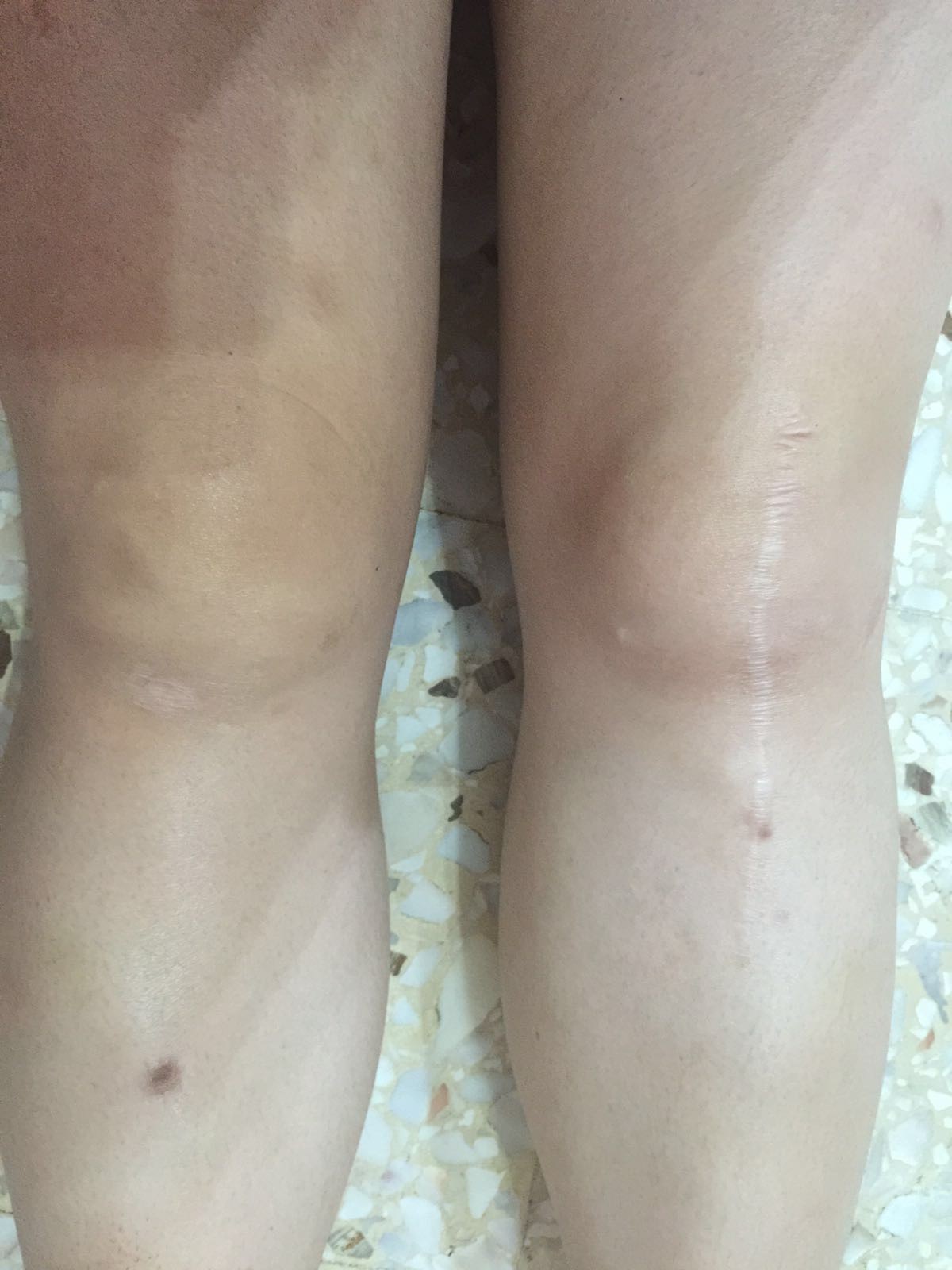
| Have a look at her battle scarred knees |
I've also had patients ask me about knuckle cracking. Common urban legend suggest that too much knuckle cracking leads to arthritis of the hand joints. Worse still, there are also medical/ health professionals who will suggest that with the clicking/ grinding/ cracking in your joints, you have take glucosamine supplements to prevent osteoarthritis. Do not be fooled. You know my thoughts on glucosamine.
Within a joint, the joint space is filled with synovial fluid. The synovial fluid lubricates the joint. It also reduces friction in the joint when you move. There are also gases such as oxygen, nitrogen and carbon dioxide in the synovial fluid.
When you manipulate (crack or pop) a joint, you stretch out the space between the bones that make up that joint. This expanding space creates a negative pressure, causing the synovial fluid and gases to rush there. The larger bubbles collapse into microscopic bubbles, leading to that characteristic popping sound, and that's what you hear. The joint often feels better as the joint space is widened and the bones are repositioned better (*see reference I copied below from the article). The joint often has better range of motion too (see my patient's WhatsApp message above).
Do not mistake joint cracking/ popping or manipulation with joint crepitus. Joint crepitus feels a little like grinding you may hear/ feel when a bone moves against articular cartilage - the lining of the bones. Crepitus happens most often in the knees and has also been described as a crunching, grinding or popping sound. I often tell my patients that crepitus with no pain is usually harmless.
Many of my patients also confuse joint cracking with the snapping sound our tendons make when tendons slide between muscles or over bones. Tendons are like rubber bands stretched between muscles and bones to connect both of them. Hence, when a joint moves, the tendon snaps over the bone and can often make a popping or sliding sound. It's very common to hear these sounds in the knees and ankles when you go from sit to stand, squatting or walking up and down stairs.
There is no need to worry about these crunching, clicking, popping or sliding sounds unless they are accompanied by pain. Now you know.
Reference
DeWeber K, Olszewski M and Ortolando R (2011). Knuckle Cracking And Hand Osteoarthritis. J Am Board Family Med. 24(2): 169-174. DOI: 10.3122/jabfm.2011.02.100156.
*During an attempt to crack a knuckle, the joint is manipulated by axial distraction, hyperflexion, hyperextension, or lateral deviation. This lengthens part or all of the joint space and greatly decreases intra-articular pressure, causing gases that have dissolved in the synovial fluid to form microscopic bubbles, which coalesce. When the joint space reaches its maximum distraction (up to 3 times its resting joint space distance), joint fluid rushes into the areas of negative pressure. The larger bubbles suddenly collapse into numerous microscopic bubbles, leading to the characteristic cracking sound. The maneuver leaves the joint space wider than it had been and synovial fluid more widely distributed. The stretching of joint ligaments required to produce the widened joint space also leaves the joint with greater range of motion.
Tuesday, May 24, 2016
A Running And Glucosamine Article I Do Not Agree With
![]() |
| ST 240516 |
I've never started an article with a quote before, but the above quote caught my eye and I feel it is only fair to give our patients and readers accurate information about how things are (even though I'm not a journalist. Don't get me wrong I'm not blaming the writer, I just want to present an evidence based view.
Not another running bashing article - that was my first thoughts glancing through the papers today "When running wears out the knees (ST 240516). This is under DocTalk on page B10.
I totally did not agree with the author on that. There is more than sufficient evidence to show that running does not wear out your knees.
The author's article also quoted studies saying that 35 percent of patients taking a regular dose of 1500 mg of glucosamine sulphate daily can increase cartilage regeneration.
May I kindly draw your attention to a Cochrane review where authors showed that glucosamine was generally safe to ingest but does not help with pain. I've written about glucosamine back in 2010 and 2009. Go and have read if you're keen.
Reference
Townheed T, Maxwell L et al (2008). Glucosamine Therapy For Treating Osteoarthritis. Cochrane Database of Systematic Reviews. DOI: 10.1002/14651858.CDOO2946.pub2.
Friday, February 5, 2016
How Effective Is Your Knee Brace?
| Assortment of soft knee braces from the Holland Village Guardian |
I've also seen so many of my patients walk in to our clinic with a self prescribed over the counter soft neoprene knee sleeve/ brace. Often, they are asked by the doctors they see to wear a brace.
| Often prescribed by doctors |
Let me explain what the differences are. Braces that are stiff and rigid are usually made from plastic, aluminium or carbon fibre. They usually restrict joint movement by physically pressing against the bones of the knee to provide firm external support.
| My patient in his rigid knee brace |
| Check out the rigid brace |
| See the difference in thigh girth? |
The softer neoprene type sleeves usually will not be able to provide the same mechanical support as they are much softer and do not have any rigid structural support. Neoprene sleeves generally help the wearer by increasing proprioception (or joint position sense) much like the high cut shoes basketball players wear to give themselves more awareness of their ankles to prevent ankle sprains. It is believed that improved proprioception around a knee joint can help stability by improving balance.
However, a 2012 published study of people with knee arthritis found no significant improvements in balance with the use of a neoprene knee sleeve.
There is also very little evidence that knee supports worn prophylactically on healthy knees protect active people against knee injuries.
Granted, knee supports/ braces are usually less expensive or as invasive against knee operations to treat injuries or even arthritis so so people will try them before resorting to surgery.
Some specialized knee supports may help to take pressure off the knee joint while walking and especially during exercise. My patient (in the picture below) intends to use her brace when she goes back to wake boarding and skiing after her injury. Of course I added that proper rehabilitation is important too. Such braces may also be able to help patients with knee arthritis remain active and put off surgery at least for a while.
![]() |
| All ready for action |
Bracing can be effective when you know what injury you have and the structures involved as a brace can be matched effectively to your needs.
| My MCL taping- "Much better than any brace" says my patient |
So don't just go and buy a sleeve/ brace.
Reference
Collins AT, Blackburn JT et al (2012). The Assessment Of Postural Control With Stochastic Resonance Electrical Stimulation And A Neoprene Knee Sleeve In The Osteoarthritic Knee. Arch Phys Med Rehab. 93(7): 1123.1128. DOI: 10.1016/j.apmr.2011.12.006.
*Big thank you's to all my patients who allowed me to take pictures or sent me pictures.
Sunday, November 23, 2014
Running Does Not Wear Out Your Knees
![]() |
| Picture by Cameron Drake on work done by Dr Noah Weiss |
Well, now you can tell all the naysayers that running (at any age) does not increase your risk of osteoarthritis (or wearing out of your joints), in fact they may even prevent the condition. This information was presented at the annual meeting of the American College of Rheumatology.
Researchers did a long term study on 2,683 subjects at four stages of their life : 12-18, 19-34, 35-49 and 50 and older. They were classified as a runner at that stage if they listed running as one of their three main activities.
X-rays of the knees were collected as well as subjects' reports of symptomatic pain. The knee x-rays were repeated again two years later. Analyses showed that 22.8 % of the participants who were runners had need osteoarthritis compared to 29.8 % who had never been a runner. And get this, average age of the participants was 64.7 years.
The authors concluded that "non-elite running at any time in life does not appear detrimental and may be protective" in regards to developing knee osteoarthritis.
Reference
http://acrannualmeeting.org/wp-content/uploads/2015/02/2014-ACR_ARHP-Annual-Meeting-Abstract-Supplement.pdf.
Monday, November 9, 2009
Glucosamine, Chondroitin & MSM

I've had many of my patients ask me if they need to be taking any supplements. Some even tell me they swear by their daily glucosamine and chondroitin pills -the 2 supplements favored by most runners. My patients were all really convinced the supplements worked until I tell them the published evidence.
In some earlier studies, there seemed to be some evidence supporting the use of glucosamine (but not chondroitin, or MSM etc). Yes, that means you do not need anything else in your tablet or pill except glucosamine. But most if not all of those studies were sponsored by the companies who made the tablets.
Based on recent studies however, researchers looked the effects of glucosamine and/ or chondroitin on joint spaces in the knees of 572 subjects with known (x-ray evidence) osteoarthritis in their knees. At the end of the 2 year follow up, there were essentially no differences between the subjects who received a placebo (or dummy) tablet and those who received glucosamine and/ or chondroitin. It was a double blinded study, meaning both researchers and subjects didn't know who were getting the dummy tablets and who were getting the real deal.
So what's my take on this. For all those who are currently taking them and feel that they work, please carry on. If not you may feel uneasy stopping anyway. For those who are thinking of starting, well, you have the evidence before you.
Have a look at much stronger evidence not to take glucosamine here.
Reference
Sawitzke AD, Shi H, Finco MF et al (2009). The Effect of Glocosamine and/ or Chondroitin Sulphate on the Progression of Knee Osteoarthritis. International Society of Sports Nutrition.