Sunday, February 8, 2015

How To Interpret The Straits Times Article (040215) On Excessive Running


According to Danish researchers, running excessively is as good as not exercising. After reading the write up, I wanted to put this out earlier, but with a new born child, this had to wait. Well here are my thoughts on that article reported by Straits Times on 040215 on page A8.

The study looked at mortality rates in sedentary people and runners. What was widely reported was that those who ran more (and more vigorously) died at a greater rate during the study period than those who ran less. More dramatically put, running fast is as deadly as sitting on your couch.

Firstly the same data used in this study was already published back in 2012 in another journal. Seems like no new data? Well let's just republish the same data in another journal. Even the authors are similar as the previous study with the addition of James O'Keefe who has basically been on almost every single one of those "running will kill you" articles if you look him up. The media never checks this I guess and reports it as if it was brand new.

A few other things to consider. The sample size in the study (for runners) was relatively small, while sample sizes were large in the "less active" group. (If you looked at the data, only 2 people in the strenuous exercise group died).

Categorization of the volume of jogging was also arbitrary and the participants' running volume, frequency and pace were all self reported. Moreover, causes of death were not identified in the study, meaning some deaths were due to accidents possibly and not health related. With a smaller sample size, one death could affect the results a fair bit.

Other than the Straits Times, other news sites have also "broadened" the conclusion to suggest that more ambitious (or hardcore) running is of equal health benefit to being sedentary (or sitting on your couch). They failed to report that there are also lots of published data to show the many health benefits of higher mileage runners (although there are big benefits from very little running).

My take? This one study should not change your views or approach on running. There obviously is a point when running stops being beneficial and another point which will worsen your health. However, this differs for everyone and probably not at the low levels described in the article referenced below.

Reference

Schnohr P O'Keefe JH et al (2015). Dose Of Jogging And Long Term Mortality The Copenhagen City Heart Study. J Am Coll Cardio. 65(5) : 411-419. DOI: 10. 1016/j.jacc2014.11.023.

The Straits Times article

Saturday, January 31, 2015

Where Does Your Fat Go?

Picture by Hey Paul Studios from Flickr
Most people will say converted to heat or converted to energy when asked about where the fat goes when you lose weight.

That was what I thought too.

Well, I did until I read that it wasn't so. According to scientists, the lungs play an important role in weight loss too, as most of it is exhaled as carbon dioxide.

In biomedical terms, people trying to lose weight are trying to use the triglycerides stored in fat cells. In order for the triglyceride molecules to be used, they must be broken down into oxygen, carbon and hydrogen via oxidation. While tracing these atoms' leaving the body, researchers found that they leave mostly as exhaled carbon dioxide.

If you lose 10 kilograms (or 22 pounds), 8.4 kilograms are exhaled as carbon dioxide according to researchers calculations, The remaining 1.6 kilograms become water and may be excreted in the urine, sweat, faeces, breath, tears and other body fluids.

The researchers' calculations showed that the lungs are the primary excretory organ for fat.

Now you know.

Reference

Meerman R and Brown A (2014). When Somebody Loses Weight, Where Does The Fat Go? BMJ. DOI: http//dx.doi.org/10.1136/bmj.g7257

At least they are riding their fat away ...... on fat tyres
Picture by Jereme Kauckman from Flickr.

Thursday, January 22, 2015

Core Work On Stable Or Unstable Surfaces?

Taken by my wife for a talk she did way back in 2005!
Many of my patients engage personal trainers to help them with their workouts regularly. Out of curiosity, I always ask them to tell me what sort of exercise routine they go through with their trainers. Turns out that "core strength workouts" are a very popular choice amongst personal trainers.

Well, here's a post on whether your "core strength" workout is giving you the workout you want.

A group of researchers studied a group of subjects doing core strength workouts. At the start of the study, the subjects performed fitness tests including tests for core muscular endurance, flexibility, balance and a 20 metre sprint.

The subjects trained twice a week for six weeks. Each session was a 30 minute circuit session rotating among three exercises : cross curl-ups, side bridging and bird dogs. One group did the session on a stable surface while group did the same exercises on unstable surfaces.

For example while doing bird dogs (starting on hands and knees and reaching alternate limbs horizontally), a basketball was placed under the supporting hand. As the study progressed, this group added additional elements of instability to each exercise. Example : putting a squishy ball/ balance cushion under the supporting knee and lifting the foot of supporting knee off the floor.

After six weeks, both groups improved significantly.Despite what the researchers thought would be the case, the group who did their exercises on unstable surfaces did not outperform the stable group.

The researchers reported that core strength training is feasible and safe and it produces marked increases in strength, flexibility and skill related components such as balance, coordination and speed.

They concluded that if the goal is to enhance physical fitness, core strength workouts on unstable surfaces has no advantage over the same exercises on stable surfaces.

Reference

Granacher U, Schellbach J et al (2014). Effects Of Core Strength Training Using Stable Versus Unstable Surfaces On Physical Fitness In Adolescents: A Randomized Controlled Trial. BMC Sports Sci Med Rehab. 6(1): 40. doi: 10.1186/2052-1847-6-40. eCollection 2014.

Another look - 10 years ago....


Sunday, January 11, 2015

How Envy Can Make You A Better Runner For This New Year

My wife said that I haven't written anything for this blog for 2 weeks and said I 'd better get started since I've been in "holiday mood" since Christmas. So here's the first post for this year.

Picture by dingler1109 from Flickr
New year, new resolutions right? How many of you wanna become better and faster runners? Have a read on how envy (traditionally considered one of the 7 deadly sins), well the right envy anyway, can help you race faster.

Now, envy is usually regarded as directed towards someone else's superior status or accomplishment.

According to the authors (who studied runners who took part in the Cologne marathon), envy has many different words in other languages (which is unlike English). These differences account for that fact that you can be "benign envious" - meaning you desire to match someone else's success. It can also mean "malicious envy" - meaning you hope the other person's success ends.

With "benign envy", the researchers suggest that runners may try to level themselves up to be as successful as the person they envied by increasing personal effort to change behaviour aimed at obtaining a desired target. They also focus their attention toward means to achieve it.

In running terms, this means specific goal setting e.g. I wanna run as fast as XYZ did in her last half marathon and doing the necessary training to meet that goal.

With "malicious envy", runners are pushed to exceed their friend's running time as it becomes a mark they judge themselves by. This is not ideal as this is independent of their own situation, leading to low perceived control over future outcomes.

The researchers found that "malicious envy" runners were not strong goal setters compared to "benign envy" runners. The latter viewed others' results resulting from subjective factors such as running more mileage to achieve a certain result and not due to talent alone.

The authors suggest that their study complements previous studies where runners tend to perform better when fellow runners that regularly finish near them were in the same race. This suggests we use familiar rivals as a motivation and benchmark to push ourselves.

Also of note is that while we spend time training our bodies, our minds too play a key role to determine success on race day.

Reference

Lange J and Crusius J. (2015). Dispositional Envy Revisited: Unraveling The Motivational Dynamics Of Benign And Malicious Envy. Personality and Social Psychological Bulletin. 41(2) : 284-294.

Sunday, December 21, 2014

Runners Who think They're On EPO Run Faster

The real deal- EPO or erythropoietin
I was looking for a picture on EPO so I asked my friend (who's a doctor) if she could take a picture of a vial of EPO from her clinic for me. She said she does not sell any evening primrose oil in her clinic. I said no, not evening primrose oil but erythropoietin (EPO).

Why did I need a picture of EPO? Well, my next post is on runners and EPO of course. We've all read about the performance enhancing effects EPO, how can shave seconds and even minutes off best marathon times. Please read on if you're interested.

Scottish researchers studied a group of runners whose average 10 km personal best time was around 39:15 minutes. Over a few weeks, these runners competed in 3 km races in a indoor 200 meter track,

During a week of the study, the runners were given OxyRBX to self inject. They were told OxyRBX contain small amounts of EPO - a known blood booster than increases endurance performances.

The runners were actually injecting themselves with saline, which of course does not have any performance enhancement qualities.

Guess what? When these same runners raced at the end of that week (in which they thought they were injecting themselves with EPO), the runners finished their 3 km race an average of 9.73 seconds faster (or about 5 seconds faster each mile).

This 1.2 % improvement is a statistically significant improvement and of clear sporting relevance. How significant is this? At the 2012 Olympics, the difference between the gold medal and fourth place was less than 1 % in all track events from 1500 - 10,000 meters for both men and women.

Almost all runners who had expected to see positive changes when injecting themselves with OxyRBX recorded a marked improvement.

This differs from those runners who did not expect much improvement whose performance improved less markedly. The runners reported lower levels of perceived exertion during the race that followed their week of "doping".The runners also said they pushed themselves harder during the races at the end the "doping" week.

Some runners also reported increase confidence in their abilities after the injections, this has been shown to increase willingness to exert extra effort in challenging tasks.

If you sincerely believe that adding a new element to your training (increasing your weekly track and hill workout, speed work etc) will improve your running, it can be a self fulfilling practice as it can increase your motivation, confidence and then better results. No need to dope.

Reference

Ross R, Gray CM et al (2014). The Effects Of An Injected Placebo On Endurance Running Performance. Med Sci Sports Ex. DOI: 10.1249/MSS.0000000000000584.

*A big thank you the Dr GL for the EPO picture.

Friday, December 12, 2014

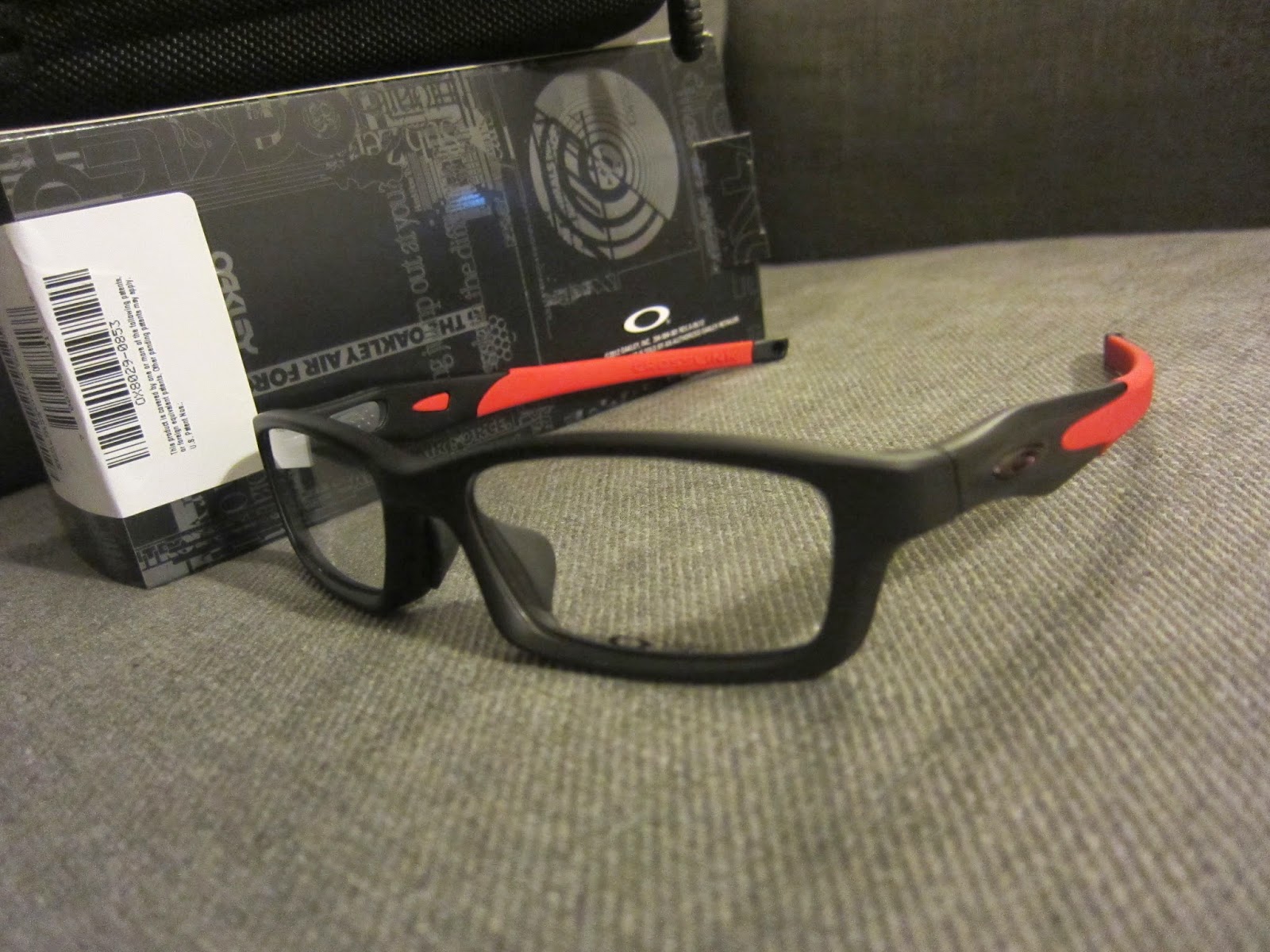
My Christmas Present From Oakley

My Crosslink with red ear stems
Every year end, I get a present from Oakley, you've read about my Fast Jacket and my Jawbone. Sometimes it's sun glasses, sometimes apparel, sometimes both.

Well I've got another early Christmas present from Oakley this year. The Oakley Crosslink. Crosslink? But you don't need glasses some of you will say..

I don't need glasses to see distance, but I am having some difficulty reading now!!  I literally woke up one morning finding it difficult to read the newspaper.

When I'm sitting outside or when it's brightly lit I have no problems reading. However when the light is not so good, I struggle to read. Hence the need for me to get prescription lenses.

A closer look. Yes you get a extra pair of ear stems too.

A big thank you to Joey from Oakley.

Sunday, December 7, 2014

How Long Rather Than How Hard ....

....  may determine your immune response to exercise. Hope I caught your attention for the right reasons with my heading.

A 2 hour bike ride sure beats a 2 hour jam
Here's quite an interesting read, especially for those of you who just finished the marathon today.

We know exercise helps strengthen our immune system, Too much exercise weakens it. How do we know what's optimal?

Researchers compared 30 minutes of moderate treadmill running, 30 minutes of intense running (when maintaining a conversation while running is difficult), 120 minutes of moderate running and of course a control group with no exercise.

This is a very interesting study as researchers administered diphenylcyclopropenone (DPCP), which is a chemical through a patch on subjects' lower back. The response on the back is redness and skin thickening which is then measured. This is very different from previous other immune function studies which use animals or measure certain blood markers or saliva.

Results? A long duration of exercise (120 minutes) causes a temporary weakening of immune function. Surprisingly, the 30 minutes short bout of intense exercise did not weaken immune function.

Other questions remain. How would a two hour bike ride (which is less stressful on the body) compare to a two hour long run? Will your overall fitness matter? If you're used to running two hours every weekend, will the two hour run still weaken your immune system?

Many questions need to be answered. However, I don't think we should oversimplify the takeaway message that it is how long rather than how hard that may affect our immune response to exercise.

So those of you who've run the full distance this morning, all the more you need to rest well.

Reference

Diment DC, Forted MB et al (2014). Exercise Intensity And Duration Effects On In Vivo Immunity. Med Sci Sp Ex. DOI: 10.1249/MSS.0000000000000562.