Sunday, November 25, 2012

Kinesio Taping In KL 251112

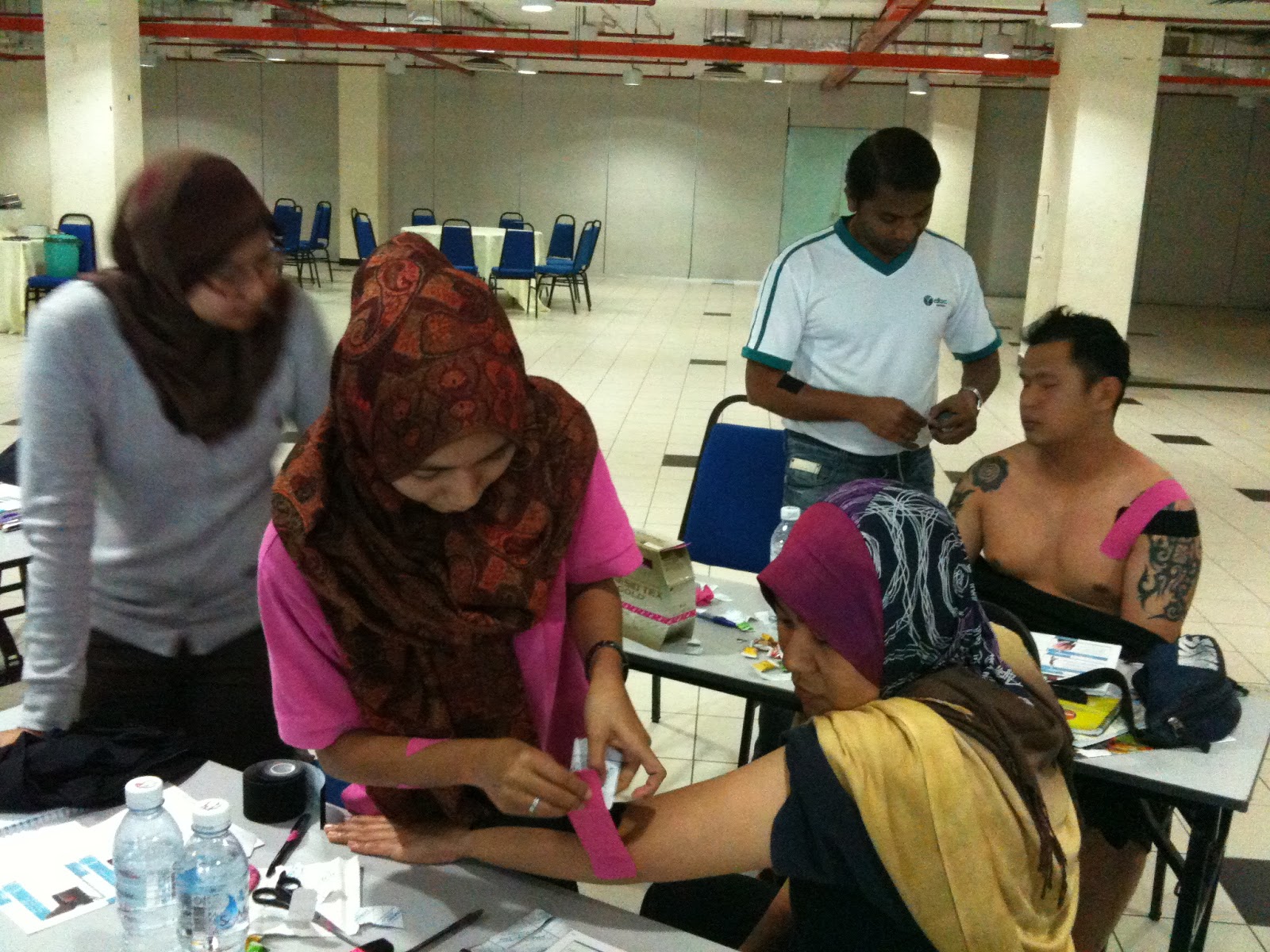
Day 2 means learning different corrective techniques for Kinesio Taping. Participants get to learn ligament / tendon corrective techniques, spring assist corrective techniques, space correction etc.

One of the current participants mentioned that he attended a Rock tape (which is a copy cat/ imitation tape) course previously and the content was nothing like what he has learnt the past 2 days. Something for you to think about if you are considering participating in a taping course.

I've done courses in different parts of the world and here in Malaysia, the women while practising usually go into a separate room/ area to be respectful of the culture/ norms etc.


Until they realized I needed to be inside to guide them as they were getting some of the techniques wrong which is how I managed to take some pictures (with their permission of course).

As time went on, they were more comfortable practising outside with the other participants.


Now, here's a mighty big Ram's head for fasical correction.


And here's a smiley face in the donut hole correction.


Staff from Medi Lifesports (Malaysian distributor for Kinesio Tapes) and their interpretation of the different Kinesio taping corrective techniques.


Here's a close up
Here's a picture of the class.


Saturday, November 24, 2012

Kinesio Taping In KL

Teaching of the Kinesio Taping course in Kuala Lumpur. On Day 1, the participants will be learning all about facilitating and inhibiting different muscles.

Here are some of the participants in action at the Olympic Council of Malaysia.


Stay tuned for more updates tomorrow.

Sunday, November 18, 2012

Kinesio Taping Level 1 and 2 on 17-18 Nov 2012

This the final Kinesio Taping KT 1 and 2 course taught by Gino Ng for this year in Singapore, held at Progress Healthcare (Singapore's Kinesio Tape distributor).

Here are some of the pictures from today's KT 2.

Making good use of the corner to practice

Interesting choice selected for the Donut Hole Space Correction

The participants


Sunday, November 11, 2012

30-20-10


In case your are wondering, no, this particular blog post is not about what happened on 30th October, 2010. The 30-20-10 refers to a new workout suggested by researchers in a recently published article in the Journal of Applied Physiology.

Experienced runners who follow the workout improved their 5 km timings by 4 % in just 7 weeks while doing the 30-20-10 workout three times a week. Other than improving their performance, their blood pressure & LDL cholesterol also decreased. Their 1500 m times improved by 6%, whilst decreasing weekly mileage by a whopping 54%.

Interested now? Well, here's their workout. After a warm up of about 1.2 km, the runners studied jogged 30 sec, ran their normal training pace 20 sec and sprinted 10 seconds. They repeated this cycle another 4 times, running one continuous five minute repeat. This was followed by a 2 minute jog and then repeating the five minute workout three more times. The runners in the study did no cool down. All in all, they ran about 9 miles a week (or about 14.4 km in a week).

The control group runners continued their normal training and of course showed no improvement after 7 weeks.

What's the main difference between the 2 groups? The control group did not spend any time running close to the maximum heart rate whereas the 30-20-10 group spent about 40 % at or near their maximum heart rate.

The researchers concluded that the intense 10 second speed intervals have a major impact on performance.

No GPS, no heart rate monitor needed, just run by feel. Hope this helps you in your training.


Reference

Gunnarsson TP and  Bangsbo J (2012). The 10-20-30 Training Concept Improves Performance and Health Profile in Moderately Trained Runners. J App Physiol 113(1) : 16-24.

* Picture by RS @ 2012 National Schools B Division 800m girls final

Sunday, October 21, 2012

Happy 3rd Anniversary Sports Solutions!


Three years ago today Sports Solutions opened its doors. Thank you Gino for all the hard work you've put into our 2nd clinic. We are grateful to our team, colleagues and patients that have supported us through this journey. We have learned tremendously.

At the heart of it are our patients. All our efforts to update, improve and progress is to help make life better for you.

Aized
X

Monday, October 15, 2012

A Podiatrist's View on Overpronation

Podiatrist Ian Griffiths feels the word "overpronation" should be banished. In fact, he feels the term "overpronation" should be erased from current day usage in both the medical and lay communities. Surprised that this is coming from a podiatrist? Please read on.

Overpronation has often been blamed for causing injuries.  In fact, there is little evidence that excessive pronation causes injury for that matter. Griffiths' view (and yours truly as well) is that pronation is only one of many factors to consider when assessing an injured patient.


In truth, pronation is completely normal. Majority of data collected suggests that the average normal foot position is actually mildly to moderately pronated and not "neutral". In fact, some studies even suggest that a pronated foot type can be protective against injury.

This does not mean that you will not suffer from pain or injury associated with your foot movement or pronation patterns. This means that the relationship between pronation and injury is not consistent or predictable and poorly understood at best.


Most of my patients who wear motion control shoes have always been told by their Physiotherapist/ Podiatrist/ Sports Doctor/ running shoe shop assistant that they go to telling them they have flat/ low arches and that they need to control their "overpronation".  Well, now you know that there is actually very poor evidence that these motion control shoes achieve this. Based on what you now know, if the shoe store you go to (or physiotherapist/ podiatrist etc) tell you to choose shoes based solely on how flat your arch looks or how much you pronate then you'd better leave.... pronto.

*Here's the Ian Griffith's article.


Have a look here to read Griffith's view on running shoe selection.

I've also written about running shoes here and here.

Sunday, October 7, 2012

Total Solutions Taping Course

Sports Solutions hosted the Total Solutions Taping course yesterday. Not like your typical rigid/ elastic taping courses, the participants were shown instances where rigid/ elastic tape is superior to even Kinesio Tape.

The participants were amazed to learn many techniques that require only a single (yes, you read right) piece of tape. They even learnt how to effectively treat a condition using just underwrap (yes, you read correctly, just underwrap).


Tools of the trade

Better take notes too