Showing posts with label gluteus medius. Show all posts

Sunday, December 14, 2025

Running Injuries Recovery Time Lines

Picture from Interplay
I feel that we live in an instantaneous society now where you snap your fingers and you want things done. Fast food, fast internet and fast access to pretty much everything. 

I have many patients who are new to running and want to be a great runner, fast. Many runners expect to improve their times with short periods of training and end up doing too much too soon.

Then there are those who are injured and try to accelerate rehabilitation and recovery beyond normal time lines. I would like to caution that effective recovery will take time and cannot be rushed or forced. 

The 2 times that I fractured my spine, I too hoped to heal faster. However, I cannot accelerate healing and rehabilitation beyond what biology will allow. I can only optimize it.

Back to running injuries. I looked at a study that studied average recovery times for common running injuries. When you look at the study the numbers may surprise you and many of the healthcare professionals that read this.

140 runners out of 839 sustained a running injury in this 24 week study (Mulvad et al, 2018). Runners in the study reported levels of pain in different body parts on a weekly basis. The injured runners attended a physical examination by a physiotherapist who provided a diagnosis. Examples are medial tibial stress syndrome (MTSS or shin splints), Achilles tendinopathy (AT), patellofemoral pain (PFP), Iliotibial band syndrome (ITBS) and plantar fascia pain (PF).

The median time to recovery for ALL types of injuries was 56 days. Yes, you read correctly. Actually let me show you the average recovery times the study found.

Plantar fascia - 35 days
Calf injury - 49 days
PFP - 49 days
AT - 56 days
ITB - 56 days
Gluteus medius tendinopathy - 56 days
Shin splints - 70 days
Hamstring - 74 days
Medial meniscus - 89 days

Surprised or shocked? You should know that effective recovery takes time. Tendons, cartilage, muscle  and especially bone will nor respond to any "magic recovery hacks" or when you try do more. They will respond to patience and appropriate loading. 

When you try to rush your rehab, it usually does not shorten the time line. It will increase the risk of flare ups, setbacks and recurrence.

Now please take note that good and correct rehab is not slow, just appropriately paced. Not everyone will take the same time to recover like those quoted in the study. Recovery is not passive, you can still train. Can't run, stationary cycling should be fine. The healthcare professional treating you should be able to give you alternatives, otherwise you should find another. It is definitely not one size fits all. 

The devil is always in the details. Only 140 out of 839 runners got injured. "Recovery" was self reported by the runners based on return to running without symptoms not performance goals.

The study did not review load management, rehab quality or whether the injuries presented early or late. Neither was training age, sleep, stress levels, nutrition nor psychology taken into account.

The goal is to work within and with the time line, not to beat it. You want the recovery to be boring but steady.

Do not believe anyone who tells you they can give you a short cut.

Reference

Mulvad B, Nielsen RO, Lind M et al (2018). Diagnoses And Time To Recovery Among Injured Recreational Runners In The RUN CLEVER Trial. PLoS One. 13(10): e0204742. DOI: 10.1371/journal.pone.0204742

Sunday, February 23, 2025

If You Want Buns Of Steel ....

Ok I admit, that was a heading to get you to read this post. But seriously, I had a patient who was referred to our clinic by a GP across the road.  He hurt his groin while doing Brazilian jiu-jitsu 2 months ago and had not gotten better. He said his previous physiotherapist just got him to do clam shell exercises and it did not help at all. 

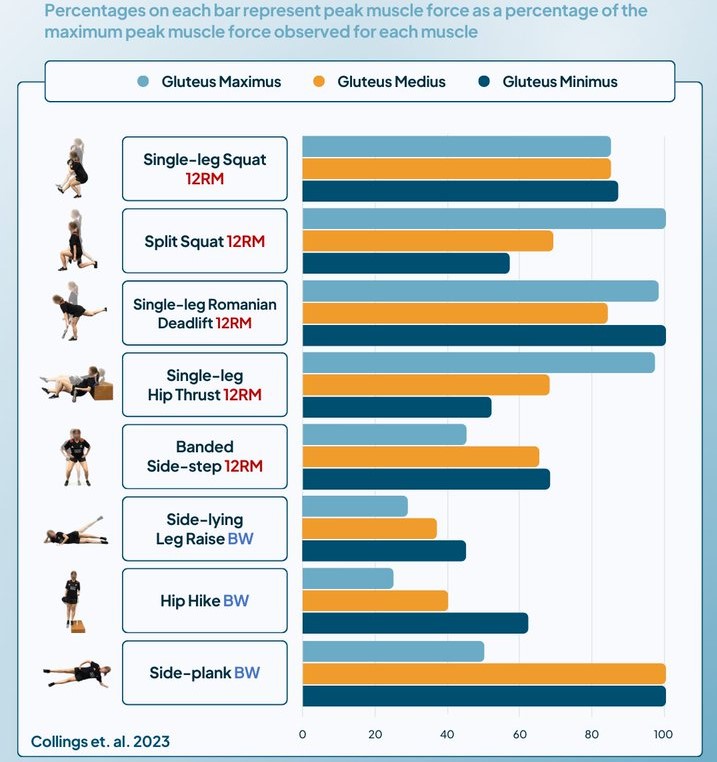
Want to know the best exercise for packing the biggest punch for the gluteal area? Let me share the results of the following study by Collings et al (2023).

Their study compared and ranked gluteal muscle forces in 8 hip focused exercises performed without and with external resistance, i.e. dumbbells or loaded barbell.

This 8 hip focused exercises in the study were single leg (S/L) squat, S/L Romanian deadlift (RDL), split squat, S/L hip thrust, banded side step, hip hike, side plank and side lying leg raise. The exercises were performed with and without weights for 12 reps max (RM)  and measured by electromyography (EMG). 

Analysis of muscle forces were limited to gluteus maximus (pictured above), medius and minimus (below). The results show that varying demands were placed on the individual gluteal muscles. Peak gluteal muscle forces significantly increased when all exercises were performed with weights compared with body weight alone. 

R gluteus medius and minimus
This is the first study to investigate a wide range of hip focused exercises that also includes isometric hip and hip abduction exercises. Clam shell exercises which you already know from my earlier  blog post is not great at activating gluteus medius and was not even included in this study. The S/L RDL and side plank  produced the highest peak gluteus medius and minimus muscle forces. 

Side plank
This is what I found most interesting. I was surprised that this variation of the side plank (pictured above) really targeted the gluteus medius and minimus too. It will be a good choice for physiotherapists to teach their patients this since no equipment is needed. Patients can easily do it at home or during on field/ court training.

Single leg RDL
We already know that the S/L RDL (pictured above) is good for  hamstrings strengthening. Done with weights, the S/L RDL activated high gluteus minimus force (100 percent observed) while gluteus maximus (98 percent) and gluteus medius (84 percent). S/L RDL is the go to exercise if you need to target all 3 gluteal muscles simultaneously along with the hamstrings.

To sum up, for the gluteus maximus, the split squat, S/L RDL and S/L hip thrust are the exercises that you want to do if that is what you want to train. The S/L RDL and side plank  produced the highest peak gluteus medius and minimus muscle forces. Those who are injured may start by doing the lower tier exercises and/ or reduce load (pictured above). You may want to remember this if your goal is to prevent injury, as part of rehabilitation or for performance.

Reference

Collings TJ, Bourne MN, Barrett RS et al (2023). Gluteal Muscle Forces During Hip-Focused Injury Prevention And Rehabilitation Exercises. Med Sci Sp Ex. 55(4): 650-660. DOI: 10.1249/MSS.0000000000003091

Sunday, May 1, 2022

Quads And Squats

We saw a few patients who tore their Anterior Cruciate ligament (ACL) in our clinic this past week. I have written many articles on the ACL before. Once you've torn your ACL, it usually takes 9 to 12 months before you can return to your sport, not to mention the financial cost. 

I came across an interesting article summarizing the evidence of the relationship between muscle forces acting on the ACL. This is important since muscles around the knee can increase and decrease the strain and mechanical loads on the ACL. This presents opportunities for preventive intenventions. 

Subsequently, our staff had interesting discussions regarding that article (referenced at the end of this post). The article demonstrated the forces acting on the knee joint and what can cause injuries there, specifically, what can hurt the ACL. 

The article reviewed muscle and and ACL loads during knee bending as well as weight bearing tasks like walking, lunging, landing, jumping and sidestep cutting.

Ready for the results? The quadriceps (thigh muscles) and gastrocnemius (calf muscles) increases load on the ACL due to anterior shearing forces at the tibial (shin bone). This is especially so when the knee is straightened.

The hamstrings and soleus (deeper calf muscles) helps to unload the ACL by generating posterior tibial shearing forces. For the hamstrings to 'protect' your ACL, your knee has to be bent at least 20 to 30 degrees.

R gluteus medius
The gluteus medius muscle was demonstated to consistently prevent the knee from collapsing inwards (knee valgus movement) and thus unloading the ACL, better than any other muscle.

Surprised? 

Patients who have been been told to strengthen their quadriceps (especially after ACL reconstruction) were really surprised when we told them. Make sure you focus on your hamstrings and soleus muscles instead.

The muscle to rule them all is of course the gluteus medius. Our patients will now understand why we always ensure their gluteus medius muscle is strong to prevent knee pain, Achilles tendon and of course ACL injuries.

Now you know.

Reference

Maniar N, Cole MH, Bryant AL et al (2022). Muscle Force Contributions To Anterior Cruciate Ligament Loading Sports Med. DOI: 10.1007/s40279-022-016743

Sunday, March 13, 2022

Train Your Tendons

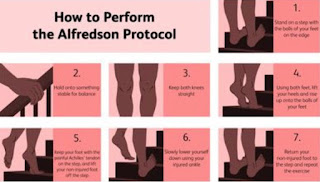
If you are a runner and have had pain in your Achilles tendon, you know it takes a long time for it to get better. Compared to muscles, our tendons and ligaments have much poorer blood supply so they take a longer time to heal. Currently, most healthcare professionals recommend the Alfredson protocol (up to 180 eccentric heel drops a day) to get your Achilles tendon better.

Trained runners have been found to have a thicker Achilles tendon, stiffer and better structure compared to novice runners. A longer, stiffer tendon stores more energy and releases that energy when you push off with each step. It has also been speculated that the dominance of international running races by Kenyan runners are due to their long and springy Achilles tendon (Tawa and Louw, 2018).

Can you then train your tendons? Consider the following study. 40 pairs of identical twins were asked about their physical activity and sports habits to determine how active they were. Researchers then measured the stiffness of their Achilles tendons.

Results show that when one twin is active and the other inactive, the active twins have tendons 28 percent stiffer. Since identical twins start with identical genes, this shows that long term training can change the structure of the Achilles. It also fits in with previous studies that trained runners have thicker and stiffer tendons. These runners were not elite runners so you don't need excessive training levels to change your tendons. But these runners have been running for an average of 15 years, so there's plenty of time for change to occur.

Another point to note from the study. Those who did activities that involve an aerial phase with both feet off the ground (running, basketball or tennis etc) had a stiffer TA compared to those with no aerial phase (cycling, walking and swimming). This suggests that jumping and landing may hold clues to getting your Achilles tendon stiffer and stronger.

Tendons may be slow to heal and adapt to load, but for those of you who run, surely this is an incentive to keep on running. Those who play football, basketball or tennis, please carry on too.

Currently, when you visit your current healthcare provider for treatment, most will just recommend the Alfredson protocol (up to 180 eccentric heel drops a day) to get your Achilles tendon better. That you can do yourself (picture below).

In our clinics, after we assess you thoroughly, we mostly use our hands to treat what we find, no ultrasound, no orthotics, no shockwave (ESWT), no electrotherapy. And we get very good results. We DO NOT get you to do exercises DURING the time you have with us. We do treatment that you cannot do yourself.

Previously, I've written that there is some evidence that gelatin (or jell-o) can help tendons heal. Perhaps that is an area you may also want to explore? And do take note that some antibiotic medications can damage your tendons.


References

Sichting F, Kram NC and Legerlotz K (2022). An Identical Twin Study On Human Achilles Tendon Adaptation: Egular Recreatinal Exercise At Comparatively Low Intensities Can Increase Tendon Stiffness. Front. Physiol. DOI: 10.3389/fphys.2021.777403

Tawa N and Louw Q (2018). Biomechanical Factors Associated With Running Economy And The Performance Of Elite Kentyan Distance Runners: A Systematic Review. J Body Mvt Ther. DOI: 10.1106/j.bmt.2017.11.004


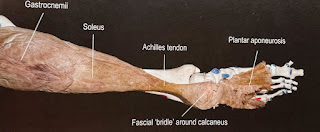
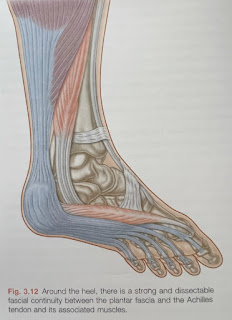
See how closely the Achilles and plantar fascia are related. In order to get the Achilles tendon better, you need to treat the plantar fascia as well.

Wednesday, August 11, 2021

PS Sim Finishes 200 Miles Race

Picture from PS Sim

Yes, you read correctly, PS Sim is the first and only finisher (male or female) so far in the 2021 Singapore 200 Miles Ultramarathon held from 6-9 August by Running Guild. She finished in an amazing 76 hours and 41 minutes!!

She came to see me last Thursday (5/8/21) for one last tune up as she had some knee pain. After treating her, she asked if I could do some taping for her. Since the cause of her knee pain was coming from her hip, I taped her left hip (instead of her left knee) and she was pain free through out the run. Have a look at the whatsapp message she sent me yesterday below.


She even offered to write me a testimonial for the Kinesio taping that I did for her. For all the naysayers who do not believe  that Kinesio taping works, the proof is in the pudding - or rather in PS Sim's legs! 

Now, I have nothing against all the published articles that say Kinesio taping does not work. And there are many healthcare professionals who do not believe in it. However, if the researchers have never learnt to do the actual Kinesio taping correctly, or used different brands/ types of tape, then I would humbly suggest that their research methodology may be flawed. 

Similarly, if I never learnt for example, Alexander technique, and I try it on my patients and end up with poor results, surely it is then unfair for me to say it does not work.

Anyway this post is not about Kinesio taping, this post is to congratulate PS Sim on a run super well done on Singapore's 56th National day! 

She has next set her sights on completing the last mountain she needs to summit before she scales the highest peaks on all 7 continents in Antarctica this coming December. After Team Singapore's outing at the recent Tokyo Olympics, there were calls for the private sector to step up and support sports in Singapore. We have always done that and we will continue to do so. Sports Solutions will be wishing her all the best and supporting her.

She has next set her sights on completing the last mountain she needs to summit before she scales the highest peaks on all 7 continents in Antarctica this coming December. After Team Singapore's outing at the recent Tokyo Olympics, there were calls for the private sector to step up and support sports in Singapore. We have always done that and we will continue to do so. Sports Solutions will be wishing her all the best and supporting her.


Sunday, July 4, 2021

Forward Lunges To Strengthen Your Knees?

Lunges by our 3 physios
A patient came in complaining of knee pain after running. Since she also did strength training with a personal trainer, she was instructed to do forward lunges (FL) to strengthen the muscles "around the knees" to avoid knee pain. Yes, the lunge is a very popular strengthening and loading exercise that is often prescribed by many health professionals. 

Alas, the front lunges made her knee pain worse.

After examining her, I explained that her knee pain was more likely coming from her hip. Meaning, she feels the pain in her knees, but the cause of her problem is her hips.

In addition, FL exert a much greater load on the patellofemoral joint compared to backward lunges (BL). I recall just reading a published article where researchers studied a group of young healthy females comparing front and back lunges.

47 body markers were placed on different parts of their bodies to record data from two force platforms in addition to 15 motion analysis cameras. The female subjects performed 10 consecutive forward and backward lunges and the researchers analyzed the middle six. 

The researchers found that peak patellofemoral joint (PFJ) reaction forces were 18.1 percent higher in FL compared to BL during the upward phase. Peak PFJ stress was 9.55 percent higher in FL compared to BL.

Peak quadriceps (or thigh) force was 18.3 percent higher in FL.  Knee bending angles were 5.85 percent larger in the upward phase of FL compared to BL. Most importantly, average PFJ loading rate was 124 percent higher in FL compared to BL. 

These results suggest strongly that there is much higher PFJ loading in the FL compared to BL. Exactly why my patient's knee pain got worse after doing her lunges. 

So if you're having knee pain, it may be best to avoid doing forward lunges until it settles. It may also be wise to strengthen your calf muscles instead.


Reference

Goulette D, Griffin P, Schiller M et al (2021). Patellofemoral Joint Loading During The Forward And Backward Lunge. Phy Ther in Sport. 47: 178-184. DOI: 10.1016/j.ptsp.2020.12.001

Sunday, December 15, 2019

Teaching Kinesio Taping @Pilatique In Malaysia

Group picture
The last time I taught in Malaysia at the very same location was back in November 2013. Now that's a fairly long time ago.

So it was really nice coming back to a familiar venue to teach Day 1 and 2 of the Kinesio Taping Assessments, Fundamental Concepts and Techniques (formerly known as KT 1 and 2) here at Pilatique.
Day 1
I'm friends with Steven and Melissa (they are Pilatique's owners) and I couldn't turn them down when they asked to come and teach in KL, Malaysia. Most of the participants were from Malaysia although we had three students hailing from Mauritius.

Day 2 of the course went much quicker as usual as we went through more practical applications such the association of Gluteus Medius and contralateral pelvic drop (or CPD), how a rotated pelvis would affect the shoulder blade and implications of the hip flexors and foot drop.

Here are some pictures from the past two days.
Clarissa having a go
All the boys listening
Watching the ladies
A big thank you to Steven and Melissa for having me over to teach. You guys organize the best courses here in Malaysia. The pleasure is all mine.

Also grateful to Mary Leou as well for coming to get me and sending me back after each day's teaching.

Sunday, November 17, 2019

Help! I Have A Snapping Hip


Yesterday, I saw a 13 year old boy who was brought to our clinic by his parents as he had knee pain as well as a "snapping" hip on the same side. After joining the school's softball team earlier this year, he had trained a fair bit more than in primary school.

He recently developed right knee pain and had a year's history of pain and "snapping" in his right hip. He had previously seen a chiropractor for the last few months. Treatment consisted of  stretching the hip flexors, the Iliotibial band (ITB) and manipulating his hip and spine. He did not get any better after all the treatment with the chiropractor.

I assessed him and confirmed that his knee pain was coming from his tibial tuberosity and indicative of doing too much too soon. That's not too difficult to manage. He definitely had a case of Osgood Schlatter's in his right knee.

There was no pain with clicking in his hip. Nor was locking observed at end of range hip flexion with added internal or external rotation (this rules out hip labral tear). Range of movement in his back, hips, knees and ankles was normal and symmetrical.

There was weakness in his right Gluteus Medius muscle, also his painful knee and snapping hip side, despite that being his dominant side. This greater contralateral pelvic drop was confirmed while watching him run.

The "snapping hip" sound was reproduced over his right greater trochanter when he was in left side lying when I straightened and bent his right hip. It was a fairly loud "clicking" and/or "snapping" sound each time I bent and straightened his hip. There was some local tenderness over his Gluteus Medius, Gluteus Maximus and Tensor Fascia Lata muscles and over the greater trochanter itself.

Snapping hip on outside part of R hip
This explained his "snapping hip" on the outer part of his hip. While my young patient did have pain over his outer hip, I've treated other cases where patients did not complain of pain there with the exact same condition.

Following treatment, my patient was pain free and I taught him and his parents what to do to maintain that.

This "snapping hip"condition is also known as Coxa Saltans, can also happen in adults. My young patient described above has a extra articular or outside the hip joint condition.  It can also be intra articular or inside the hip joint.
It's Psoas Major/ Iliacus if inner part of R hip
If the condition occurs on the inner part of the hip, extra articularly, it is usually due to the Psoas Major or Iliacus muscle. A snapping hip inside the hip is usually confirmed by an MRI. Those who have intra articular hip snapping will usually complain of hip catching, painful clicking or locking. And that will probably have to be another post.


Reference

Winston P, Awan R et al (2007). Clinical Examination And Ultrasound Of Self-Reported Snapping Hip Syndrome In Elite Ballet Dancers. AJSM. 35(1): 118-126. DOI: 10.1177/0363546506293703.

Friday, October 18, 2019

Is Your Running Style Causing Your Running Injury?

How's my running gait?
I saw a patient yesterday who was training for the upcoming Singapore marathon. He started having knee and heel pain after doing a long run of 22 km over the weekend. Upon assessment, he definitely demonstrated a greater contralateral (or opposite) pelvic drop (CPD), indicating Gluteus Medius muscle weakness.
Picture A- Injured runner with CPD and right hip adduction 
Last week we discussed whether doing clam shell exercises was still relevant for someone with Gluteus Medius muscle weakness. Turn's out that this week's post is related to that.

The referenced study (Bramah et al, 2018) investigated and identified certain faulty running gait patterns that contribute to running injuries. In all, 108 runners were studied, including 72 injured runners and 36 healthy runners in the control group matched for age, height and weight.

None of the injured runners received any prior treatment for their injury. Those with an increase with more than 30 percent in training volume were also excluded from the study. The control group of runners ran at least 30 miles (or 48 km) a week.

The injuries the injured runners had were patella femoral pain (PFP), Iliotibial Band Syndrome (ITBS), Medial Tibial Stress Syndrome (MTSS or shin splints) and Achilles Tendinopathy (AT). The injuries were selected as they are most prevalent among runners.

All the injured runners showed a greater contralateral (or opposite) pelvic drop (CPD), demonstrating Gluteus Medius muscle weakness. They had a more extended knee and dorsiflexed ankle (heel striking) at initial contact and a forward trunk lean at the midstance phase of running. These patterns were consistent across each of the four injured groups.
Contralateral pelvic drop
CPD was found to be the most important variable predicting whether the study participants were healthy or injured. For every 1 degree increase in pelvic drop, there was a 80 percent increase in the odds of getting injured.
Injured runner (L) heel striking, forward trunk lean vs normal
Those who had more knee extension makes the patella (kneecap) more vulnerable to lateral tilting and displacement. This may affect knee joint contact areas and increase stress when the foot strikes the ground. If a runner heel strikes with the knee extended, their center of mass is further away from their foot. This leads to an increase in knee joint loading and a increase "braking" forces (imagine applying brakes on while you're running).

Those with a forward trunk lean may have weakness around the back and gluteal muscles as shown by previous studies. The injured runners with PFP and ITB problems had more hip adduction than other runners. More female runners were also found to more hip adduction compared to male runners.

So make sure your Gluteus Medius muscles are strong enough so that you will be less likely to have a running injury.


References

Bramah C, Preece SJ Nimh G et al (2018). Is There A Pathological Gait Associated With Common Soft Tissue Running Injuries? AJSM. 46(12): 3023-3031. DOI: 10.1177/0363546518793657

Lessi GC, Dos Santos AF et al (2017). Effects Of Fatigue On Lower Limb, Pelvis And Trunk Kinematics And Muscle Activation. J Electrom Kinesiol. 32: 9-14

Thursday, October 10, 2019

Clam Shell Exercises?

Clam shell exercises?
My patient came in complaining of knee pain after running. She had seen another physiotherapist who after treating her knee, prescribed clam shell exercises for her to do as well. But she still had knee pain after running and climbing stairs despite doing them regularly.

How many of you have been asked to do clam shell exercises to make your Gluteus Medius (or hip) muscles stronger? If you have, maybe you need not bother any more.

Latest research (Moore et al, 2019) shows that clam shell exercises do not activate your Gluteus Medius as much as you think.
Right Gluteus Medius muscle
The Gluteus Medius muscle is very important for female runners, especially if they have knee pain. You can treat their knees but their pain will not go away until you have addressed the weakness  in their Gluteus Medius muscle.
View from the back, Left Gluteus Medius
In that small study, three sets of six common lower limb exercises were performed by ten healthy adults after a short warm up. They did single leg squats, single leg bridging, hip abduction (lifting) in side lying, clam shell exercise in side lying, running man exercise (simulates running motion of running one leg at a time) and resisted hip abduction-extension exercise.

The participants had electromyography or EMG electrodes to measure muscle activity attached to all three parts of the Gluteus Medius muscle (in front, middle and posterior).

Results showed that clam shell exercises were not effective in activating any part of the Gluteus Medius muscle. Highest levels of overall activity were seen in the single leg squat, single leg bridging and the resisted hip abuction-extension exercise.

Other than the knee, you need to know that weakness in your Gluteus Medius can also contribute to pain or problems in your Achilles. Make sure you are doing the strengthening correctly.


Reference

Moore D, Pizzari T et al (2019). Rehabiliation Exercises For The Gluteus Medius Muscle Segments: An Electromyography Study. J Sp Rehab. DOI: 10.1123/jsr.2018-0340.

Sunday, April 14, 2019

It May All Be In The Hips

*Very nice hip extension, Prefontaine leading Viren
Last week article was all about reducing your injury risk to stay healthy so you can keep training consistently.  Training consistently allows you to improve. For those of you who participate in races, this week's article will discuss how to improve your athletic performance with another simple exercise.

The biggest muscle we have in the human body is the big and very strong gluteus maximus muscle (there are also two smaller gluteus medius and gluteus minimus muscles). The gluetus maximus muscle extend our hips. This is evident when we're climbing stairs, running up slopes and especially if you're having to sprint for the finish line.

My patients who run tell me they often go to the gym to do strengthening exercises as well to get stronger. Often they are told by their personal trainers to make their quadriceps stronger. Nothing against making the quads stronger, but if you're hoping to improve your sprint performance by doing lots of squats then you should consider another exercise.

Researchers studied whether training the gluteus maximus or the quadriceps stronger was more effective for performance found that the hip thrust exercise (for gluteus maximus) more specific and better gains transferred to running/ sprinting (Gonzalez-Garcia et al, 2019).
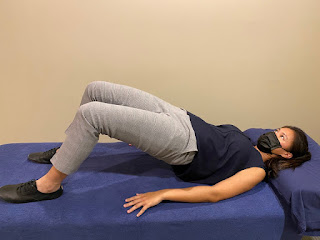
Hip thrust (also called bridging)
What exactly is a hip thrust? The easiest way to do it is lying on a firm surface with your knees bent and lift your buttocks (also known as bridging). You can add resistance by doing it with a elastic band around your waist to make it more difficult. In the hospitals, this exercise is often given to patients who are recuperating from surgery.
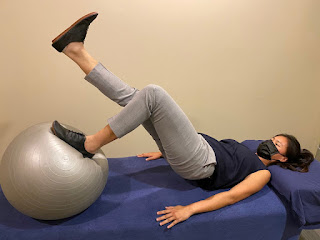
Single leg version on unstable surface
To progress, you can bridge on an unstable surface like a gym ball with both legs followed by single leg (picture above).

If you're in the gym, while facing upwards, you can rest your arms and neck on a bench and bridge with your knees bent. I've also seen gym rats resting a loaded barbell on the hips to make it more difficult.

All the above described exercises are all suitable and good if you want to make your hip extensors (gluteus maximus) stronger. However, they are all done lying down, i.e. in a non weight bearing position. In running, you are definitely upright and not lying down.
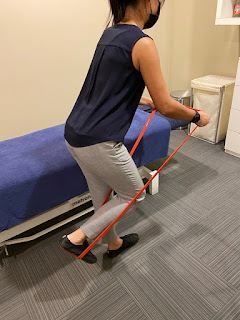
Starting position
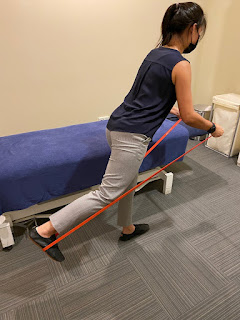
Hence, my preferred way to make the gluteus maximus stronger is in a standing position with an elastic band. Lean forward slightly with your back straight and straighten your right leg against the resistance of the elastic band. Repeat with good form until fatigue and do the same with your left leg.
Extending the R hip
I find that this way of strengthening the gluteus maximus is more specific and mimics the running posture. Strength gains are more easily transferred.


Reference

Gonzalez-Garcia J, Morencos E et al (2019). Effects Of 7-Week Hip Thrust Versus Back Squt Resistance Training On Performance In Adolescent Female Soccer Players. Sports. 7(4): 80. DOI: 10.3390/sports7040080.
*Taken from page 46 and 47 with my iPhone X from one of my favorite books "The Olympians" by Sebastian Coe with Nicholas Mason.

You see Steve Prefontaine leading Lasse Viren in the 1972 Munich Olympics with brilliant form! Excellent hip extension, Viren with his R hip, Prefontaine with his L hip. Both were wearing Adidas at this Olympics.

Prefontaine would later be the poster boy for Nike while Viren would do the same for Asics.

Saturday, September 1, 2018

Can Your Calf Muscle Cause Your Knee To Hurt?

Now that's some very defined soleus muscles
Really? You must be wondering how and why after looking at the title of this week's post. Well, my last patient today had knee pain caused by her soleus (or calf) muscle. She had recently been doing a lot of step ups in her gym classes and her knee pain started soon after.

Runners' knee or patellofemoral joint pain (pain under the kneecap) is very common in runners. I've written before about how this may be due to heel striking, heavy landing and hip dysfunction.

There is also some evidence where the length of the soleus muscle can influence patellofemoral joint pain (PFP). It has been suggested that in runners with PFP, there is a greater activation in the muscle compared to runners without knee pain (Piva et al, 2005).
See soleus after you cut away gastrocnemius
Your calf muscles consist of the more superficial gastrocnemius muscles and the deeper soleus muscle. If you peel off the gastrocnemius muscles, the soleus muscle lies underneath. Together they end as the Achilles tendon finishing at the heel bone (picture above).

The soleus muscle is largely thought to help with our posture as it is mostly made up of Type I slow twitch muscle fibres. The gastrocnemius muscle is made up of mainly Type II fast twitch fibres.

The fast twitch muscles of the gastrocnemius allows you to sprint. However, the gastrocnemius muscles tire easily.

The slow twitch soleus muscle is very important for your walking and running. Since they're more fatigue resistant, you use them a lot chalking up mileage whenever you run.

One of the main functions of the calf muscles is to absorb shock. If they're overused, they can't absorb shock well, your knee takes more of the load and you get knee pain.

A very simple way to take load off your soleus muscle is to take smaller steps when walking or running. Increasing your step rate, especially while running will ensure you're not over striding and heel striking. This reduces impact loading and lessens your chances of knee pain.

Reference

Piva SR, Goodnite EA et al (2005). Strength Around The Hip And Flexibility Of Soft Tissues In Individuals With And Without Patellofemoral Pain Syndrome. JOSPT. 35(2): 793-801. DOI: 10.2519/jospt.2005.35.12.793.

Monday, October 28, 2013

Achilles Pain Related To Your Glute Strength


I've just had 3 patients in a row today all come and see me with pain in their Achilles. Strangely enough, all 3 had weakness in their gluteus medius muscle despite that side being their dominant (and should be stronger) leg. That was also the leg that had Achilles pain. Hence this write up.

It has been published and I've written before on how your gluteus medius (or buttock muscles) can cause knee pain especially in females. Well guess what, I just found a published paper from Australian researchers that found a link between gluteus medius and maximus weakness and Achilles pain (in male runners). Yet more confirmation on how important your gluteus medius and maximus really are.

The Australian researchers in the published paper compared 2 groups of male runners where one group had Achilles pain while the control group did not. Both groups of  runners did short runs at about 6:40 min per mile pace and the group of runners with Achilles pain were found to activate their gluteus muscles later than the group with no Achilles pain.

And not only that, their gluteal activation was also shorter in duration compared to the pain free group. This is of significance as poorer gluteal muscle activation can cause increased hip internal rotation and adduction (movement towards the midline of the body) leading to Achilles problems.

The authors are suggest retraining and strengthening gluteal muscles be included for runners with Achilles injuries.

The causes of your Achilles pain can be multifactorial, one of which can be due to your weakness in your gluteus medius and maximus as described above. Come see us at Physio and Sports Solutions to treat the cause of your Achilles pain.

Worth a look?
Reference

Smith MM, Honeywill C et al (2013). Neuromotor Control in Runners with Achilles Tendinopathy. Med Sci in Sports Ex. doi: 10.1249/MSS .0000000000000133.

*Pictures from Flickr.com

Friday, August 28, 2009

Ladies, Your Knee Pain May Be Coming From Your Hips


How many of you ladies have knee pain? Well, you may be interested in this then. I have seen quite a few women runners/ triathletes the last couple of weeks, both elite and recreational with knee pain in the clinic. And guess what? Majority of my patients knee pain came as a result of weakness in the hips. Yes, some of them do have contributing factors coming from the knee itself, but the main cause was the hip weakness. So the hip weakness basically led to knee pain.

Well, you do know that at Physio and Sports Solutions we are really good at treating the cause of your pain rather than just treating the pain itself. So besides treating the patients' knee pain, the main thing was to explain the rationale of the treatment plan to them and then teach them how to specifically strengthen the hip muscles.

The strange thing is I've actually noticed this trend quite a while earlier from treating previous patients. So I was really pleased to find an article that was published earlier this year that confirms what I thought.

The study had 19 female runners with knee pain and a separate control group of another 19 female runners as well without knee pain. The group of women with knee pain had greater average hip internal rotation range and reduced hip muscle strength compared to the other group.

The authors concluded that it is the abnormal hip mechanics and decrease strength levels rather than the difference in hip shape and structure of women (as compared to men) that caused their knee pain.

So ladies, if your knees are causing you grief while running, please come in and see us and we will treat the cause of it to prevent it from coming back. And then you can run, pain free of course.


Reference

Souza RB and Powers CM (2009). Predictors of Hip Internal Rotation during Running: An Evaluation of Hip Strength and Femoral Structure in Women With and Without Patellofemoral Pain. Am J Sp Med. 37(3):579-587.