Sunday, March 21, 2021

Reliable Predictors Of Running Injuries

You need a new pair of running shoes so you decide to go to a specialist running store to choose a pair that's suitable for you. The store manager at the specialist running store tells you to hop onto their in store treadmill and 'analyzes' your running gait.

He then proceeds to critique your running gait and its biomechanical implications. And suggests the most expensive running shoe (in the store) for you so you do not get injured. Is that a common scenario that happens?

Contrary to several long held beliefs, most biomechanical and structural factors are not reliable factors at predicting running injuries

Researchers studied 300 runners who have been injury-free for the past six months and found several more reliable factors (rather than biomechanical and structural factors) in predicting who would be more likely to get injured.

The runners' demographics, physiology, biomechanics, psychosocial issues and training were documented. Their hamstrings, quadriceps muscle strength, knee, ankle flexibility, arch height of their feet were tested. 

A gait analysis studied how their feet, knees and hips distribute forces while running

Any runner who reported an injury were followed up at six and twelve months later. After the first year, the researchers emailed the injured runners a biweekly questionnaire asking them what injuries they sustained in the past two weeks.

Those that were injured went to a doctor and physiotherapist who were part of the study for treatment.

Results of their study after the two year follow up indicate that female runners sustain injuries at a higher rate than male runners. Stiffness in the knee joint, which were more common in runners weighing more than 80 kg significantly increases the chances of an overuse running injury. 

The runners who were injured also reported significantly worse mental health related to their quality of life and more negative emotions compared to the non injured runners.
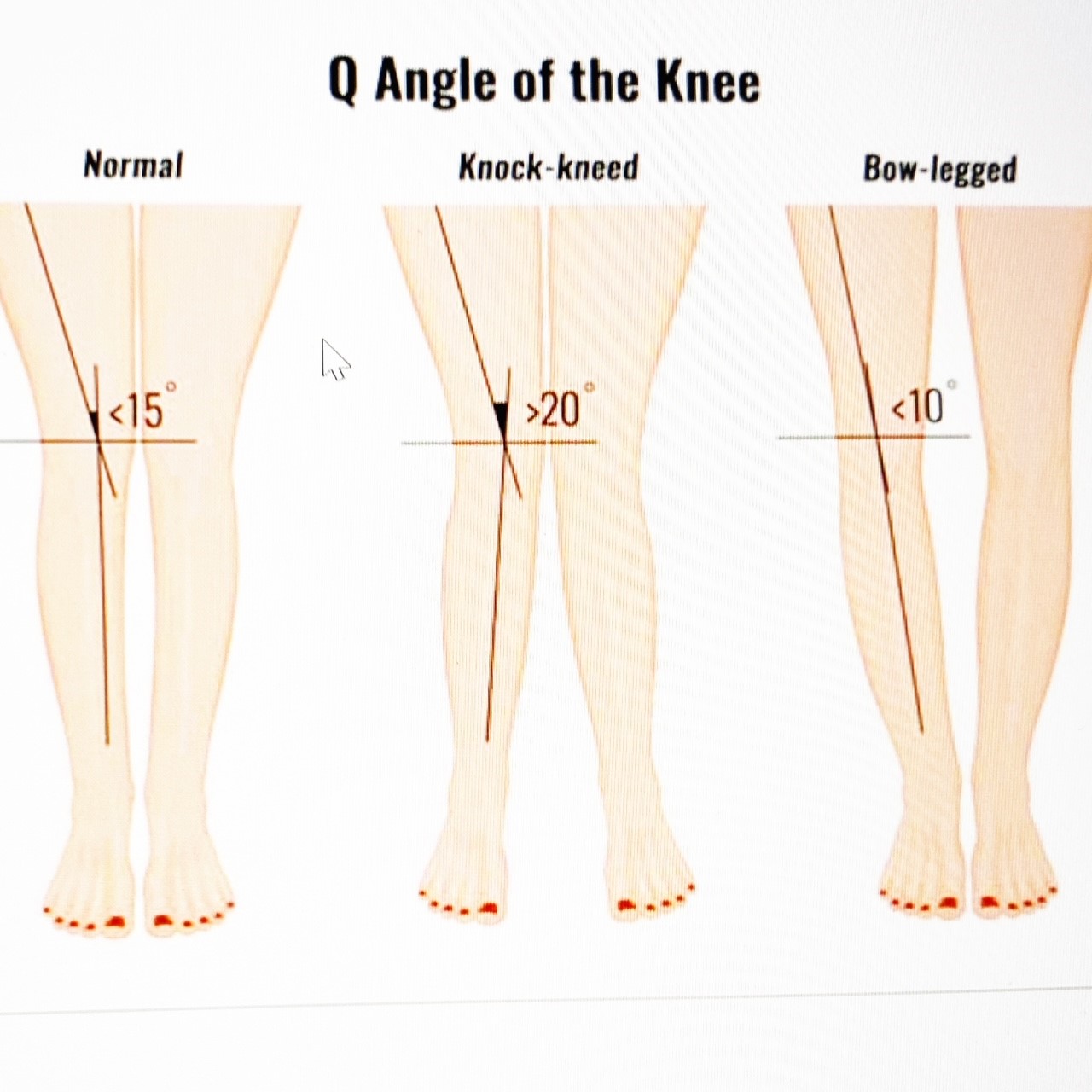

Most biomechanical, structural factors like arch height, overpronation, flexibility, Q-angle  (see picture above), lower limb strength, weekly mileage, footwear and previous injury are not reliable factors for overuse running injuries.

The researchers recommended that caution should be used when trying to alter what were commonly thought risk factors such as excessive pronation, poor flexibility, weekly mileage etc unless a runner has extreme values.

It appears from this study that the importance of biomechanics and anatomical structures assumed by doctors, physiotherapists, personal trainers and other clinicians are not as high risk as assumed. 

I feel that this does not mean they are not important. It is still important to consider the individual patient/ runner when assessing their condition. 

We still need to be aware of each patient's individual structural and biomechanical anomalies, but not to the point where we nitpick every discrepancy in strength, joint angle, foot position and range of motion.      

Reference

Messier SP, Martin DF, Shannon L et al (2018). A 2-Year Prospective Cohort Study Of Overuse Running Injuries: The Runners Injury Longitudinal Study (TRAILS). AJSM. 46(9): 2211-2221. DOI: 10.1177/0363546518773755

Sunday, March 14, 2021

Is It Better To Bend Your Back Or Knees When Picking Something Off The Ground?

Thanks to Tasneem and Joakim for the photo
I can't find any similar statistics in the local Singapore context, but more than 40% of employees in European countries suffer from work related musculoskeletal disorders (WMSD) yearly. This results in 3-6% absence from work, affecting 2.5% of the gross domestic product across Europe. 52% of injuries are attributed to overloading during lifting tasks, of which 65% affect the lower back.

When picking up something off the floor, we generally use two standard lifting techniques, the stoop or squat technique, which have been well described in many articles. The squatting technique is usually advised when lifting heavy objects since this technique is thought to result in lowering intervertebral disc (IVD) compression and shear forces compared to the stoop technique. 

Squat (a) versus Stoop (b)
Stoop lifting is usually restricted to lifting light objects since it is thought that stoop lifting causes higher IVD compression and shear forces compared to the squat.

However, there is no agreement or sound evidence for lifting ergonomic guidelines (or good lifting techniques). Hence the following study to investigate if squat or stoop lifting imposes more load on the person lifting.

Different weights were tested for both lifting techniques using a full body musculoskeletal model, 3D marker and ground reaction forces. They were used to calculate joint angles, forces and power. Muscle activity of nine different muscles were also measured to calculate effort.

Ready for the results? For all lifting conditions and both techniques, the highest joint forces during lifting and lowering were at the L5S1 spine levels, followed by the hip and knee. The hip joint generated the most power while lifting for both techniques.

Squat lifting was mainly executed by additional work on the knee extensors (Quadriceps), shoulder and elbow, potentially explaining similar prevalence of WMSD in the shoulder, elbow to LBP in people who do frequent lifting. 

The authors concluded that based on their findings, squat lifting is not favored over stoop lifting (this is in contrast to current recommendations) although forces were slightly higher in the L5,S1, hip and knee during the stoop technique. This is also supported by Van Dieen et al (1999) who concluded that there is no evidence to suggest squat over stoop lifting after reviewing 27 studies.

Now, many of you reading this may already not agree with what the authors concluded. There are so many variables that can change the results. How low the object is will influence the load on the back, making comparisons with other studies difficult. 

Even a small adjustment like turning the knees out (not controlled in this study) while squatting already reduces back loading. Likewise, healthy volunteers in this study will likely have different lifting dynamics compared to real blue collar/ laborers since the latter would have efficient strategies for all the lifting done over the years. Lifting in the research setting may not totally replicate real world situations.

Weight (10kg in this study) and dimensions of the load lifted will definitely affect the lifting technique as well since the box (length 36 cm, width 14 cm and height 21 cm) used in this study was relatively small. 

For those of you who do not have low back pain, this post may possibly challenge or even change the way you lift a box off the ground or while picking a pen that you've dropped. You have always been told that when you're picking up something or lifting that you should bend your knees, keep your back straight before you lift. That is supposed to be good form or good ergonomics.

Well, especially for those of you who are pain free, you can say to anyone who insist you bend your knees and not your back while lifting that it is not totally true. 

Reference 

Van Der Have A, Van Rossom S and Jonkers I (2019). Squat Lifting Imposes Higher Peak Joint And Muscle Loading Compared to Stoop Lifting. Ap Sci 9(18): 3794. DOI: 10.3390/app9183794

Van Dieen JH, Hoozemans MJM and Toussaint HM (1999). Stoop Or Squat: A Review Of Biomechanical Studies On Lifting Technique. Clin Biomech. 14: 686-696

Thank you for reading this long article. If you're interested, another study by Mawston et al, (2021) pictured above and referenced below found that during a maximal lift in pain free individuals, a flexed lumbar spine (picture C) is more efficient and stronger as opposed to a straight spine! So much for having a 'good' posture while weight training. Perhaps that shall be another post.

Mawston G, Holder L, O' Sullivan P et al (2021). Flexed Lumbar Spine Postures Are Associated With Greater Strength And Efficiency Than Lordotic Postures During A Maximal Lift In Pain-free Individuals. Gait and Posture. DOI: 10.1016/j.gaitpost.2021.02.029

Sunday, March 7, 2021

No Need To Stretch Or Foam Roll Your ITB?

You are a runner and you haven't been able to run more than 2 km before a sharp pain in your outer knee reduces your run to a hobble. Resting, icing and changing your running shoes made no difference. The sports doctor you saw just diagnosed you with the dreaded Iliotibial Band Syndrome (ITBS). He tells you that you need to stretch your Iliotibial band (ITB) and use a foam roller.

Sounds familiar? Well, this latest published paper on the ITB by Paul Giesler (2020) challenges common treatment approaches of stretching and massaging the ITB. Basically, he says that you do not want to stretch or foam roll your ITB.

Attachments of ITB at L knee
I've written about the ITB before in a few different posts. Except for Daniel Liberman and Carolyn Eng's study, most other articles seem to suggest that the ITB causes pain via a 'friction syndrome'. This is thought to be due to the ITB rubbing to and fro over Gerdy's tubercle on the outer shin bone while running due to hip weakness. 

Treatment is normally targeted at stretching the ITB (to reduce friction). Doctors will often suggest a steroid injection to reduce 'inflammation' (in the bursa) on the outer knee.  Giesler (2020) however,  suggested that ITB pathology is more likely to involve compression of sensitive structures beneath the ITB rather than friction.

also know as Iliotibial tract (ITT)
Since the ITB is a really broad, strong and complex structure with many attachments (picture above) along the hip, thigh and around the knee, it can provide stability for both the hip and knee. Like I wrote before, the ITB is actually thought to function like our Achilles tendon. To store and release energy like a spring. Therefore you cannot and would not want to stretch a spring. A coiled spring can release energy much better than a spring that is stretched out.

From Carolyn Eng's running simulation 
Hence the need to treat the cause of the problem rather than just treating the pain over the outer knee. Hip strength and control thus thought to be key in causing ITBS, especially weakness in hip increased hip adduction (dropping of the hip inwards) during loading. 

Runner on L has increased hip adduction
In runners/ patients with excessive hip adduction while running, progressive rehab and addressing potential causes should be adapted for individual runners, especially while running downhill and during longer runs. I've written on this topic specifically, you can read that article here.

So treatment should be to calm the symptoms (knee pain) and treat the cause. We don't get you to stretch your ITB or use the foam roller in our clinics, come see us if you want to run pain free.

The Paul Geisler (2020) article is free, click on the link under references if you want to read it.

References

Bramah C, Preece SJ Nimh G et al (2018). Is There A Pathological Gait Associated With Common Soft Tissue Running Injuries? AJSM. 46(12): 3023-3031. DOI: 10.1177/0363546518793657

Eng CM, Arnold AS, Liberman DE et al (2015). The Capacity Of The Human Iliotibal Band To Store Elastic Energy During Running. J Biomech. pii: S0021-9290 (15) 00354-1. DOI:10.1016/j.jbiomech.2015.06.017.

Geisler PR (2020). Iliotibial Band Pathology: Synthesizing The Available Evidence For Clinical Progress. J Ath Trg. DOI: 10.4085/JAT0548-19

Sunday, February 28, 2021

Shoulder Still Painful After Subacromial Decompression Surgery

Recently, we had a patient referred to our clinic for his shoulder pain (shoulder impingement). He had pain just lifting his arm/shoulder sideways. After talking to him, he mentioned that he already had surgery a few years ago to remove part of his acromion to increase the subacromial space. 

R shoulder impingement
This surgery (usually called subacromial decompression) is done to free up more space for the supraspinatus muscle and subacromial bursa so there is less chance of an impingement.

If part of the acromion (see picture above) was already shaved off and removed, how can the patient still be getting shoulder pain from shoulder impingement?

Actually, I was not surprised at all. Two recent systematic reviews/ meta-analyses and a Cochrane systematic review (referenced below) concluded with high certainty that for patients who painful shoulder impingement, subacromial decompression surgery does not help. Pain wise, function or health-related quality of life is not better compared with placebo surgery or physiotherapy.

In the United States alone, there are more than 500,000 procedures of subacromial compression done for subacromial pain, or in conjunction with a rotator cuff repair every year. 

In another recently published study, authors from Finland did a 5 year follow up on patients to compare arthroscopic subacromial decompression versus diagnostic arthroscopy, a placebo surgical intervention, and exercise therapy. They found that arthroscopic subacromial decompression provided no benefit over diagnostic arthroscopy or exercise therapy at 5 years follow up.

Looking at all the current evidence, if you have subacromial shoulder pain or shoulder impingement, then it is safe to say that going under the surgeon's knife may not help after all. The study by Paavola et al (2020) suggested exercise therapy was just as effective.

What did we do? Treating his neck and nerve root irritation got rid of his shoulder pain.

References

Hao Q, Devji T, Zeraatkar D et al (2019). Minimal Important Differences For Improvement In Shoulder ConditionPatient-reported Outcomes: A Systematic Review To Inform a BMJ Rapid Recommendation. BMJ Open DOI: 10.1136/bmjopen-2018-028777.

Karjalainen TV, Jain NB, Page CM et al (2019). Subacromial Decompression Surgery For Rotator Cuff Disease. Cochrane Database Syst Rev. 1:CD005619. DOI: 10.1002/14651858.CD005619.pub

Lahdeoja T, Karjalainen TV, Jokihaara J et al (2020). Subacromial Decompression Surgery For Adults With Shoulder Pain: A Systematic Review With Meta-analysis. BJSM. 54: 665-73. DOI: 10.1136/bjsports-2018-10048.

Paavola M, Kanto K, Ranstam J et al (2020). Subacomial Decompression Versus Diagnostic Arthroscopy For Shoulder Impingement: A 5-year Follow-up Of A Randomised, Placebo Surgery Controlled Clinical Trial. BJSM 55(2): 99-107. DOI: 10.1136/bjsports-2020-102216.

Sunday, February 21, 2021

Many Physiotherapists Cannot Prescribe Exercise?


Teaching Ronald Susilo how to ride
I definitely don't agree with the following research (Barton et al, 2021) which concluded that physiotherapists cannot prescribe physical activity and exercise well for people with muscle and joint pain/ problems. Let me explain further.

I was asked to go to court last year to be questioned by the lawyer of the insurer (for the truck driver) for my accident in 2013. Yes, after waiting for almost 7 years, and numerous adjournments by the other party, the hearing was finally scheduled. 

Their lawyer questioned why I needed physiotherapy after my accident and he added that "isn't physiotherapy just doing some exercises". If so then I would not need to attend any more sessions and just do the exercises at home and the insurer would not have to pay anymore.

I explained that he (and perhaps the general public) may think when you see a physiotherapist, all the physiotherapist does is to teach you strengthening exercises for your pain or condition. But teaching strengthening exercises isn't the only thing physiotherapists do. At least not at our clinics anyway. 

But physiotherapists in Singapore can definitely teach exercises, especially in the hospital setting. That's what my patients tell me anyway.

Back to the study. 1,352 physiotherapists from 56 countries were surveyed. Most agreed that their job requires exercise prescription of aerobic exercise (75%) and resistancestrength training (89%) to patients with muscle and joint pain/ problems. 
38 to 50 percent of the physiotherapists reported that they were not confident and had no training/ skills to prescribe aerobic exercise and resistancestrength training (50 to 67%). Only 11% were able to give the correct guidelines for aerobic exercise and resistancestrength training (21%).

62 to 79 percent  felt that their packed schedule (seeing too many patients), access to equipment/ space and lack of opportunity to attend professional development affected their ability to prescribe guidelines for effective exercise. 

The authors concluded that many physiotherapists lack training and knowledge to give advice for physical activity, and to prescribe resistancestrength training and aerobic exercise to people with muscle and joint pain.

The general public (and the lawyer that quizzed me) thinks that all a physiotherapist does is teach exercise for treatment. Is that what you think?

Reference

Barton CJ, King MG, Dascombe G et al (2021). Many Physiotherapists Lack Preparedness To Prescribe Physical Activity and Exercise To People With Musculoskeletal Pain: A Multi-national Survey. Phy Therapy in Sport. DOI: 10.16/j.ptsp.2021.02.002.

Saturday, February 13, 2021

Cupping Gone Bad

Picture from Newsflash/ Australscope

Cupping became very popular after Michael Phelps was pictured with cupping marks on his back while competing at the 2016 Rio Olympics.

However, there was a major outcry after a three month old baby with 'too much gas' in Turkey was pictured being treated by cupping. At least cupping seems better compared to a two week old baby being treated by a chiropractor in Melbourne.

In my humble opinion, treatments like that should not be allowed when a child is that young.

Research (a meta-analysis of 135 controlled trials) show that there seems to be no negative effects on adults if cupping was done in moderation (Cao et al, 2012) In addition, adults are able give consent and feedback.

Picture from CEN/ Australscope

Treatment can go wrong with adults too. The 63 year old man pictured above wanted to treat his 'frozen shoulder' and went for cupping treatment 10 days in a row. The person treating him placed the cups in exactly the same positions daily. He was due to continue with the same treatment for two more days but experienced severe pain and a high fever. Fortunately, he went to the hospital instead. 

The following article explains how cupping for treatment works and attempts to offer possible  explanations of its effects (Al-Bedah et al, 2019), of which includes the Pain Gate Theory, TENs, blood detoxification and Reflex zone theory etc. However, no single theory exists to explain the whole effect of cupping.

Well, what we can learn from the above incidences is to ensure that cupping isn't done to the same spot on consecutive days.

References

Al-Bedah AMN, Elsubai IS, Qureshi NA et al (2019). The Medical Perspective Of Cupping Therapy: Effects And Mechanisms Of Action. J Tradit Complement Med. 9(2): 90-97. DOI: 10.1016/j.jcme.2018.03.003

H Cao, X Li and J Liu (2012). An Updated Review Of The Efficacy Of Cupping Therapy. PLos One. 7(2): e31793. DOI: 10.1371/journal.pone.0031793.

Sunday, February 7, 2021

Motion Control Shoes To Control Overpronation?

Brooks Adrenaline GTS 21
Most of our patients choose their running shoes based on comfort. Recently, we've had a few new patients who were told to buy motion control shoes to control pronation. Yes, there are still sales people from running shoe shops, doctors, physiotherapists and podiatrists etc who recommend running shoes based on their foot type

They will check if you have a normal, high, low/ or no arches and then recommend you use stability, cushion and motion control shoes respectively. The rationale for motion control shoes are that since a person with low or no arches tends to overpronate, they need sturdy motion control shoes to control that overpronation.

What does current research say?

327 runners were studied and followed up for six months by researchers. The runners were randomly allocated to run in neutral running shoes or motion control shoes (Malisoux et al, 2016). The researchers concluded that runners who used motion control shoes will benefit those with low/ no arches (or or pronated feet).

Another group of researchers (Willems et al, 2020) reanalyzed data from Malisoux's 2016 study to include type of injury sustained. Malisoux was also in this current group of researchers. Running injuries that occurred were classified into pronation related (Achilles tendinopathy, plantar fasciitis, exercise related lower leg pain and anterior knee pain) or other running related injuries.

Upon analysis, 25 runners were found to have sustained pronation related injuries while 68 other runners had other running related injuries. Those who ran with a motion control shoe had a lower risk or pronation related injuries while there was no difference on the risk of other running related injuries.

The above mentioned results differs from previous published research on motion control shoes which showed that runners who overpronated and assigned to run in motion control shoes actually complained of pain and missed training days after wearing them (Ryan et al 2011). Another published study involving 927 new runners also found that pronation is not associated with increased injury risk.

The contrast in conclusions will no doubt confuse you. I was initially confused too. It is always difficult to combine multiple sources and research methods to come away with practical results because the definitions vary.

The main question for me in the Willems et al (2020) study is how do they really know any of the running injuries are 'pronation related'? They also defined injury as pain interfering with training for 1 day. Other studies defined injury as no running for a week.

My suggestion is to assess individual response to change in footwear and see if it reduces pain/ injury. If it does, then you should lay off that pair of running shoes for a while before trying it again. 


References

Nielsen RO, Buist I, Parner ET et al (2014). Foot Pronation Is Not Associated With Increased Injury Risk In Novice Runners Wearing A Neutral Shoe: A 1-year Prospective Cohort Study. BJSM. 48: 440-447. DOI: 10.1136/bjsports-2013-092202

Malisoux L Chambon N, Delattre N (2016). Injury Risk In Runners Using Standard Or Motion Control Shoes: A randomised Controlled Trial With Participant And Assessor Blinding. BJSM. 50(8): 481-487. DOI: 10.1136/bjsports-2015-095031

Ryan MB, Valiant GA, McDonald K et al (2011). The Effect Of Footwear Stability Levels On Pain Outcomes In Women Runners: A Randomised Control Trial. BJSM. 45:715-721. DOI:10.1136/bjsm.2009.069849 

Willems T, Ley C, Goetghebeur E et al (2020). Motion Control Shoes Reduce The Risk Of Pronation-related Pathologies In Recreational Runners: A Secondary Analysis Of A Randomized Controlled Trial. JOSPT. pp 1-31. DOI: 10.25

rent Malisoux,
1
Nicolas Chambon,
2
Nicolas Delattre,
2
Nils Guegu